

1 scudo – Roman Sister Republic
Add to wishlist
Italy
Context
Years: 1798–1799
Country: Italy
Issuer: Roman Sister Republic
Period:
(1798—1799)
Currency:
(1798—1799)
Demonetized: Yes
Material
References
KM: #
Numista: #21530
Value
Bullion value: $61.24
Obverse
Description:
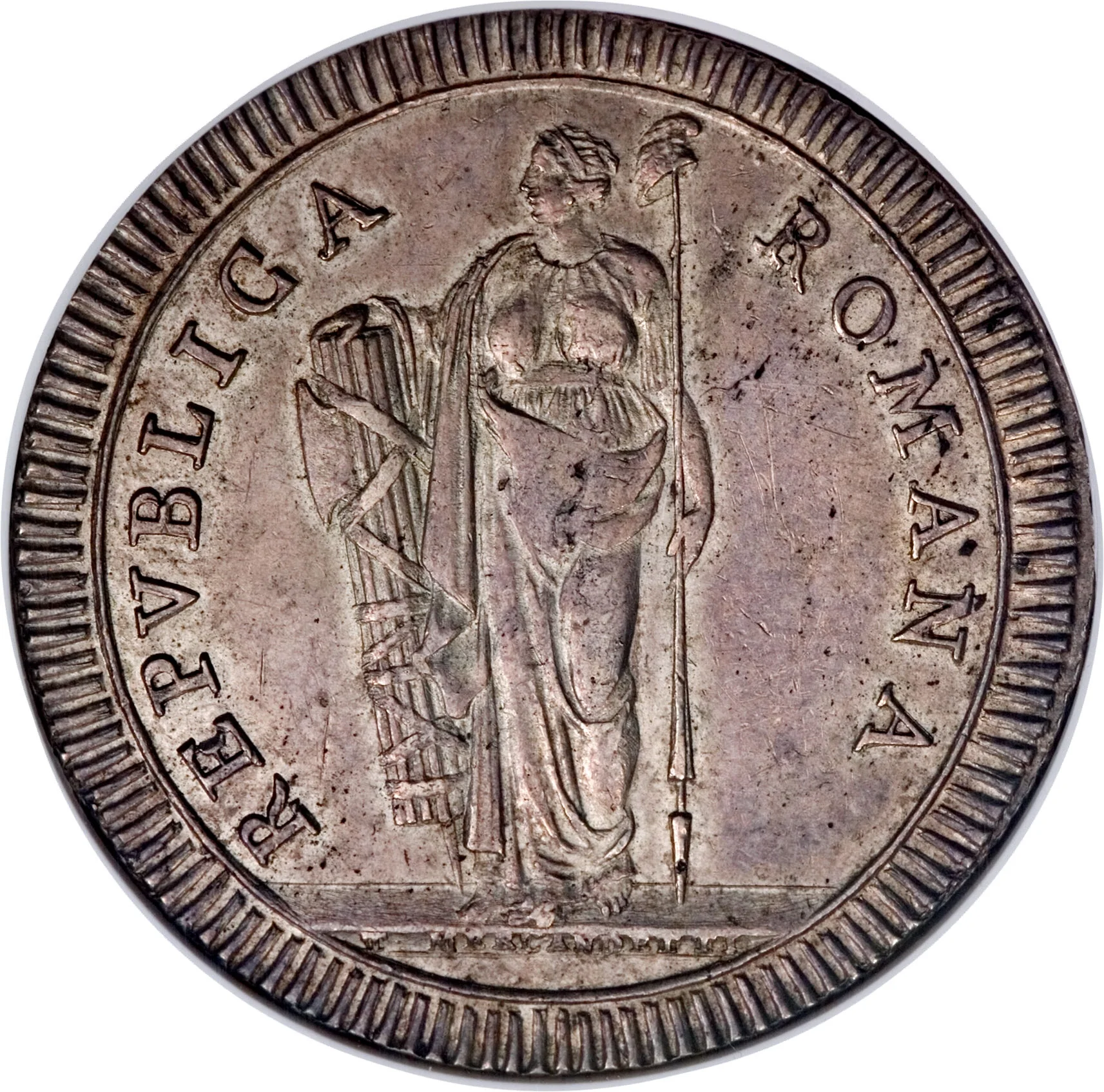
Figure holding fasces and liberty cap on a pole.
Inscription:
REPVBLICA ROMANA
Script: Latin
Engraver: Tommaso Mercandetti
Reverse
Description:
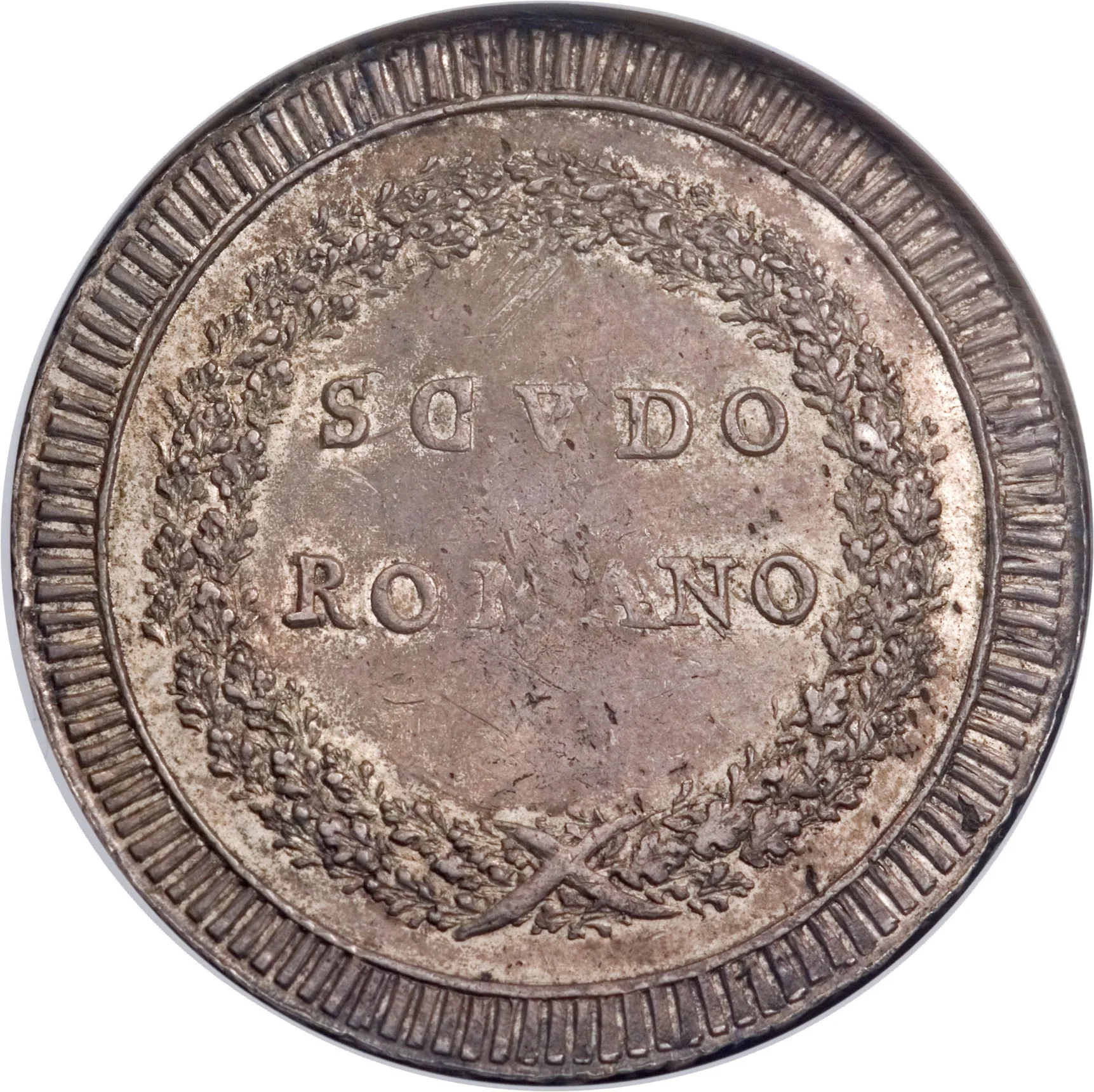
Value inscribed in wreath.
Inscription:
SCVDO
ROMANO
ROMANO
Script: Latin
Engraver: Tommaso Mercandetti
Edge
Embossed leaves
Mints
| Name | Mark |
|---|---|
| Rome | — |
Mintings
| Year | Mint Mark | Mintage | Quality | Collection |
|---|---|---|---|---|
| — | — | — |
Historical background
In 1798, the Roman Republic was a short-lived revolutionary state established by French forces after the invasion of the Papal States. Its currency situation was chaotic and deeply unstable, a direct reflection of its political and economic fragility. The new republic inherited the complex monetary system of the Papacy, which included various papal scudi, baiocchi, and giuli, but its legitimacy and ability to manage this system were severely undermined. To finance its operations and the ongoing French military occupation, the republican government resorted to drastic measures, including the forced requisition of precious metals from churches and wealthy citizens, severely eroding public trust.
The most infamous financial policy was the issuance of a new paper currency, the mandato, intended to replace the old papal coinage. This was essentially an assignat-style experiment, backed by the value of nationalized ecclesiastical properties. However, in a climate of war, widespread resistance to the French-backed regime, and a lack of public confidence, the mandato rapidly depreciated. It failed to circulate effectively beyond Rome and its immediate surroundings, leading to a severe dichotomy between the collapsing paper money and the scarce but still-desired silver and gold coinage, which people hoarded.
Consequently, the economy was crippled by hyperinflation, severe shortages of goods, and a collapse in trade. The currency crisis exacerbated popular discontent against the French and the republican government, as wages and savings became worthless. This financial disintegration was a critical factor in the republic's inability to establish stability. When the French withdrew in late 1799, the Roman Republic collapsed, and the restored Papal government under Pius VII immediately moved to abolish the worthless mandato, attempting to restore the former papal monetary system and stabilize the economy.
The most infamous financial policy was the issuance of a new paper currency, the mandato, intended to replace the old papal coinage. This was essentially an assignat-style experiment, backed by the value of nationalized ecclesiastical properties. However, in a climate of war, widespread resistance to the French-backed regime, and a lack of public confidence, the mandato rapidly depreciated. It failed to circulate effectively beyond Rome and its immediate surroundings, leading to a severe dichotomy between the collapsing paper money and the scarce but still-desired silver and gold coinage, which people hoarded.
Consequently, the economy was crippled by hyperinflation, severe shortages of goods, and a collapse in trade. The currency crisis exacerbated popular discontent against the French and the republican government, as wages and savings became worthless. This financial disintegration was a critical factor in the republic's inability to establish stability. When the French withdrew in late 1799, the Roman Republic collapsed, and the restored Papal government under Pius VII immediately moved to abolish the worthless mandato, attempting to restore the former papal monetary system and stabilize the economy.
✨ Legendary