

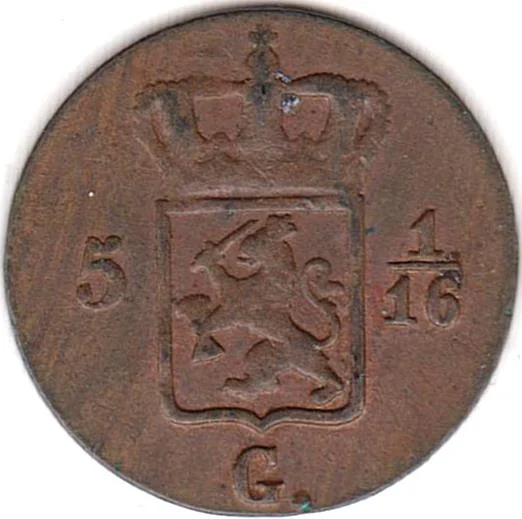
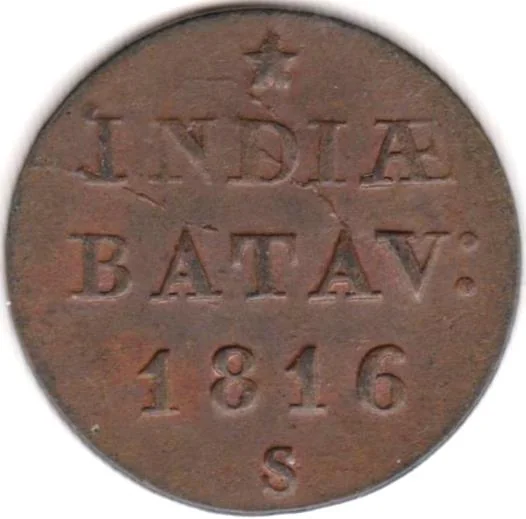
1 Duit – Netherlands East Indies
Indonesia
Context
Year: 1816
Country: Indonesia 
Issuer: Netherlands East Indies
Ruler: William I
Currency:
(1726—1854)
Demonetized: Yes
Total mintage: 64,562
Material
References
KM: #Click to copy to clipboard281
Numista: #123217
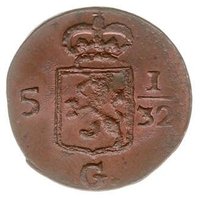
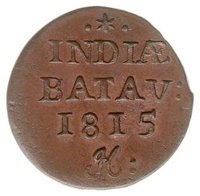
Obverse
Reverse
Edge
Plain
Mints
| Name | Mark |
|---|---|
| Royal Dutch Mint | — |
Mintings
| Year | Mint Mark | Mintage | Quality | Collection |
|---|---|---|---|---|
| 1816 | S | 64,562 |
Historical background
Following the return of Dutch colonial rule in 1816 after the British interregnum, the Netherlands East Indies faced a complex and chaotic currency situation. The archipelago was flooded with a bewildering variety of coins, including Spanish-American silver dollars (real), Dutch guilders, Indian rupees, and local copper duits. The British administration had also introduced the Java rupee, adding to the monetary confusion. This lack of a uniform, trusted currency severely hampered trade and governance, as exchange rates fluctuated wildly and counterfeiting was rampant.
Recognizing the urgent need for monetary order to stabilize the economy and assert sovereignty, the new Governor-General, G.A.G.P. Baron van der Capellen, prioritized currency reform. In 1816, he took the decisive step of demonetizing the British Java rupee and other foreign silver coins, aiming to establish a unified system based on the Dutch guilder. However, this transition was fraught with difficulty. The colony lacked sufficient minted coinage of its own, leading to a severe shortage of acceptable money in circulation.
Consequently, the years immediately following 1816 were a period of painful adjustment rather than immediate resolution. The government's attempt to introduce a new guilder-based currency was slow, and the scarcity of official coinage meant that barter and the use of old, discounted foreign coins often persisted in daily transactions. Thus, while 1816 marked the critical starting point for Dutch efforts to create a standardized colonial currency, the goal of a stable and unified monetary system remained a significant challenge for the administration in the ensuing decades.
Recognizing the urgent need for monetary order to stabilize the economy and assert sovereignty, the new Governor-General, G.A.G.P. Baron van der Capellen, prioritized currency reform. In 1816, he took the decisive step of demonetizing the British Java rupee and other foreign silver coins, aiming to establish a unified system based on the Dutch guilder. However, this transition was fraught with difficulty. The colony lacked sufficient minted coinage of its own, leading to a severe shortage of acceptable money in circulation.
Consequently, the years immediately following 1816 were a period of painful adjustment rather than immediate resolution. The government's attempt to introduce a new guilder-based currency was slow, and the scarcity of official coinage meant that barter and the use of old, discounted foreign coins often persisted in daily transactions. Thus, while 1816 marked the critical starting point for Dutch efforts to create a standardized colonial currency, the goal of a stable and unified monetary system remained a significant challenge for the administration in the ensuing decades.
⭐ Somewhat Rare