

1 Millime – Tunisia
Circulating commemorative coins
Commemoration: Food Security in 21st century
Tunisia
Context
Years: 1999–2000
Issuer: Tunisia 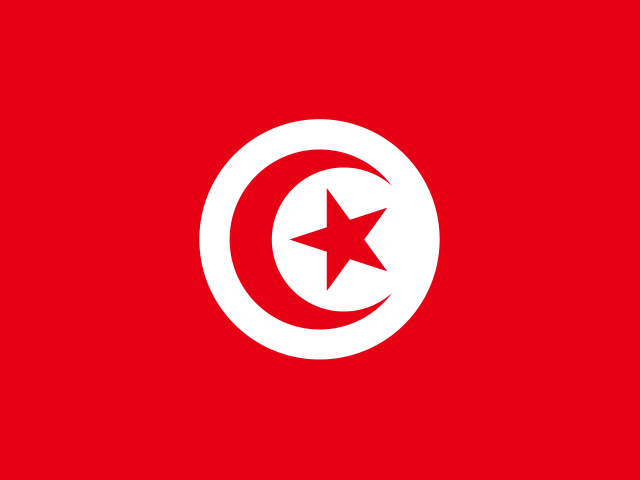
Issuing organization: Central Bank of Tunisia
Period:
(since 1957)
Currency:
(since 1958)
Demonetized: Yes
Material

References
KM: #Click to copy to clipboard349
Numista: #10034
Value
Exchange value: 0.001 TND
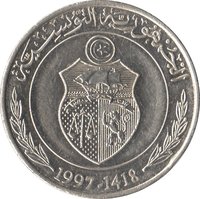
Obverse
Description:
Ancient oak, timeless.
Inscription:
البنك المركزي التونسي
2000
2000
Translation:
Central Bank of Tunisia
2000
2000
Language: Arabic
Reverse
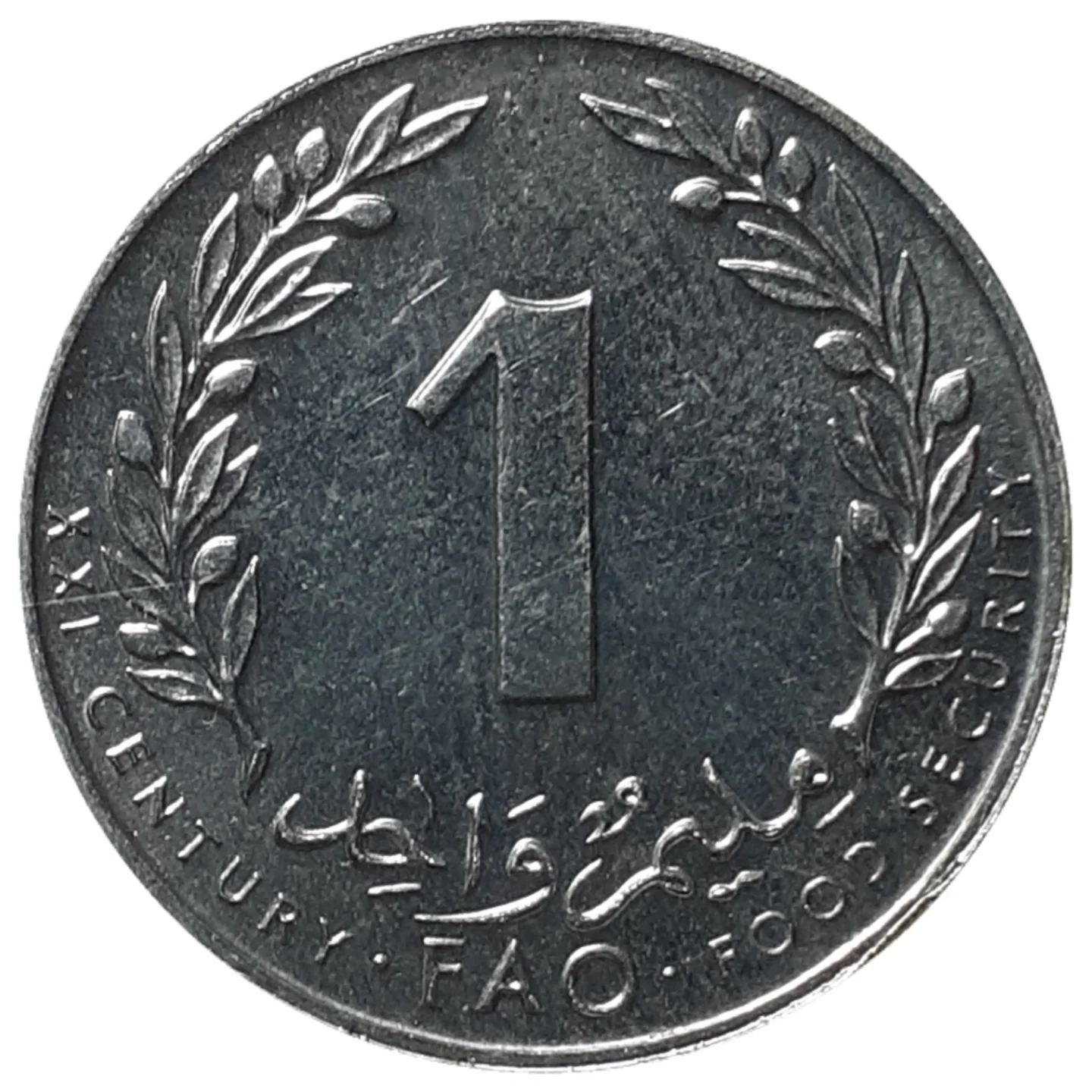
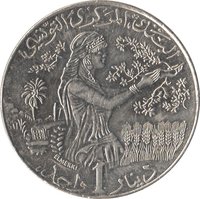
Description:
Sprig value
Inscription:
1
مليم واحد
XXI CENTURY · FAO · FOOD SECURITY
مليم واحد
XXI CENTURY · FAO · FOOD SECURITY
Translation:
One Millime
XXI CENTURY · FAO · FOOD SECURITY
XXI CENTURY · FAO · FOOD SECURITY
Language: Arabic
Edge
Plain
Categories
| Organization> FAO |
| Plant> Tree |
Mintings
| Year | Mint Mark | Mintage | Quality | Collection |
|---|---|---|---|---|
| 1999 | — | — | ||
| 2000 | — | — |
Historical background
In 1999, Tunisia's currency situation was characterized by a tightly managed exchange rate regime and a period of relative macroeconomic stability following a decade of significant structural adjustment. The Tunisian Dinar (TND) was, and remains, a non-convertible currency, with its value pegged to a basket of currencies heavily weighted toward the Euro (replacing the French Franc after 1999) and the US Dollar. This peg was administered by the Central Bank of Tunisia (BCT), which maintained strict capital controls to defend the exchange rate, limit speculative flows, and preserve foreign exchange reserves.
The economy in the late 1990s was transitioning from a focus on import-substitution industrialization toward greater export-orientation and integration into global markets. This period saw consistent but modest economic growth, supported by sectors like textiles, tourism, and phosphates. The managed dinar provided a measure of predictability for domestic businesses and foreign investors, helping to control inflation, which was kept at relatively low single digits. However, this stability came at a cost: the overvalued peg, estimated by some international institutions like the IMF, hurt the competitiveness of Tunisian exports and contributed to a persistent current account deficit.
Overall, the currency framework in 1999 represented a cautious, state-led approach to economic management. While it provided short-term stability and helped anchor prices, it also masked underlying structural challenges, including rigidities in the financial sector and the growing need for greater flexibility to absorb external shocks. The system maintained its core features into the 2000s, but the tensions it managed would later become more pronounced following the 2011 revolution and subsequent economic pressures.
The economy in the late 1990s was transitioning from a focus on import-substitution industrialization toward greater export-orientation and integration into global markets. This period saw consistent but modest economic growth, supported by sectors like textiles, tourism, and phosphates. The managed dinar provided a measure of predictability for domestic businesses and foreign investors, helping to control inflation, which was kept at relatively low single digits. However, this stability came at a cost: the overvalued peg, estimated by some international institutions like the IMF, hurt the competitiveness of Tunisian exports and contributed to a persistent current account deficit.
Overall, the currency framework in 1999 represented a cautious, state-led approach to economic management. While it provided short-term stability and helped anchor prices, it also masked underlying structural challenges, including rigidities in the financial sector and the growing need for greater flexibility to absorb external shocks. The system maintained its core features into the 2000s, but the tensions it managed would later become more pronounced following the 2011 revolution and subsequent economic pressures.
🌱 Common