

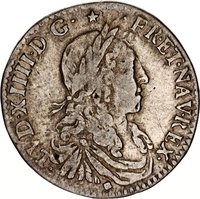
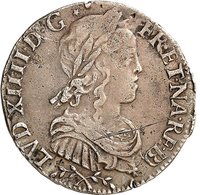
Obverse
Description:
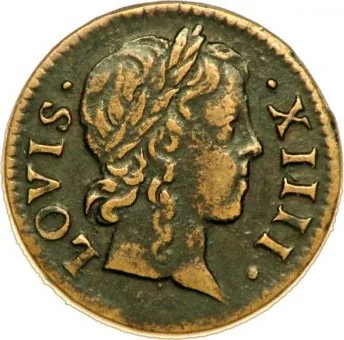
Young laureate Louis XIV, right profile.
Inscription:
.LOVIS. .XIIII.
Script: Latin
Engraver: Jean Warin
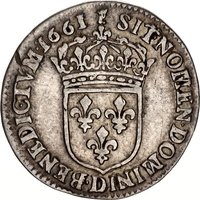
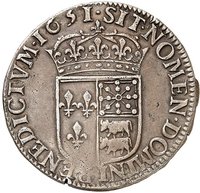
Reverse
Description:
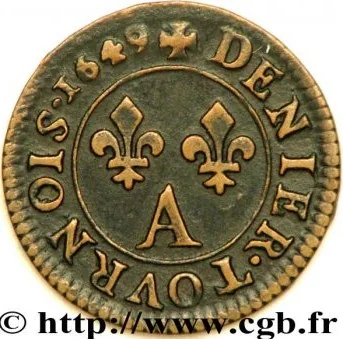
Two lilies, one A, arranged 2:1.
Inscription:
+DENIER. TOVRNOIS. 1648
Script: Latin
Engraver: Jean Warin
Edge
Plain
Categories
| Person> Monarch |
| Symbol> Fleur-de-lis |
Mints
| Name | Mark |
|---|---|
| Monnaie de Paris | A |
Historical background
In 1648, France was in a state of severe financial and monetary crisis, a direct consequence of its prolonged involvement in the Thirty Years' War (1618-1648). The fiscal demands of the conflict had pushed the monarchy, under the young King Louis XIV and his regent mother Anne of Austria, guided by Chief Minister Cardinal Mazarin, to the brink of bankruptcy. The state's primary response was not currency debasement, but rather relentless and innovative taxation—increasing the taille (land tax), creating new offices to sell, and extracting forced loans from wealthy financiers and the parlements. This heavy fiscal pressure, rather than a collapse of the coinage itself, was the immediate financial trigger for the outbreak of the Fronde rebellions that very year.
The currency system itself, however, was under significant strain. France operated on a bimetallic system of gold écus and silver livres tournois, but the government frequently manipulated the official exchange rates between coins and the accounting unit (livre tournois) to generate short-term revenue. By periodically issuing edicts that arbitrarily increased the nominal value of coins, the crown sought to attract bullion to the mints and create seigniorage profit. This practice created widespread economic uncertainty, disrupted trade, and eroded public trust, as the real value of money became unstable and unpredictable.
Ultimately, the currency situation was a symptom of a deeper structural failure: the crown's inability to fund its ambitions through a transparent and equitable tax system. The financial exhaustion of the country, combined with the perceived corruption of Mazarin's regime and its attacks on the privileges of traditional elites like the Parlement de Paris, led to a political explosion. Therefore, while the coinage in circulation remained largely intact in 1648, the manipulative monetary policies and, more critically, the oppressive fiscal measures they accompanied, were central to the social and political upheaval that defined the beginning of the Fronde.
The currency system itself, however, was under significant strain. France operated on a bimetallic system of gold écus and silver livres tournois, but the government frequently manipulated the official exchange rates between coins and the accounting unit (livre tournois) to generate short-term revenue. By periodically issuing edicts that arbitrarily increased the nominal value of coins, the crown sought to attract bullion to the mints and create seigniorage profit. This practice created widespread economic uncertainty, disrupted trade, and eroded public trust, as the real value of money became unstable and unpredictable.
Ultimately, the currency situation was a symptom of a deeper structural failure: the crown's inability to fund its ambitions through a transparent and equitable tax system. The financial exhaustion of the country, combined with the perceived corruption of Mazarin's regime and its attacks on the privileges of traditional elites like the Parlement de Paris, led to a political explosion. Therefore, while the coinage in circulation remained largely intact in 1648, the manipulative monetary policies and, more critically, the oppressive fiscal measures they accompanied, were central to the social and political upheaval that defined the beginning of the Fronde.
🌟 Limited