

⅓ Thaler – Duchy of Mecklenburg-Strelitz
Germany
Context
Year: 1773
Country: Germany 
Issuer: Duchy of Mecklenburg-Strelitz
Ruler: Adolphus Frederick IV
Currency:
(1701—1872)
Demonetized: Yes
Total mintage: 3,727
References
KM: #Click to copy to clipboard71
Numista: #198737
Value
Bullion value: $16.72
Obverse
Description:
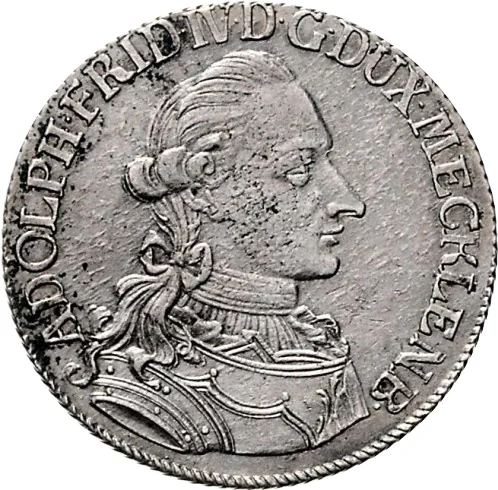
Armored bust, right profile.
Script: Latin
Reverse
Description:
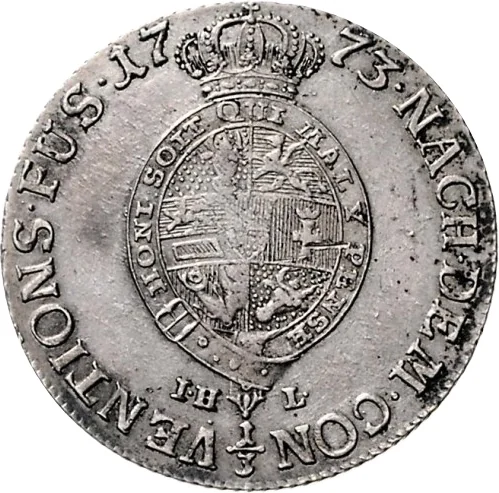
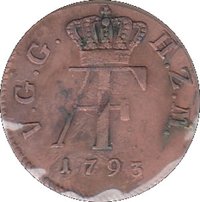
Crowned oval arms, date above.
Script: Latin
Edge
Mints
| Name | Mark |
|---|---|
| Strelitz | — |
Mintings
| Year | Mint Mark | Mintage | Quality | Collection |
|---|---|---|---|---|
| 1773 | — | 3,727 |
Historical background
In 1773, the currency situation in the Duchy of Mecklenburg-Strelitz was complex and fragmented, typical of the Holy Roman Empire's myriad states. The duchy did not have a strong, independent minting tradition and primarily relied on a circulation of foreign and regional coins. The most important legal tender was the Mecklenburg Thaler, which was part of the Reichsthaler system standardized by the Imperial Coinage Ordinance of 1566. However, in daily transactions, a plethora of coins from neighboring states like Mecklenburg-Schwerin, Prussia, Hanover, and even Dutch and Swedish coins circulated freely, leading to a confusing monetary environment.
This circulation was governed by official Kurant (specie) and Courant (accounting) systems. The Kurant system valued coins by their intrinsic silver content, while the Courant system was a simplified accounting unit used for larger contracts and state finances, often with a fixed exchange rate to the Reichsthaler. Furthermore, small change was chronically scarce and problematic. Locally minted dreipölcher and sechspölcher (low-value copper coins) were often insufficient, leading to the use of clipped, worn, or even counterfeit minor coins from elsewhere, which hampered everyday trade and caused frequent disputes.
The year 1773 fell within the reign of Duke Adolf Friedrich IV, a period of relative stability but not significant monetary reform. The duchy's economy was predominantly agrarian, and its limited financial resources meant it could not easily impose a unified, sovereign currency. Consequently, monetary policy was largely reactive, focused on periodically publishing exchange rate tables to regulate the values of the multitude of circulating foreign coins. This situation of dependence on external minting output and the constant struggle to manage coinage values would persist until the 19th century and the dissolution of the Holy Roman Empire.
This circulation was governed by official Kurant (specie) and Courant (accounting) systems. The Kurant system valued coins by their intrinsic silver content, while the Courant system was a simplified accounting unit used for larger contracts and state finances, often with a fixed exchange rate to the Reichsthaler. Furthermore, small change was chronically scarce and problematic. Locally minted dreipölcher and sechspölcher (low-value copper coins) were often insufficient, leading to the use of clipped, worn, or even counterfeit minor coins from elsewhere, which hampered everyday trade and caused frequent disputes.
The year 1773 fell within the reign of Duke Adolf Friedrich IV, a period of relative stability but not significant monetary reform. The duchy's economy was predominantly agrarian, and its limited financial resources meant it could not easily impose a unified, sovereign currency. Consequently, monetary policy was largely reactive, focused on periodically publishing exchange rate tables to regulate the values of the multitude of circulating foreign coins. This situation of dependence on external minting output and the constant struggle to manage coinage values would persist until the 19th century and the dissolution of the Holy Roman Empire.
✨ Legendary