

5 Thalers – Duchy of Mecklenburg-Strelitz
Germany
Context
Year: 1748
Country: Germany 
Issuer: Duchy of Mecklenburg-Strelitz
Ruler: Adolphus Frederick III
Currency:
(1701—1872)
Demonetized: Yes
Total mintage: 2,616
References
KM: #Click to copy to clipboard32
Numista: #198661
Value
Bullion value: $1111.52
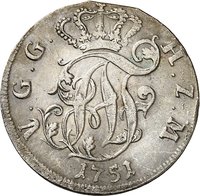
Obverse
Description:
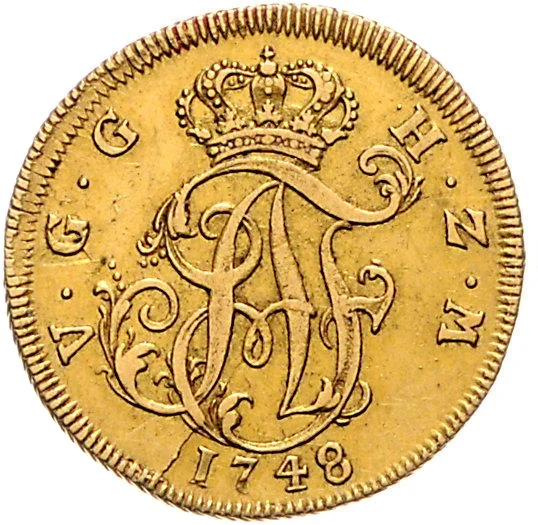
Crowned AF monogram script.
Script: Latin
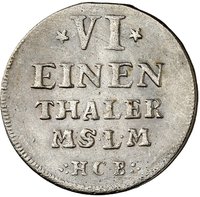
Reverse
Description:
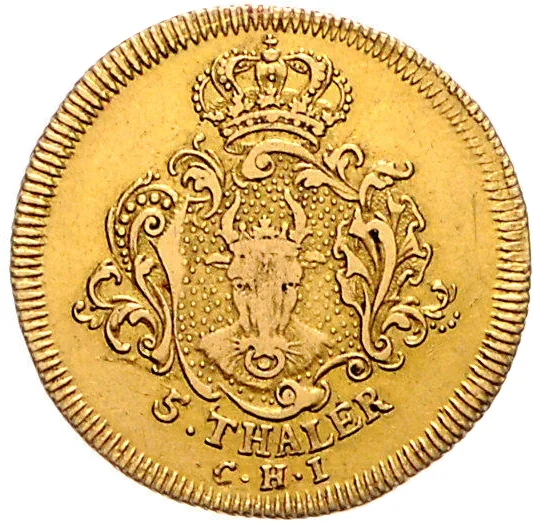
Crowned steer head arms.
Script: Latin
Edge
Mints
| Name | Mark |
|---|---|
| Stargard-Szczeciński | — |
Mintings
| Year | Mint Mark | Mintage | Quality | Collection |
|---|---|---|---|---|
| 1748 | CHI | 2,616 |
Historical background
In 1748, the currency situation in the Duchy of Mecklenburg-Strelitz was characterized by significant complexity and instability, common across the fragmented German states of the Holy Roman Empire. The duchy did not possess a strong, unified monetary system of its own. Instead, its economy operated with a chaotic mix of circulating coins, including those minted by its larger neighbor and co-duchy, Mecklenburg-Schwerin, as well as various Reichsthalers, Gute Groschen, and Pfennigs from other German territories. This proliferation of different coins, each with varying metallic content and value, created a cumbersome environment for trade and daily transactions.
The core of the problem lay in the debasement of coinage. Rulers often reduced the precious metal content in coins to generate short-term revenue, leading to inflation and a loss of public trust. While specific minting records for Mecklenburg-Strelitz in this exact year are sparse, the duchy was undoubtedly affected by the wider regional "Kipper und Wipper" crisis of the early 18th century, the aftermath of which lingered for decades. The monetary landscape was further complicated by the circulation of foreign coins, particularly from Hamburg and Lübeck, which were crucial for the duchy's Baltic trade but whose values fluctuated against local issues.
Consequently, the year 1748 saw a monetary system in Mecklenburg-Strelitz that was not truly sovereign but rather a dependent and disordered part of a regional patchwork. Effective trade required constant recourse to money changers and complex conversion tables. This instability hindered economic development and underscored the duchy's limited fiscal autonomy, a reality that would persist until the broader currency reforms of the 19th century, long after the duchy's elevation to a Grand Duchy.
The core of the problem lay in the debasement of coinage. Rulers often reduced the precious metal content in coins to generate short-term revenue, leading to inflation and a loss of public trust. While specific minting records for Mecklenburg-Strelitz in this exact year are sparse, the duchy was undoubtedly affected by the wider regional "Kipper und Wipper" crisis of the early 18th century, the aftermath of which lingered for decades. The monetary landscape was further complicated by the circulation of foreign coins, particularly from Hamburg and Lübeck, which were crucial for the duchy's Baltic trade but whose values fluctuated against local issues.
Consequently, the year 1748 saw a monetary system in Mecklenburg-Strelitz that was not truly sovereign but rather a dependent and disordered part of a regional patchwork. Effective trade required constant recourse to money changers and complex conversion tables. This instability hindered economic development and underscored the duchy's limited fiscal autonomy, a reality that would persist until the broader currency reforms of the 19th century, long after the duchy's elevation to a Grand Duchy.
✨ Legendary