

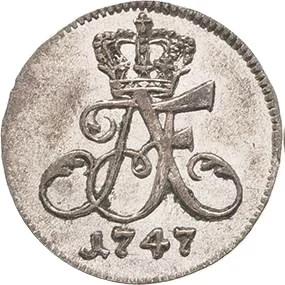
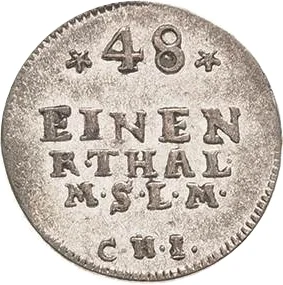
1⁄48 Thaler – Duchy of Mecklenburg-Strelitz
Germany
Context
Years: 1745–1747
Country: Germany 
Issuer: Duchy of Mecklenburg-Strelitz
Ruler: Adolphus Frederick III
Currency:
(1701—1872)
Demonetized: Yes
Total mintage: 282,000
References
KM: #Click to copy to clipboard20
Numista: #198653
Obverse
Description:
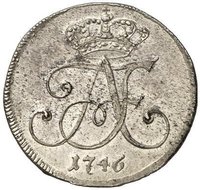
Crowned AF monogram with date beneath.
Script: Latin
Reverse
Description:
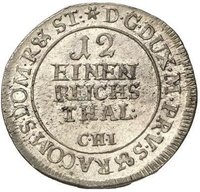
Denomination and mintmaster initials in five lines.
Inscription:
48
EINEN
R THAL
M.S.L.M.
C.H.I.
EINEN
R THAL
M.S.L.M.
C.H.I.
Script: Latin
Edge
Mints
| Name | Mark |
|---|---|
| Stargard-Szczeciński | — |
Mintings
| Year | Mint Mark | Mintage | Quality | Collection |
|---|---|---|---|---|
| 1745 | — | — | ||
| 1746 | — | 104,000 | ||
| 1747 | — | 178,000 |
Historical background
In 1745, the Duchy of Mecklenburg-Strelitz, a small north German territory within the Holy Roman Empire, operated within a complex and fragmented monetary landscape. Like many German states of the era, it did not possess full, exclusive sovereignty over coinage. Its currency system was deeply entangled within the wider framework of the Reichsmünzfuß (Imperial Coinage Standard), as regulated by the Imperial Diets. The most relevant standard at the time was the Leipziger Fuß of 1690, which set the silver content and value for Reichsthalers, Groschen, and Pfennigs. In practice, Mecklenburg-Strelitz's coins circulated alongside those of its larger neighbor, Mecklenburg-Schwerin, and a plethora of other regional and foreign currencies, leading to a chronic circulation of heterogeneous coins.
The duchy's own minting activity was limited and often economically motivated by seigniorage (profit from coin production) rather than purely monetary need. Rulers would periodically strike coins, such as fractional Thalers, Groschen, and Pfennigs, but these were insufficient to dominate local commerce. Consequently, the daily economy relied heavily on a mix of coins from neighboring states, older domestic issues, and even clipped or debased pieces. This proliferation of different coins with fluctuating intrinsic values created persistent challenges for trade, requiring constant exchange calculations and fostering uncertainty.
Therefore, the 1745 currency situation was characterized by this tension between theoretical imperial standards and messy local reality. The monetary system was not unified or centrally managed in a modern sense. Duke Adolf Friedrich III’s government faced the continual tasks of attempting to enforce official exchange rates, combating the inflow of inferior foreign coin, and periodically renewing coinage to secure revenue and stabilize—however temporarily—the local money in circulation. The situation was inherently unstable, typical of the Holy Roman Empire’s decentralized political structure before the greater monetary reforms of the later 18th and 19th centuries.
The duchy's own minting activity was limited and often economically motivated by seigniorage (profit from coin production) rather than purely monetary need. Rulers would periodically strike coins, such as fractional Thalers, Groschen, and Pfennigs, but these were insufficient to dominate local commerce. Consequently, the daily economy relied heavily on a mix of coins from neighboring states, older domestic issues, and even clipped or debased pieces. This proliferation of different coins with fluctuating intrinsic values created persistent challenges for trade, requiring constant exchange calculations and fostering uncertainty.
Therefore, the 1745 currency situation was characterized by this tension between theoretical imperial standards and messy local reality. The monetary system was not unified or centrally managed in a modern sense. Duke Adolf Friedrich III’s government faced the continual tasks of attempting to enforce official exchange rates, combating the inflow of inferior foreign coin, and periodically renewing coinage to secure revenue and stabilize—however temporarily—the local money in circulation. The situation was inherently unstable, typical of the Holy Roman Empire’s decentralized political structure before the greater monetary reforms of the later 18th and 19th centuries.
✨ Legendary