

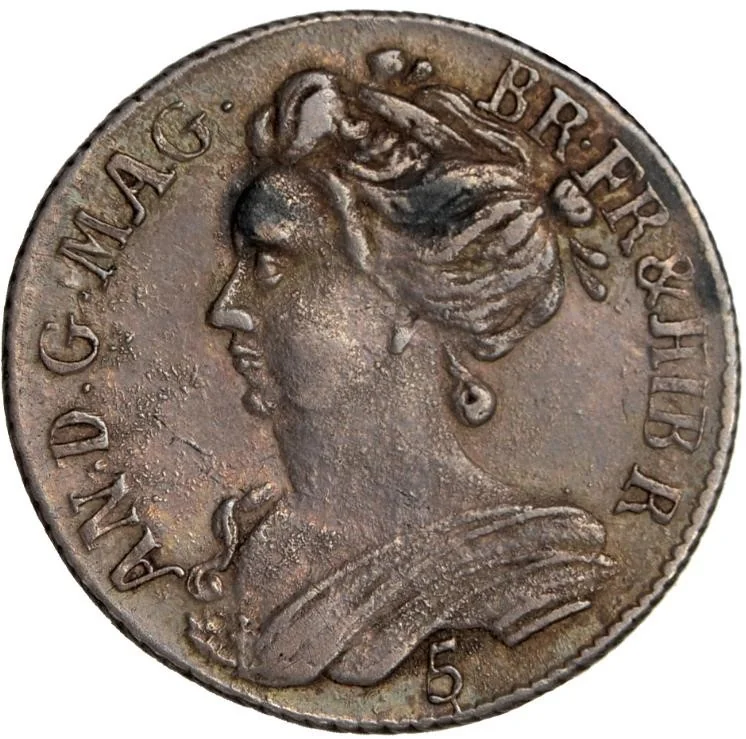
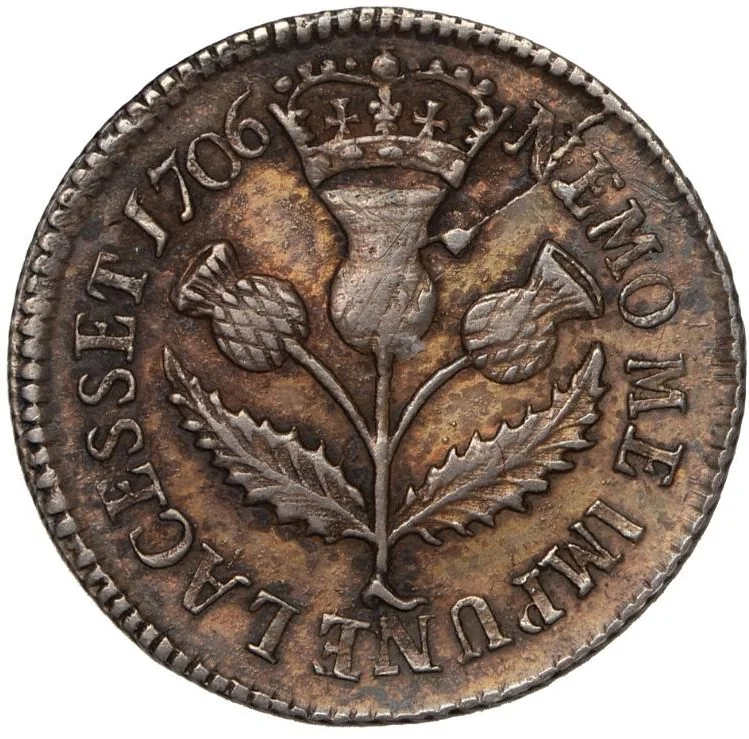
5 shillings – Scotland
Add to wishlist
United Kingdom
Context
Year: 1706
Country: United Kingdom
Issuer: Scotland
Ruler: Anne
Currency:
(1136—1707)
Demonetization: 1 June 1708
Material
References
KM: #
Numista: #108623
Obverse
Description:
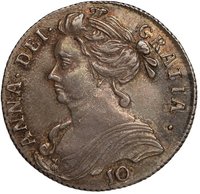
Queen Anne left-facing bust, value mark below.
Inscription:
AN · D · G · MAG · BR · FR · & HIB · R
Script: Latin
Reverse
Edge
Mints
| Name | Mark |
|---|---|
| Edinburgh | — |
Mintings
| Year | Mint Mark | Mintage | Quality | Collection |
|---|---|---|---|---|
| 1706 | — | — |
Historical background
In 1706, Scotland’s currency was in a state of profound instability and debasement, a key economic pressure that influenced the drive toward political union with England. Following the disastrous failure of the Darien Scheme in the 1690s, which had drained the nation of capital, the Scottish economy was weak and its coinage deeply problematic. The Scottish pound had long been a separate currency from the English pound sterling, but it traded at a significant discount, typically valued at just one-twelfth of its English counterpart. This reflected Scotland’s weaker economy and the poor state of its silver coinage, which was often underweight, clipped, and widely counterfeited, eroding public trust and hampering trade.
The monetary chaos was exacerbated by a severe shortage of specie (coin), particularly following the recoinage in England in 1696, which drew what good Scottish silver remained across the border. This liquidity crisis crippled domestic commerce and made international trade, especially with England—Scotland’s largest trading partner—extremely difficult. Merchants faced complex and unfavourable exchange rates, while the crown lacked the resources to implement a effective recoinage. The situation created a powerful faction within the Scottish merchant and landowning classes who saw a fixed, stable currency as essential for economic recovery.
Therefore, the currency crisis became a central plank in the arguments of pro-unionists, known as the "Court Party," during the negotiations for the Treaty of Union in 1706. A key provision of the treaty (Article 16) promised the introduction of a uniform currency across the new united kingdom, based on the stable and strong English sterling. This guaranteed a fixed exchange rate and mandated a full recoinage in Scotland, funded by the English exchequer. For many Scots, this tangible economic benefit—the promise of monetary stability and access to a broader market—outweighed political apprehensions, making union a pragmatic solution to a crippling financial problem.
The monetary chaos was exacerbated by a severe shortage of specie (coin), particularly following the recoinage in England in 1696, which drew what good Scottish silver remained across the border. This liquidity crisis crippled domestic commerce and made international trade, especially with England—Scotland’s largest trading partner—extremely difficult. Merchants faced complex and unfavourable exchange rates, while the crown lacked the resources to implement a effective recoinage. The situation created a powerful faction within the Scottish merchant and landowning classes who saw a fixed, stable currency as essential for economic recovery.
Therefore, the currency crisis became a central plank in the arguments of pro-unionists, known as the "Court Party," during the negotiations for the Treaty of Union in 1706. A key provision of the treaty (Article 16) promised the introduction of a uniform currency across the new united kingdom, based on the stable and strong English sterling. This guaranteed a fixed exchange rate and mandated a full recoinage in Scotland, funded by the English exchequer. For many Scots, this tangible economic benefit—the promise of monetary stability and access to a broader market—outweighed political apprehensions, making union a pragmatic solution to a crippling financial problem.
✨ Legendary