

4 skilling – Denmark
Add to wishlist
Denmark
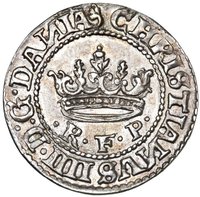
Obverse
Description:
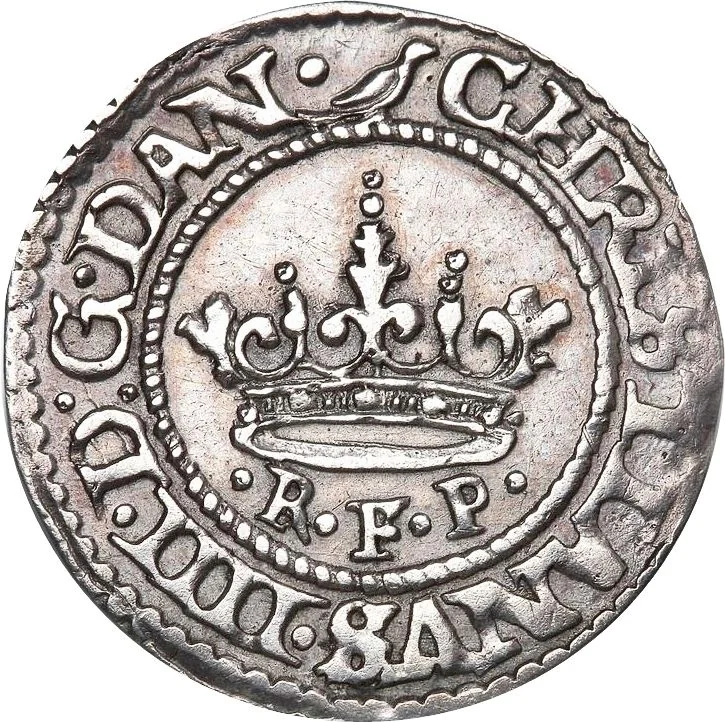
High crown over R.F.P. in pearled circle. Outer legend (mintmark at end if present).
Inscription:
.R.F.P. (= REGNA FIRMAT PIETAS)
CHRISTIANVS.IIII.D:G.DAN
CHRISTIANVS.IIII.D:G.DAN
Script: Latin
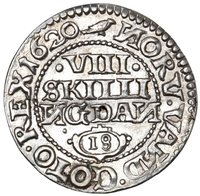
Reverse
Description:
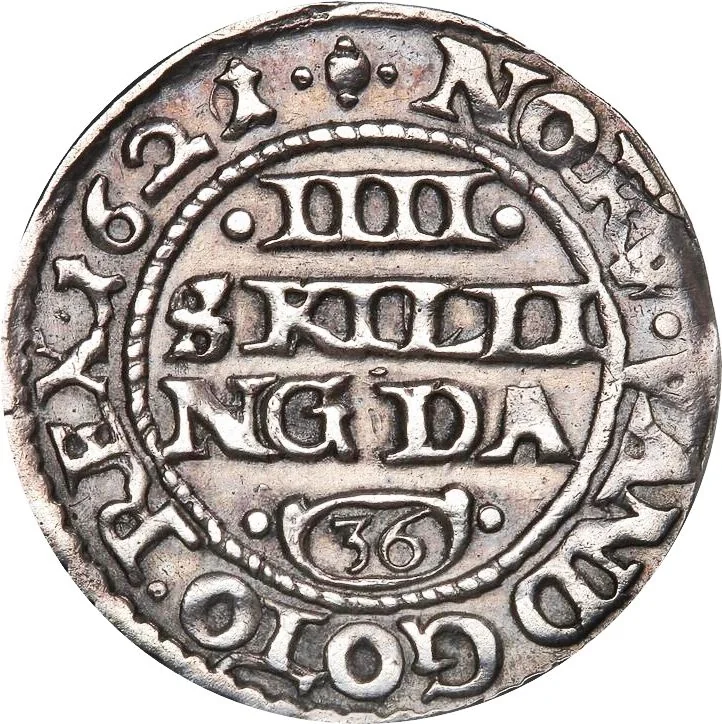
Three lines of lettered value above an oval containing its fractional value; all within a beaded circle. Outer legend around rim, ending with date and mintmark.
Inscription:
.IIII.
SKILLI
NG.DA
(36)
NORV.VAND.GOTO.REX. 1621
SKILLI
NG.DA
(36)
NORV.VAND.GOTO.REX. 1621
Script: Latin
Edge
Mints
| Name | Mark |
|---|---|
| Copenhagen | — |
Mintings
| Year | Mint Mark | Mintage | Quality | Collection |
|---|---|---|---|---|
| 1620 | c | — | ||
| 1620 | n | — | ||
| 1620 | r | — | ||
| 1620 | ☘ | — | ||
| 1621 | n | — | ||
| 1621 | r | — | ||
| 1621 | ☘ | — |
Historical background
In 1620, Denmark was navigating a complex and challenging monetary situation, characterized by a fragmented and debased currency system. The country did not have a unified national coinage; instead, a multitude of different coins, both domestic and foreign, circulated simultaneously. These included Danish marks and skillings, but also a heavy influx of lower-quality German coins, Dutch duyts and stykker, and other European currencies brought through trade. This proliferation made everyday transactions confusing and fostered widespread distrust.
The core of the problem was severe debasement. The state, particularly under King Christian IV, frequently engaged in currency manipulation to raise short-term revenue for its expansive military ambitions and costly projects. By reducing the silver content in minted coins while mandating their face value remain the same, the crown generated immediate profit. However, this practice led to rapid inflation, as the public and merchants quickly adjusted prices to reflect the coins' true metallic worth. "Good" older coins with higher silver content were often hoarded or melted down, leaving the poorer-quality new coins in circulation—a classic example of Gresham's Law.
This unstable environment created significant economic strain, hampering both domestic commerce and international trade. Merchants faced uncertainty, and the peasantry, often paying fixed rents in an inflating economy, suffered. While attempts at reform were made, including the establishment of the Kurantbank in 1624 to provide a stable unit of account, the fundamental pressures of war finance meant that monetary instability would remain a persistent feature of Danish economic life for much of the 17th century.
The core of the problem was severe debasement. The state, particularly under King Christian IV, frequently engaged in currency manipulation to raise short-term revenue for its expansive military ambitions and costly projects. By reducing the silver content in minted coins while mandating their face value remain the same, the crown generated immediate profit. However, this practice led to rapid inflation, as the public and merchants quickly adjusted prices to reflect the coins' true metallic worth. "Good" older coins with higher silver content were often hoarded or melted down, leaving the poorer-quality new coins in circulation—a classic example of Gresham's Law.
This unstable environment created significant economic strain, hampering both domestic commerce and international trade. Merchants faced uncertainty, and the peasantry, often paying fixed rents in an inflating economy, suffered. While attempts at reform were made, including the establishment of the Kurantbank in 1624 to provide a stable unit of account, the fundamental pressures of war finance meant that monetary instability would remain a persistent feature of Danish economic life for much of the 17th century.
💎 Extremely Rare