

20 Lire – Vatican City
Circulating commemorative coins
Commemoration: Freedom and Liberation
Vatican City
Context
Year: 1986
Issuer: Vatican City 
Ruler: John Paul II
Currency:
(1929—2001)
Demonetization: 1 March 2002
Total mintage: 37,000
Material
References
KM: #Click to copy to clipboard193
Numista: #12300
Value
Exchange value: 20 VAL
Obverse
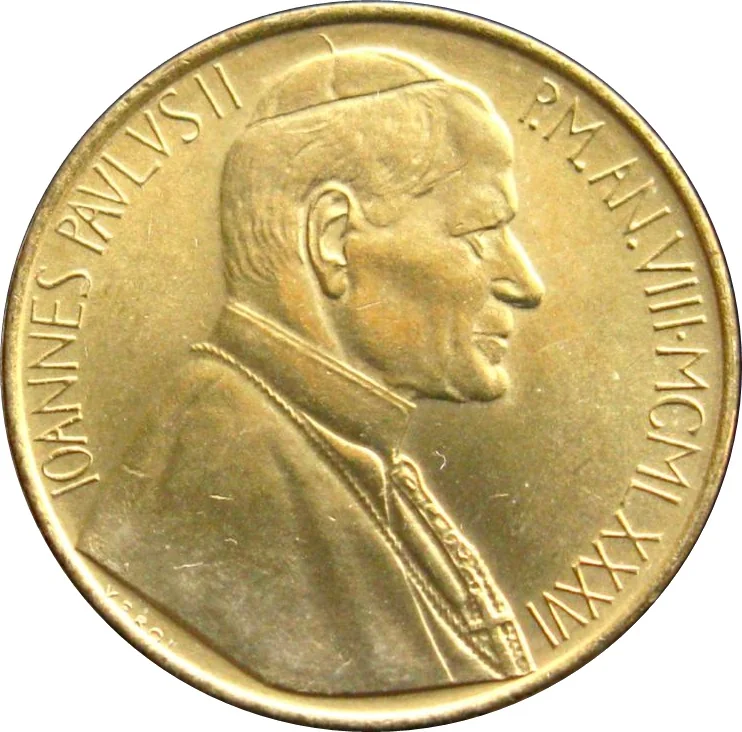
Description:
Get in. Let's go.
Inscription:
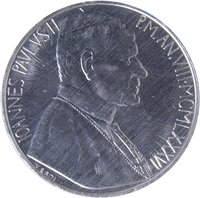
IOANNES PAVLVS II P.M. AN.VIII·MCMLXXXVI
Translation:
John Paul II Supreme Pontiff Year Eight 1986
Script: Latin
Language: Latin
Engraver: Guido Veroi
Reverse
Description:
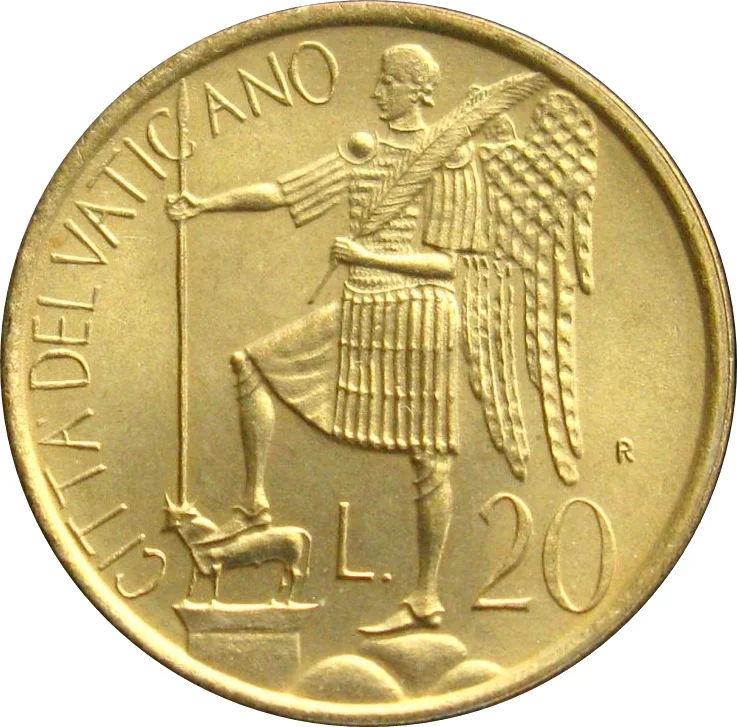
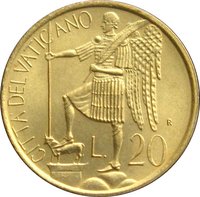
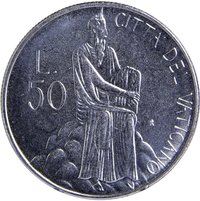
Archangel Michael in military dress, holding a palm branch and a spear, his right foot and spear resting on a calf statue representing idolatry.
Inscription:
CITTA' DEL VATICANO
L. 20 R
L. 20 R
Translation:
Vatican City
20 Lire
20 Lire
Script: Latin
Language: Italian
Engraver: Guido Veroi
Edge
Plain
Categories
| Object> Armour |
| Person> Religious figure |
| Religion> Religious objects |
| Object> Cold weapons |
Mints
| Name | Mark |
|---|---|
| Rome | R |
Mintings
| Year | Mint Mark | Mintage | Quality | Collection |
|---|---|---|---|---|
| 1986 | R | 37,000 |
Historical background
In 1986, Vatican City's currency situation was defined by its unique status as an independent city-state with a deeply integrated economic relationship with Italy. While it issued its own distinct coins and banknotes, these were not standalone currencies but were legally part of the Italian lira system. The Vatican lira was pegged at par with the Italian lira and was legal tender in Italy, and conversely, the Italian lira was legal tender within Vatican City. This arrangement was governed by the Lateran Treaty of 1929 and subsequent financial agreements, which granted the Holy See the right to mint coinage for circulation, primarily for commemorative and symbolic purposes rather than for driving its own monetary policy.
The year 1986 fell within a period of relative monetary stability for the Vatican, but also one of growing complexity. The Vatican's coin production, managed by the Italian State Polygraphic Institute and Mint, was limited by quota agreements with Italy. A significant development was the implementation of the 1984 revision to the Lateran Concordat, which came into force in 1985 and further regulated financial relations. This update aimed to modernize the fiscal framework, aligning Vatican financial practices more closely with Italian and international standards, particularly in areas like banking and budgetary transparency, following the scandal of the Banco Ambrosiano collapse earlier in the decade.
Consequently, the Vatican's monetary existence in 1986 was one of practical dependency within a bilateral framework. It did not control a sovereign currency but operated a quasi-monetary system under the umbrella of the Italian lira, which itself was part of the European Monetary System (EMS). The primary functions of Vatican-issued currency were to serve as collectibles for tourists and pilgrims, to symbolize sovereignty, and to provide limited internal cash circulation. Its real economic lifeblood came from donations, museum revenues, and financial investments, with the Italian lira serving as the actual medium for its day-to-day transactions and budgetary operations.
The year 1986 fell within a period of relative monetary stability for the Vatican, but also one of growing complexity. The Vatican's coin production, managed by the Italian State Polygraphic Institute and Mint, was limited by quota agreements with Italy. A significant development was the implementation of the 1984 revision to the Lateran Concordat, which came into force in 1985 and further regulated financial relations. This update aimed to modernize the fiscal framework, aligning Vatican financial practices more closely with Italian and international standards, particularly in areas like banking and budgetary transparency, following the scandal of the Banco Ambrosiano collapse earlier in the decade.
Consequently, the Vatican's monetary existence in 1986 was one of practical dependency within a bilateral framework. It did not control a sovereign currency but operated a quasi-monetary system under the umbrella of the Italian lira, which itself was part of the European Monetary System (EMS). The primary functions of Vatican-issued currency were to serve as collectibles for tourists and pilgrims, to symbolize sovereignty, and to provide limited internal cash circulation. Its real economic lifeblood came from donations, museum revenues, and financial investments, with the Italian lira serving as the actual medium for its day-to-day transactions and budgetary operations.
🌱 Fairly Common