

1 Thaler – Hungary
Hungary

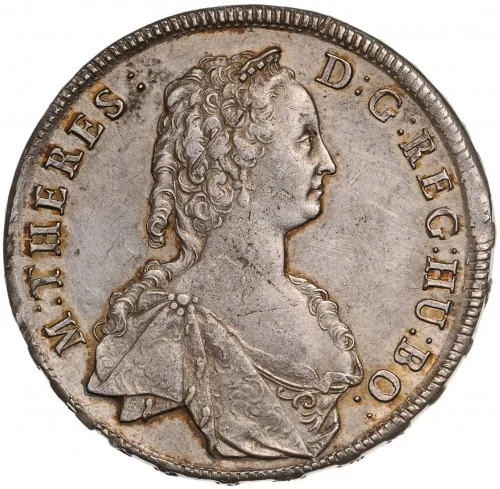
Obverse
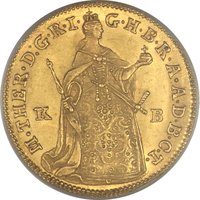
Description:
Young portrait with a corolla, modified hairstyle and dress, a longer back curl, smaller image.
Inscription:
M : THERES : D : G : REG : HU : BO :
Script: Latin
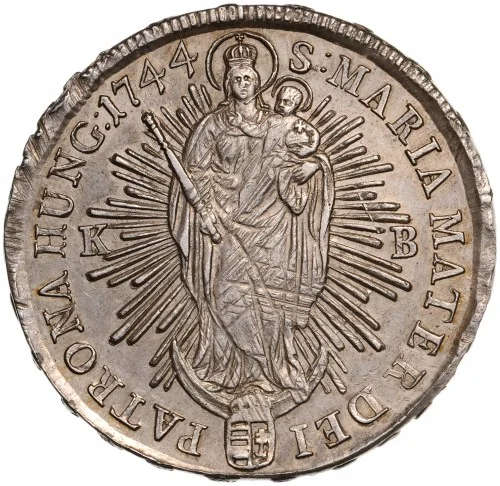
Reverse
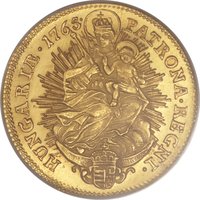
Description:
A crowned Madonna stands on a crescent, holding the child, a scepter, and an orb. The Hungarian coat of arms below separates the mintmark and lettering.
Inscription:
S : MARIA MATER DEI PATRONA HUNG:
Script: Latin
Edge
Inscripted
Legend:
IUSTITIA ET CLEMENTIA
Mints
| Name | Mark |
|---|---|
| Kremnica | K B |
Mintings
| Year | Mint Mark | Mintage | Quality | Collection |
|---|---|---|---|---|
| 1744 | K | — | ||
| 1745 | K | — |
Historical background
In 1744, the currency situation in the Kingdom of Hungary, part of the Habsburg Monarchy, was characterized by severe instability and devaluation, primarily driven by the financial demands of the ongoing War of the Austrian Succession (1740-1748). To fund the massive military expenditures, the Viennese court, under Empress Maria Theresa, heavily relied on debasing the coinage. The state mint in Nagybánya (today Baia Mare, Romania) produced so-called Kriegsgeld (war money), coins with a significantly reduced silver content compared to their nominal value. This practice, while providing immediate cash, eroded public trust and sparked widespread economic disruption.
The consequences within Hungary were acute. The influx of debased coinage led to rampant inflation, as merchants and the population quickly recognized the inferior money and adjusted prices upward. This effectively created a two-tier currency system: older, full-value coins were hoarded and disappeared from circulation (Gresham's Law in action), while the new, poor-quality coins became the common medium of exchange, constantly losing purchasing power. This devaluation disproportionately harmed fixed-income groups, soldiers, and civil servants, while creating opportunities for speculators and counterfeiters to exploit the chaotic monetary environment.
This period represented a low point in a longer 18th-century struggle for monetary stability. While the immediate crisis was a wartime fiscal measure, it exacerbated existing tensions between the Hungarian estates and the Habsburg crown regarding economic autonomy. The estates resented Vienna's unilateral decisions that destabilized the Hungarian economy. The situation would only begin to stabilize after the war's conclusion, leading to the monetary reforms of the 1750s and 1760s aimed at standardizing and restoring the value of the currency across the empire.
The consequences within Hungary were acute. The influx of debased coinage led to rampant inflation, as merchants and the population quickly recognized the inferior money and adjusted prices upward. This effectively created a two-tier currency system: older, full-value coins were hoarded and disappeared from circulation (Gresham's Law in action), while the new, poor-quality coins became the common medium of exchange, constantly losing purchasing power. This devaluation disproportionately harmed fixed-income groups, soldiers, and civil servants, while creating opportunities for speculators and counterfeiters to exploit the chaotic monetary environment.
This period represented a low point in a longer 18th-century struggle for monetary stability. While the immediate crisis was a wartime fiscal measure, it exacerbated existing tensions between the Hungarian estates and the Habsburg crown regarding economic autonomy. The estates resented Vienna's unilateral decisions that destabilized the Hungarian economy. The situation would only begin to stabilize after the war's conclusion, leading to the monetary reforms of the 1750s and 1760s aimed at standardizing and restoring the value of the currency across the empire.
✨ Legendary