

½ Thaler – Hungary
Hungary

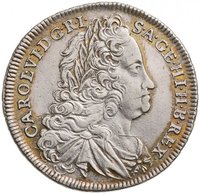
Obverse
Description:
Curly-wigged laureate bust in simple drapery, breaking inscriptions above and below. Surrounding legend begins at left, without inner circle. Absent are the crowned Hungarian shield and Madonna-and-child stamp. Mintmark "NB" in cartouche below.
Inscription:
CAROL · VI · D · G · R · I · S · A · GE · HI · HU · BO · REX
NB
NB
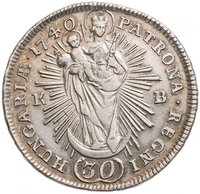
Reverse
Description:
Imperial eagle in inner circle, inscription interrupted by eagle heads. On chest, crowned U-shaped cartouche with fourfold imperial arms. Central crowned Hungarian shield topped by small Madonna and child. No pearl circle, date ends inscription.
Inscription:
ARCHID · AV · D · BV · M · MOR · COM · TYR · 1739 ·
Edge
Plain
Mints
| Name | Mark |
|---|---|
| Baia Mare | NB |
Mintings
| Year | Mint Mark | Mintage | Quality | Collection |
|---|---|---|---|---|
| 1739 | NB | — |
Historical background
In 1739, the currency situation in the Kingdom of Hungary, then part of the Habsburg Monarchy, was characterized by significant instability and complexity. The primary circulating coin was the silver forint (florin), but its value and purity were under constant pressure. Decades of expensive warfare, particularly against the Ottoman Empire, had drained the monarchy's treasury, leading to repeated debasements. The government frequently reduced the silver content in coins to mint more from the same bullion, a short-term fiscal fix that eroded public trust and caused inflation, as the intrinsic value of the coins fell below their face value.
This period also saw a chaotic mix of older, purer coins circulating alongside newer, debased issues, as well as various foreign currencies, especially the durable Dutch leeuwendaalder (lion dollar). People hoarded older, high-silver coins, driving them out of circulation—a classic example of Gresham's Law, where "bad money drives out good." This complicated trade and daily transactions, as merchants and the public had to constantly assess and negotiate the actual worth of different coins, creating a cumbersome and inefficient monetary environment.
The underlying issue was a structural conflict between the Habsburg central government in Vienna and the Hungarian estates. Vienna sought to control Hungary's mines and fiscal policy to fund its imperial ambitions, while the Hungarian nobility fiercely guarded their historic privileges, including control over taxation and mining revenues. This tension prevented coherent monetary reform. Consequently, in 1739, Hungary's currency system remained a fragile patchwork, undermining economic stability and reflecting the broader struggle for power within the Habsburg realm.
This period also saw a chaotic mix of older, purer coins circulating alongside newer, debased issues, as well as various foreign currencies, especially the durable Dutch leeuwendaalder (lion dollar). People hoarded older, high-silver coins, driving them out of circulation—a classic example of Gresham's Law, where "bad money drives out good." This complicated trade and daily transactions, as merchants and the public had to constantly assess and negotiate the actual worth of different coins, creating a cumbersome and inefficient monetary environment.
The underlying issue was a structural conflict between the Habsburg central government in Vienna and the Hungarian estates. Vienna sought to control Hungary's mines and fiscal policy to fund its imperial ambitions, while the Hungarian nobility fiercely guarded their historic privileges, including control over taxation and mining revenues. This tension prevented coherent monetary reform. Consequently, in 1739, Hungary's currency system remained a fragile patchwork, undermining economic stability and reflecting the broader struggle for power within the Habsburg realm.

✨ Legendary