

15 Kreuzers – Hungary
Hungary
Context

Material
References
KM: #Click to copy to clipboard175
Numista: #189281
Value
Bullion value: $15.86
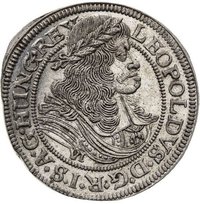
Obverse
Description:
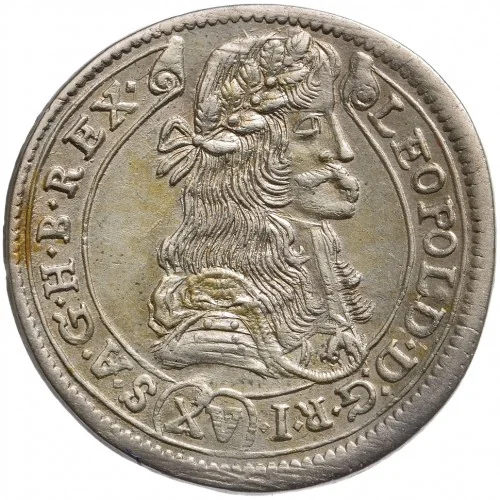
Young laureate portrait facing right, with long straight hair. Bust overlaps top ribbon bearing face value (XV) and inscription.
Inscription:
LEOPOLD · D · G · R · I · (XV) S · A · G · H · B · REX ·
Script: Latin
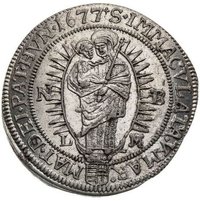
Reverse
Description:
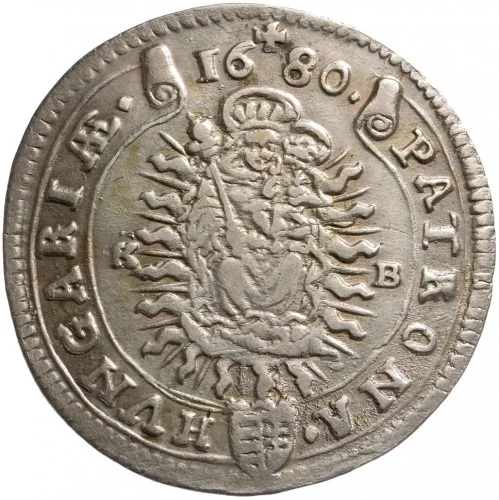
Radiant Madonna crowned and holding child and scepter. Mintmark split by scepter. Double-crowned Hungarian shield below, with dated ribbon inscription above.
Inscription:
PATRONA · HVNGARIÆ · 16 77 ·
Script: Latin
Edge
Plain
Mintings
| Year | Mint Mark | Mintage | Quality | Collection |
|---|---|---|---|---|
| 1677 | K | — | ||
| 1678 | K | — | ||
| 1679 | K | — | ||
| 1680 | — | — | ||
| 1680 | K | — | ||
| 1681 | K | — | ||
| 1682 | K | — | ||
| 1683 | K | — | ||
| 1684 | K | — | ||
| 1685 | K | — | ||
| 1686 | K | — |
Historical background
In 1677, the currency situation in the Kingdom of Hungary was one of profound instability and debasement, a direct consequence of its position on the front line of the Habsburg-Ottoman wars. The ongoing conflict, particularly the Great Turkish War which would formally begin a few years later, placed an enormous financial strain on the Habsburg monarchy. To fund military campaigns and fortifications, the imperial authorities in Vienna repeatedly resorted to debasing the silver coinage minted for circulation in Hungary, notably the denarius (denár). This resulted in a severe loss of precious metal content, causing the coins' intrinsic value to plummet far below their nominal face value.
This monetary decay triggered a classic "bad money drives out good" scenario (Gresham's Law). Older, higher-silver coins were hoarded, melted down, or exported, leaving only the poor-quality new coins in daily circulation. The situation was exacerbated by the circulation of a multitude of foreign coins, including Ottoman akçe and Dutch leeuwendaalders, as well as a flood of even more debased counterfeit coins. This chaotic multi-currency system led to wildly fluctuating exchange rates, rampant inflation, and a deep crisis of trust, severely disrupting trade and market transactions within the war-ravaged kingdom.
The Habsburg financial administration's attempts to rectify the situation, such as the currency regulations proposed by the Chamber of Szepes (Spiš), were largely ineffective in the face of relentless military expenditure. Thus, in 1677, Hungary's currency was not a tool of economic unity but a symptom of its distress: a destabilized, heterogeneous, and degraded medium of exchange that reflected the kingdom's battered state between the hammer of the Imperial treasury and the anvil of Ottoman military pressure. This instability would persist until more comprehensive reforms were attempted under Leopold I in the early 1690s.
This monetary decay triggered a classic "bad money drives out good" scenario (Gresham's Law). Older, higher-silver coins were hoarded, melted down, or exported, leaving only the poor-quality new coins in daily circulation. The situation was exacerbated by the circulation of a multitude of foreign coins, including Ottoman akçe and Dutch leeuwendaalders, as well as a flood of even more debased counterfeit coins. This chaotic multi-currency system led to wildly fluctuating exchange rates, rampant inflation, and a deep crisis of trust, severely disrupting trade and market transactions within the war-ravaged kingdom.
The Habsburg financial administration's attempts to rectify the situation, such as the currency regulations proposed by the Chamber of Szepes (Spiš), were largely ineffective in the face of relentless military expenditure. Thus, in 1677, Hungary's currency was not a tool of economic unity but a symptom of its distress: a destabilized, heterogeneous, and degraded medium of exchange that reflected the kingdom's battered state between the hammer of the Imperial treasury and the anvil of Ottoman military pressure. This instability would persist until more comprehensive reforms were attempted under Leopold I in the early 1690s.
⭐ Rare