

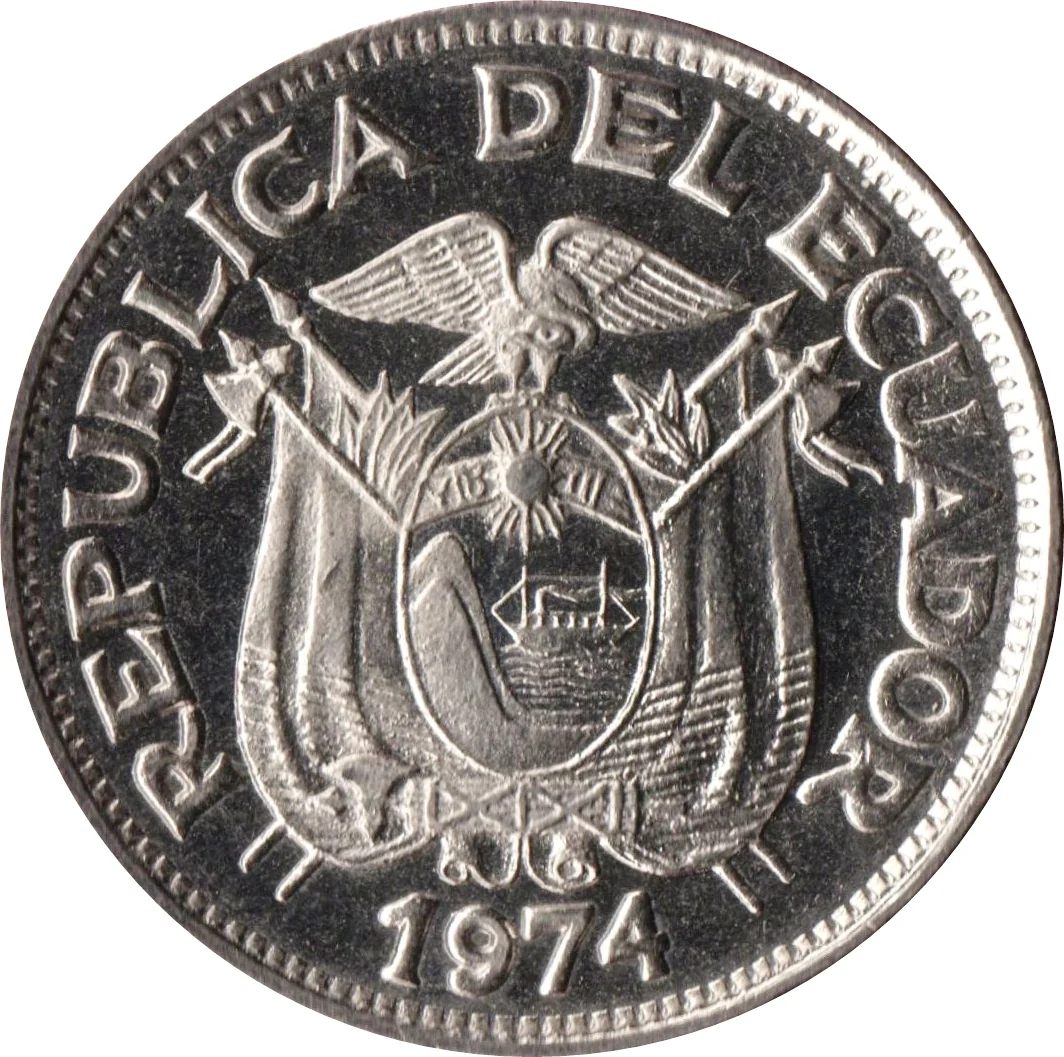
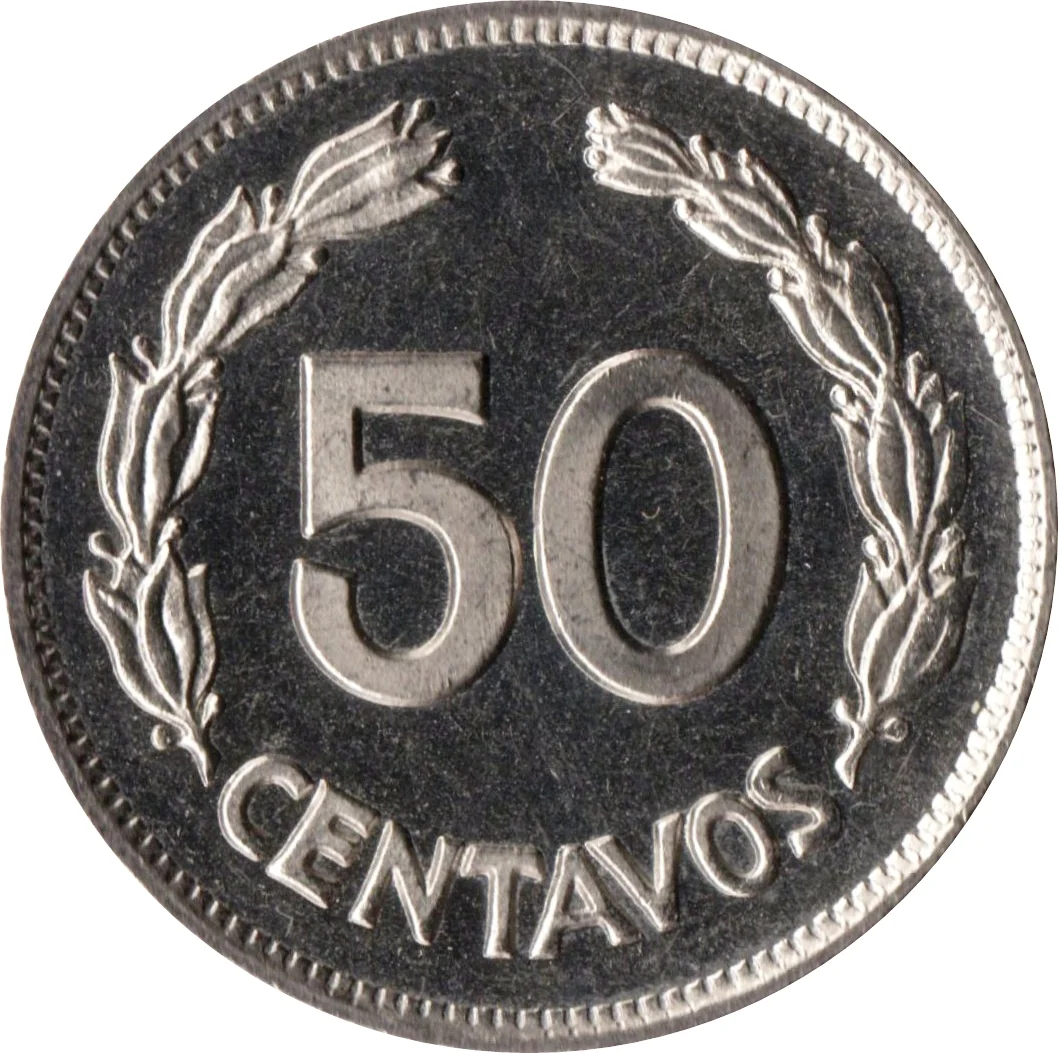
50 centavos – Ecuador
Add to wishlist
Ecuador
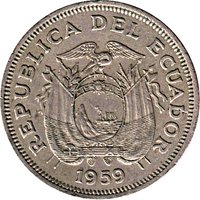
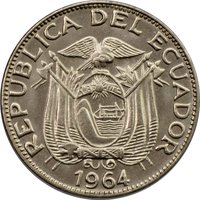
Obverse
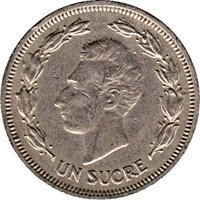
Reverse
Edge
Reeded
Categories
| Symbols> Coat of Arms |
Mints
| Name | Mark |
|---|---|
| Hamburgische Münze | — |
| Royal Mint (Tower Hill) | — |
| Royal Mint | — |
| VDM Metals / Vereinigte Deutsche Metallwerke | — |
Mintings
| Year | Mint Mark | Mintage | Quality | Collection |
|---|---|---|---|---|
| 1963 | — | 20,000,000 | ||
| 1971 | — | 5,000,000 | BU | |
| 1974 | — | — | ||
| 1975 | — | — | ||
| 1977 | — | 40,000,000 | ||
| 1979 | — | 25,000,000 | ||
| 1982 | — | 20,000,000 |
Historical background
In 1963, Ecuador's currency situation was defined by the sucre, its national currency since 1884, which operated under a fixed exchange rate regime pegged to the U.S. dollar. This peg was maintained through the Central Bank of Ecuador (founded in 1927), which held reserves in gold and foreign currency to back the money supply and guarantee convertibility. The system aimed to provide monetary stability and control inflation, but it was inherently vulnerable to Ecuador's primary economic reality: its heavy dependence on volatile agricultural exports, particularly bananas, which accounted for over 60% of export earnings.
The stability of the sucre was under persistent strain due to chronic fiscal deficits and balance of payments pressures. Government spending often outpaced revenues, leading to monetary financing of deficits—effectively printing money—which eroded confidence in the currency. Furthermore, the economy's reliance on a few commodity exports made foreign exchange earnings unpredictable; a drop in global banana prices or a poor harvest could swiftly deplete the dollar reserves needed to maintain the fixed parity. This created a cycle where pressure on the sucre would lead the Central Bank to use its reserves to defend the peg, followed by periods of tight credit and economic contraction.
Consequently, 1963 fell within a period of relative but fragile stability shortly before more severe crises. The fixed exchange rate was officially maintained, but underlying weaknesses were clear to economic observers. The military junta that had taken power in 1963 prioritized infrastructure projects, further straining public finances. These structural problems would intensify later in the decade, leading to a major devaluation in 1970 and the eventual abandonment of the fixed peg in the 1980s after years of mounting inflation and currency instability. Thus, 1963 represents a point where the institutional framework of the sucre was still intact, but the economic foundations for its long-term viability were increasingly precarious.
The stability of the sucre was under persistent strain due to chronic fiscal deficits and balance of payments pressures. Government spending often outpaced revenues, leading to monetary financing of deficits—effectively printing money—which eroded confidence in the currency. Furthermore, the economy's reliance on a few commodity exports made foreign exchange earnings unpredictable; a drop in global banana prices or a poor harvest could swiftly deplete the dollar reserves needed to maintain the fixed parity. This created a cycle where pressure on the sucre would lead the Central Bank to use its reserves to defend the peg, followed by periods of tight credit and economic contraction.
Consequently, 1963 fell within a period of relative but fragile stability shortly before more severe crises. The fixed exchange rate was officially maintained, but underlying weaknesses were clear to economic observers. The military junta that had taken power in 1963 prioritized infrastructure projects, further straining public finances. These structural problems would intensify later in the decade, leading to a major devaluation in 1970 and the eventual abandonment of the fixed peg in the 1980s after years of mounting inflation and currency instability. Thus, 1963 represents a point where the institutional framework of the sucre was still intact, but the economic foundations for its long-term viability were increasingly precarious.

🌱 Very Common