

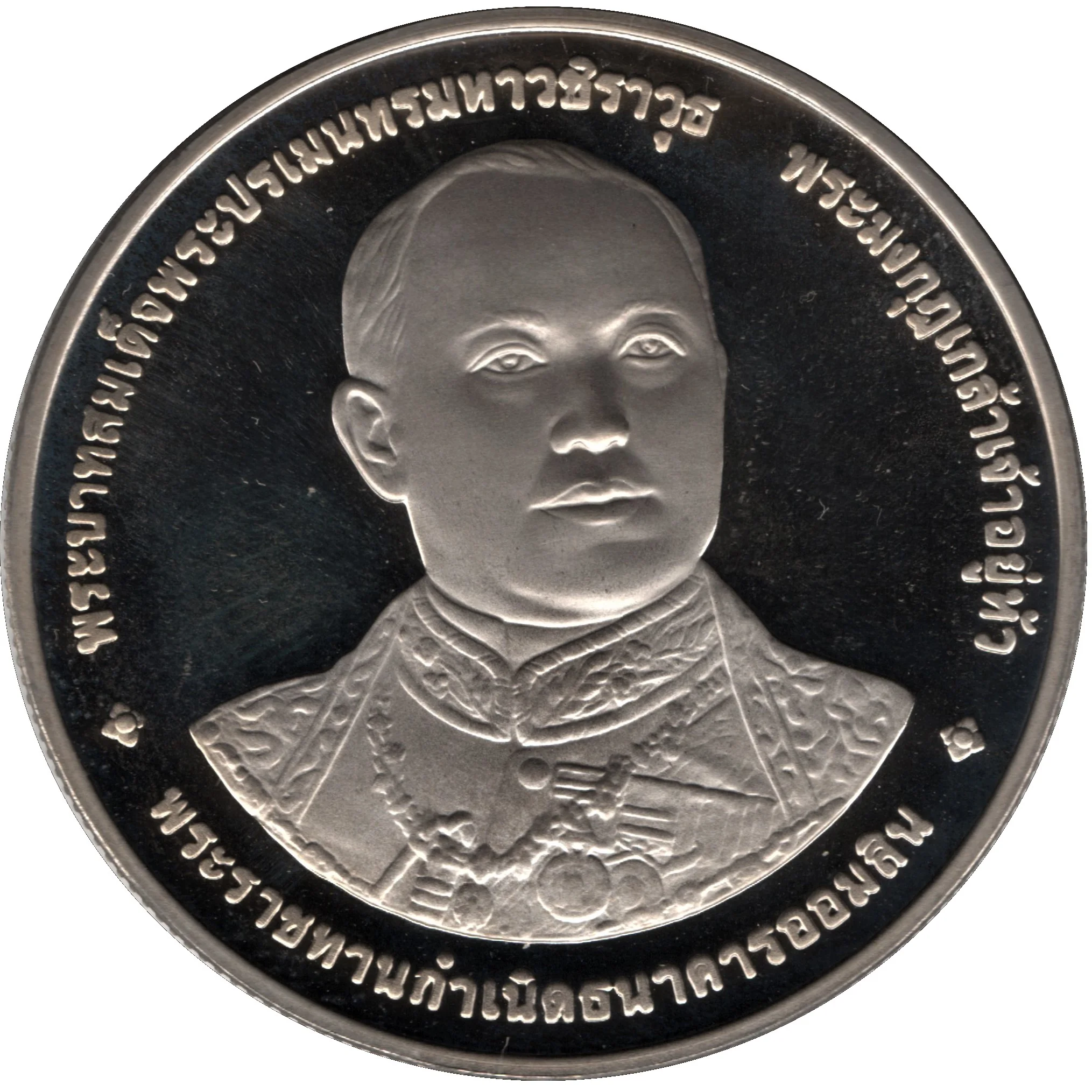

20 Bahts (Government Savings Bank) – Thailand
Circulating commemorative coins
Commemoration: 84th Anniversary of Government Savings Bank
Thailand
Context
Year: 1997
Thai Year: 2540
Issuer: Thailand 
Ruler: Bhumibol Adulyadej
Currency:
(since 1897)
Total mintage: 1,370,000
Material
Diameter: 32 mm
Weight: 15 g
Thickness: 2.5 mm
Shape: Round
Composition: Copper-nickel (75% Copper)
Technique: Milled
Alignment: Medal alignment
flip

References
Y: #Click to copy to clipboard333
Numista: #12286
Value
Exchange value: 20 THB = $0.64
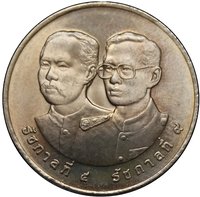
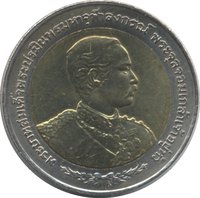
Obverse
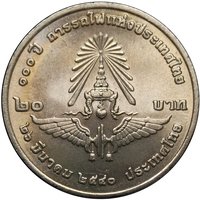
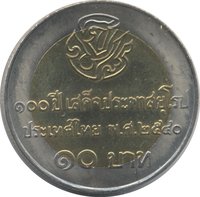
Reverse
Description:
Symbol of Government Savings Bank: a circle divided into three sections—a Vajura (symbol of Rama VI) upper-left, a Five-tiered Chatra (symbol of Prince Purachatra Jayakara) upper-right, and a ficus tree (representing stability) below, all surrounded by inscriptions.
Inscription:
๘๔ ปี ธนาคารออมสิน ๑ เมษายน ๒๕๔๐
ประเทศไทย ๒๐ บาท
ประเทศไทย ๒๐ บาท
Translation:
Eighty-fourth Year, Savings Bank, 1 April 1997
Thailand, 20 Baht
Thailand, 20 Baht
Script: Thai
Language: Thai
Edge
Reeded
Mintings
| Year | Mint Mark | Mintage | Quality | Collection |
|---|---|---|---|---|
| 1997 | — | 1,350,000 | ||
| 1997 | — | 20,000 | Proof |
Historical background
In the years leading up to 1997, Thailand experienced a period of remarkable economic growth, fueled by large-scale foreign investment and a booming property market. To attract this capital, the Thai government maintained a fixed exchange rate regime, pegging the baht primarily to the U.S. dollar. This peg created an illusion of stability, encouraging Thai banks and corporations to borrow heavily in foreign currencies, especially U.S. dollars, where interest rates were lower. However, this strategy created a dangerous vulnerability: as Thailand's current account deficit widened and export competitiveness waned due to the strong baht, the economy became increasingly reliant on short-term "hot money" inflows to sustain the peg.
By early 1997, the underlying weaknesses were exposed. The property bubble burst, leaving financial institutions saddled with non-performing loans. Speculators, recognizing the baht was overvalued and the country's foreign exchange reserves were insufficient to defend the peg, began a massive assault on the currency. Despite desperate attempts by the Bank of Thailand to intervene—spending billions of dollars and imposing capital controls—the pressure became unsustainable. On July 2, 1997, the authorities were forced to abandon the peg and let the baht float, a decision that triggered an immediate and catastrophic devaluation.
The collapse of the Thai baht acted as the catalyst for the wider Asian Financial Crisis. The currency's plunge doubled the burden of foreign-denominated debt for Thai companies, leading to widespread bankruptcies and a severe banking crisis. The Thai government was compelled to seek a $17.2 billion bailout from the International Monetary Fund, which imposed strict austerity measures. The crisis plunged the country into a deep recession, with GDP contracting sharply in 1998, and served as a stark lesson on the risks of fixed exchange rates, unhedged foreign borrowing, and fragile financial systems.
By early 1997, the underlying weaknesses were exposed. The property bubble burst, leaving financial institutions saddled with non-performing loans. Speculators, recognizing the baht was overvalued and the country's foreign exchange reserves were insufficient to defend the peg, began a massive assault on the currency. Despite desperate attempts by the Bank of Thailand to intervene—spending billions of dollars and imposing capital controls—the pressure became unsustainable. On July 2, 1997, the authorities were forced to abandon the peg and let the baht float, a decision that triggered an immediate and catastrophic devaluation.
The collapse of the Thai baht acted as the catalyst for the wider Asian Financial Crisis. The currency's plunge doubled the burden of foreign-denominated debt for Thai companies, leading to widespread bankruptcies and a severe banking crisis. The Thai government was compelled to seek a $17.2 billion bailout from the International Monetary Fund, which imposed strict austerity measures. The crisis plunged the country into a deep recession, with GDP contracting sharply in 1998, and served as a stark lesson on the risks of fixed exchange rates, unhedged foreign borrowing, and fragile financial systems.
🌱 Fairly Common