

10 Satangs – Thailand
Thailand
Context
Year: 1945
Thai Year: 2488
Issuer: Thailand 
Ruler: Ananda Mahidol
Currency:
(since 1897)
Demonetized: Yes
Material
Diameter: 20 mm
Weight: 4 g
Thickness: 2 mm
Shape: Round with a round hole
Composition: Tin
Magnetic: No
Technique: Milled
Alignment: Coin alignment
flip
References
Y: #Click to copy to clipboard62a
Numista: #100304
Value
Exchange value: 0.10 THB = $0.00
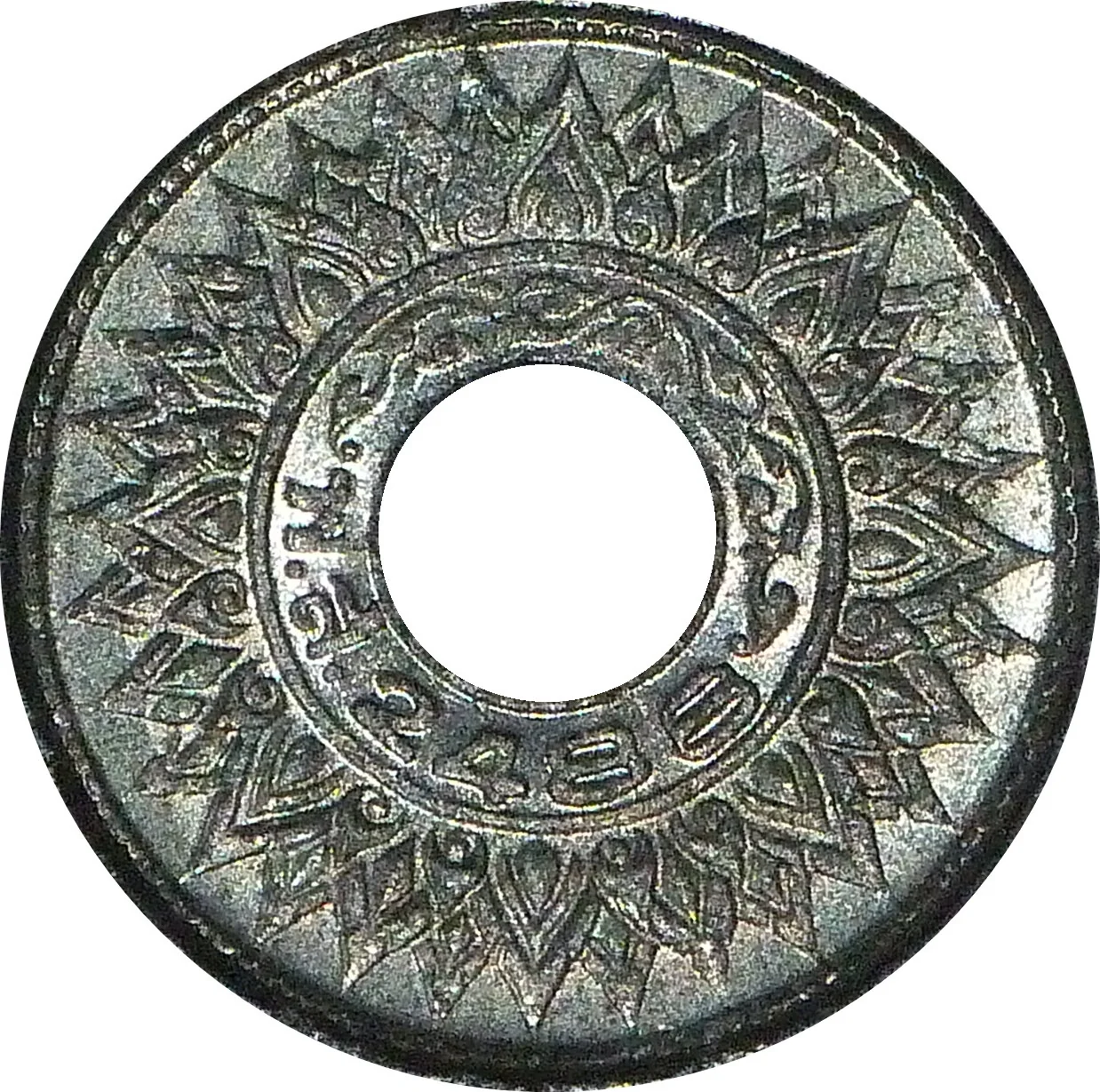
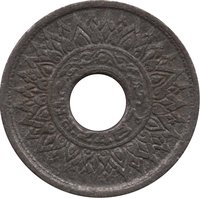
Obverse
Description:
Central hole.
Inscription:
พ.ส.2488
Translation:
Phrabat Somdet Phra Paraminthara Maha Prajadhipok Phra Pok Klao Chao Yu Hua
Language: Thai
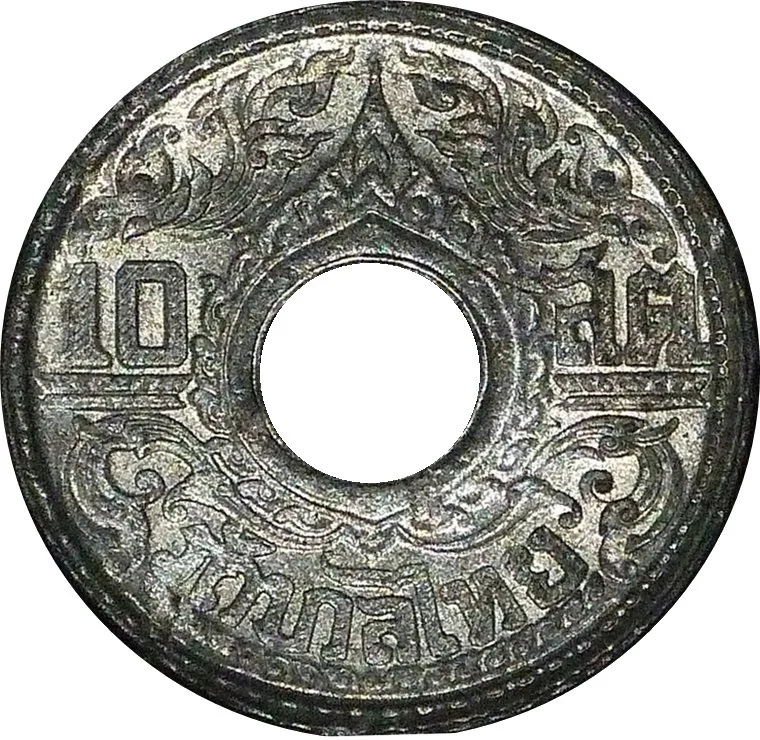
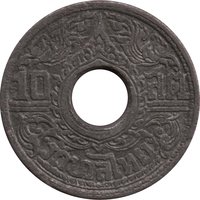
Reverse
Description:
Central hole.
Inscription:
10 สต.
รัถบาลไทย
รัถบาลไทย
Translation:
Government of Thailand
10 Satang
10 Satang
Language: Thai
Edge
Mintings
| Year | Mint Mark | Mintage | Quality | Collection |
|---|---|---|---|---|
| 1945 | — | — |
Historical background
In 1945, Thailand faced a severe and complex currency crisis, a direct legacy of its wartime alliance with Japan. During the war, the Japanese military government had forced the Bank of Thailand to print vast quantities of baht to fund its occupation and military operations across Southeast Asia, leading to rampant inflation. This "Japanese-sponsored" baht circulated widely alongside pre-war currency, but its value was unstable and it was not recognized by the Allied powers, creating a fractured monetary system.
Following Japan's surrender in August 1945, the country's financial situation became critical. The new, post-coup Thai government under Prime Minister Seni Pramoj was saddled with a massive public debt owed to the Bank of Thailand—a debt essentially incurred to finance the enemy. Furthermore, the victorious Allies, particularly the British, demanded reparations and blocked Thailand's foreign reserves held abroad. This strangled the nation's ability to support its currency with hard assets, threatening a complete collapse of the baht's value and impeding the import of essential goods for recovery.
The immediate post-war period was thus defined by urgent financial triage. The government implemented strict currency reforms, including the demonetization and exchange of certain wartime banknotes to purge the economy of the illegitimate currency. Concurrently, intense diplomatic negotiations, especially with Britain, were paramount to unfreeze assets and secure loans. These painful but necessary steps in 1945 and 1946 laid the groundwork for subsequent stabilization under agreements like the 1946 Anglo-Siamese Financial Agreement, which began the long process of reintegrating Thailand into the global financial system and restoring monetary order.
Following Japan's surrender in August 1945, the country's financial situation became critical. The new, post-coup Thai government under Prime Minister Seni Pramoj was saddled with a massive public debt owed to the Bank of Thailand—a debt essentially incurred to finance the enemy. Furthermore, the victorious Allies, particularly the British, demanded reparations and blocked Thailand's foreign reserves held abroad. This strangled the nation's ability to support its currency with hard assets, threatening a complete collapse of the baht's value and impeding the import of essential goods for recovery.
The immediate post-war period was thus defined by urgent financial triage. The government implemented strict currency reforms, including the demonetization and exchange of certain wartime banknotes to purge the economy of the illegitimate currency. Concurrently, intense diplomatic negotiations, especially with Britain, were paramount to unfreeze assets and secure loans. These painful but necessary steps in 1945 and 1946 laid the groundwork for subsequent stabilization under agreements like the 1946 Anglo-Siamese Financial Agreement, which began the long process of reintegrating Thailand into the global financial system and restoring monetary order.
🌟 Uncommon