

10 ducats (Gustav Vasa's Liberation War and political and religious freedom) – Sweden
Add to wishlist
Circulating commemorative coins
Commemoration: 200th Anniversary of Gustav Vasa's Liberation War and 200th Anniversary of political and religious freedom.
Sweden
Context
References
KM: #
Numista: #184878
Value
Bullion value: $5247.97
Obverse
Description:
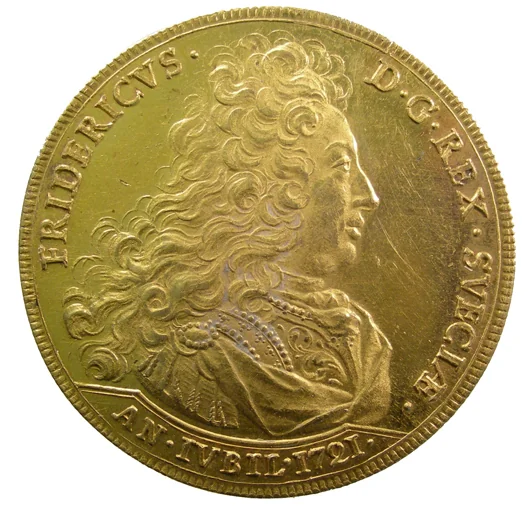
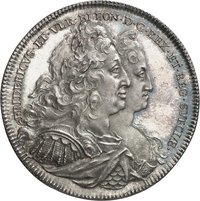
Bust of Frederick I with long curls divides the legend. He wears ornate armor under a drape. Date in exergue.
Inscription:
FRIDERICVS· D·G·REX·SVECIÆ·
AN·IVBIL·1721·
AN·IVBIL·1721·
Script: Latin
Engraver: Johann Karl von Hedlinger
Reverse
Description:
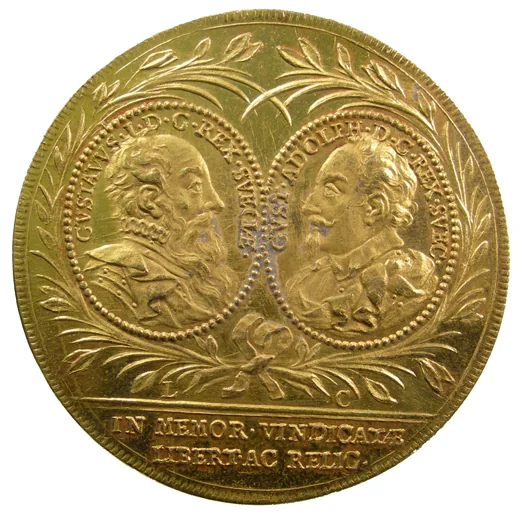
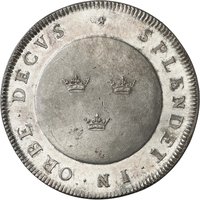
Gustav Vasa and Gustaf Adolf II busts within a palm wreath, legend below, mintmaster initials on the exergue line.
Inscription:
GVSTAVVS·I·D·G·REX·SVECIÆ·
GVST·ADOLPH·D·G·REX·SVEC·
L C
IN MEMOR·VINDICATÆ
LIBERT·AC RELIC·
GVST·ADOLPH·D·G·REX·SVEC·
L C
IN MEMOR·VINDICATÆ
LIBERT·AC RELIC·
Script: Latin
Engraver: Johann Karl von Hedlinger
Edge
Lettering:GLORIA IN EXCELSIS DEO
Legend:
GLORIA IN EXCELSIS DEO
Mints
| Name | Mark |
|---|---|
| Stockholm | — |
Mintings
| Year | Mint Mark | Mintage | Quality | Collection |
|---|---|---|---|---|
| 1721 | — | — |
Historical background
Following the Great Northern War (1700-1721), Sweden's currency situation in 1721 was one of profound crisis and debasement. To finance the immense costs of the prolonged conflict, the state had resorted to repeated manipulations of the coinage. The government, notably under the influence of the mercantilist financier Baron Georg Heinrich von Görtz, dramatically reduced the silver content in coins while officially maintaining their face value. This created a flood of so-called "necessity coins" (nödmynt), which were essentially copper coins with a minimal silver wash, leading to a severe loss of public trust in the currency.
The result was a chaotic monetary system with a vast discrepancy between the intrinsic metal value and the nominal value of the coins in circulation. Prices soared as merchants and the public reacted to the devaluation, creating significant inflation and economic hardship. Furthermore, older, full-value silver coins were hoarded or exported, leaving the debased currency as the primary medium of exchange, a classic example of Gresham's Law where "bad money drives out good."
The war's end in 1721 with the Treaty of Nystad brought military defeat and the loss of Sweden's Baltic empire, but no immediate monetary relief. The state faced a colossal war debt and a broken currency. One of the first major tasks for the new Age of Liberty government was to address this financial wreckage, leading to a complex and lengthy process of currency stabilization that would culminate in the 1745 decree establishing the riksdaler as a stable silver-based currency, finally resolving the instability born from the war's desperate finances.
The result was a chaotic monetary system with a vast discrepancy between the intrinsic metal value and the nominal value of the coins in circulation. Prices soared as merchants and the public reacted to the devaluation, creating significant inflation and economic hardship. Furthermore, older, full-value silver coins were hoarded or exported, leaving the debased currency as the primary medium of exchange, a classic example of Gresham's Law where "bad money drives out good."
The war's end in 1721 with the Treaty of Nystad brought military defeat and the loss of Sweden's Baltic empire, but no immediate monetary relief. The state faced a colossal war debt and a broken currency. One of the first major tasks for the new Age of Liberty government was to address this financial wreckage, leading to a complex and lengthy process of currency stabilization that would culminate in the 1745 decree establishing the riksdaler as a stable silver-based currency, finally resolving the instability born from the war's desperate finances.
✨ Legendary