

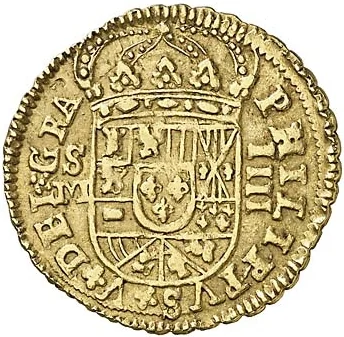
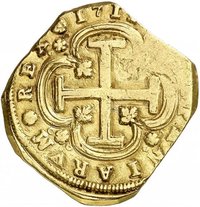
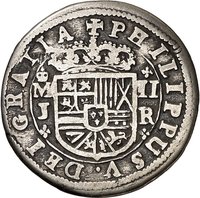
Obverse
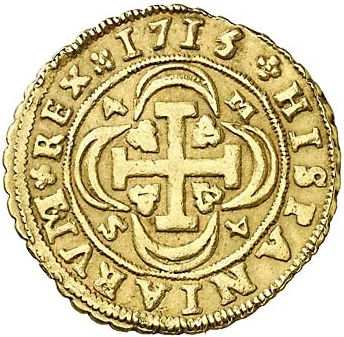
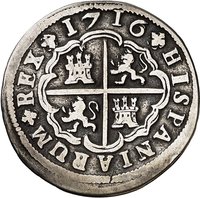
Reverse
Edge
Categories
| Symbols> Coat of Arms |
| Symbol> Cross |
Mints
| Name | Mark |
|---|---|
| Royal Mint of Seville | S |
Mintings
| Year | Mint Mark | Mintage | Quality | Collection |
|---|---|---|---|---|
| 1712 | SM | — | ||
| 1713 | SM | — | ||
| 1715 | SM | — |
Historical background
In 1712, Spain’s currency system was in a state of profound crisis and confusion, a direct consequence of the War of the Spanish Succession (1701-1714). The costly global conflict had drained the royal treasury, leading the Crown to repeatedly debase the coinage to pay for military expenses. The primary silver coin, the real, and the gold escudo saw their precious metal content drastically reduced, while the government issued vast quantities of low-value vellón (copper) coins to cover day-to-day expenditures. This resulted in severe inflation, as the face value of the circulating coinage far exceeded its intrinsic metal worth, undermining both domestic trade and international financial confidence.
The monetary landscape was further fragmented by regional disparities. While the Crown attempted to impose a unified system, older regional currencies like the Catalan lliura and Valencian lliura still circulated in areas loyal to the Habsburg Archduke Charles, who controlled much of the Crown of Aragon. Meanwhile, in Castile, which remained loyal to the Bourbon Philip V, the debased royal coinage dominated. This division meant that Spain lacked a single, reliable currency, complicating commerce not just internationally but within the kingdom itself. The influx of even more copper currency in 1711 and 1712 exacerbated the collapse of vellón's value, leading to popular discontent and a effective breakdown in the pricing system.
Ultimately, the currency chaos of 1712 was a symptom of the broader struggle for the Spanish throne. Philip V’s eventual victory the following year would set the stage for major Bourbon reforms. The first task was monetary stabilization, leading to the pivotal decree of 1715 that initiated a sweeping recoinage. This reform retired the debased and chaotic currency of the war years, including the discredited vellón, and established a new, unified silver real and gold escudo based on stricter Castilian standards, laying the foundation for 18th-century financial recovery.
The monetary landscape was further fragmented by regional disparities. While the Crown attempted to impose a unified system, older regional currencies like the Catalan lliura and Valencian lliura still circulated in areas loyal to the Habsburg Archduke Charles, who controlled much of the Crown of Aragon. Meanwhile, in Castile, which remained loyal to the Bourbon Philip V, the debased royal coinage dominated. This division meant that Spain lacked a single, reliable currency, complicating commerce not just internationally but within the kingdom itself. The influx of even more copper currency in 1711 and 1712 exacerbated the collapse of vellón's value, leading to popular discontent and a effective breakdown in the pricing system.
Ultimately, the currency chaos of 1712 was a symptom of the broader struggle for the Spanish throne. Philip V’s eventual victory the following year would set the stage for major Bourbon reforms. The first task was monetary stabilization, leading to the pivotal decree of 1715 that initiated a sweeping recoinage. This reform retired the debased and chaotic currency of the war years, including the discredited vellón, and established a new, unified silver real and gold escudo based on stricter Castilian standards, laying the foundation for 18th-century financial recovery.
✨ Legendary