

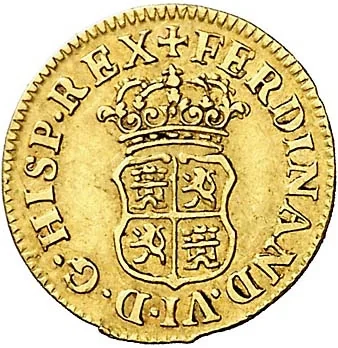
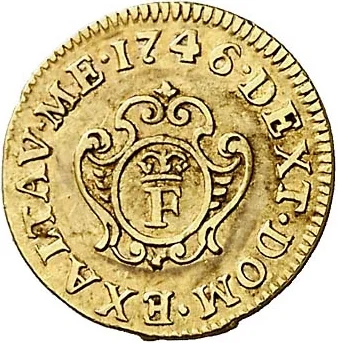
½ escudo – Spain
Add to wishlist
Non-circulating coins
Commemoration: Proclamation
Spain
Obverse
Reverse
Description:
Crowned F monogram of Ferdinand VI.
Inscription:
DEXT · DOM · EXALTAV · ME · 1746
Script: Latin
Edge
Categories
| Symbols> Coat of Arms |
| Symbols> Monogram |
Mints
| Name | Mark |
|---|---|
| Royal Mint of Madrid | — |
Mintings
| Year | Mint Mark | Mintage | Quality | Collection |
|---|---|---|---|---|
| 1746 | — | — |
Historical background
In 1746, Spain's currency situation was a complex and troubled legacy of the early Bourbon monarchs, particularly Philip V (r. 1700-1746), who died that very year. The state finances were strained by decades of nearly continuous warfare, including the War of Spanish Succession and the ongoing War of Austrian Succession. To meet these colossal expenses, the crown had repeatedly resorted to debasement—reducing the silver content in coins like the real and the peso—and to issuing vast amounts of vellón, a cheap copper or billon (copper-silver alloy) coinage. This created a dysfunctional bimetallic system where the overvalued and abundant vellón drove the full-bodied silver and gold coins out of circulation (Gresham's Law), causing inflation and hampering both domestic commerce and international trade.
The monetary chaos was not merely metallic. The crown also relied heavily on short-term debt instruments and anticipations of future tax revenue from the American colonies, leading to frequent liquidity crises. Furthermore, the kingdom was not a unified monetary zone; regional mints operated with some autonomy, and older coins from the Habsburg era still circulated alongside newer, lighter Bourbon issues, confusing valuations. The system's fragility was exposed by the fact that much of Spain's substantial silver imports from its American colonies were immediately dispatched to northern Europe to pay for war debts and trade deficits, rather than strengthening the domestic coinage.
Ferdinand VI, ascending to the throne in 1746, inherited this precarious financial landscape. His reign would mark a shift towards much-needed peace and fiscal reform. One of his government's primary goals became the stabilization of the currency, a process that would culminate in the serious attempts at monetary reform in the 1750s, seeking to restore confidence by addressing the vellón glut and standardizing the coinage. Thus, 1746 represents a low point of monetary disorder but also a turning point, as the new king recognized that lasting political stability was impossible without sound money.
The monetary chaos was not merely metallic. The crown also relied heavily on short-term debt instruments and anticipations of future tax revenue from the American colonies, leading to frequent liquidity crises. Furthermore, the kingdom was not a unified monetary zone; regional mints operated with some autonomy, and older coins from the Habsburg era still circulated alongside newer, lighter Bourbon issues, confusing valuations. The system's fragility was exposed by the fact that much of Spain's substantial silver imports from its American colonies were immediately dispatched to northern Europe to pay for war debts and trade deficits, rather than strengthening the domestic coinage.
Ferdinand VI, ascending to the throne in 1746, inherited this precarious financial landscape. His reign would mark a shift towards much-needed peace and fiscal reform. One of his government's primary goals became the stabilization of the currency, a process that would culminate in the serious attempts at monetary reform in the 1750s, seeking to restore confidence by addressing the vellón glut and standardizing the coinage. Thus, 1746 represents a low point of monetary disorder but also a turning point, as the new king recognized that lasting political stability was impossible without sound money.
✨ Legendary