

¼ Thaler – Hungary
Hungary

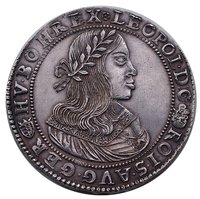
Obverse
Description:
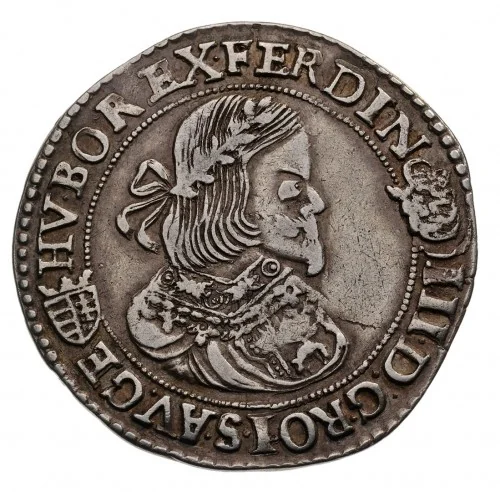
Right-facing laureate bust with curls, necklace, and Golden Fleece ring; behind neck, crowned double Hungarian shield; on right, Madonna on crescent.
Inscription:
FERDIN : · III · D · G · RO · I · S · AV ·GE · HV · BO · REX ·
Script: Latin
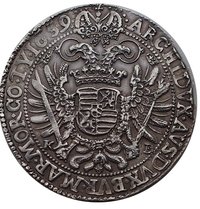
Reverse
Description:
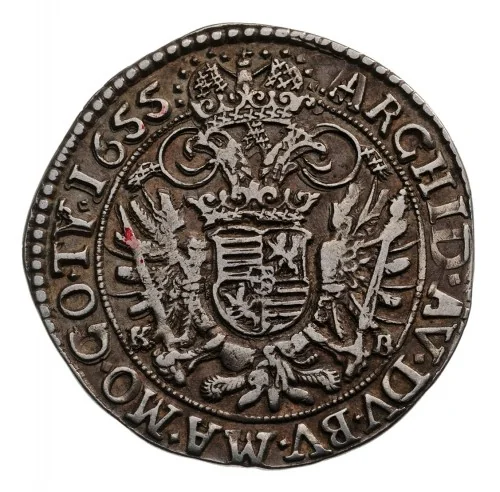
Imperial double-headed eagle with sword and scepter, holding a quartered shield (Árpád stripes, Bohemian lion twice, Árpád stripes) with an inescutcheon of Austrian and Burgundian arms. Mintmark below.
Inscription:
ARCHID.AV.DV.BV.MA.MO.CO.TY.1650
Script: Latin
Edge
Plain
Mints
| Name | Mark |
|---|---|
| Kremnica | KB |
Mintings
| Year | Mint Mark | Mintage | Quality | Collection |
|---|---|---|---|---|
| 1639 | K-B | — | ||
| 1640 | K-B | — | ||
| 1641 | K-B | — | ||
| 1642 | K-B | — | ||
| 1643 | K-B | — | ||
| 1644 | K-B | — | ||
| 1645 | K-B | — | ||
| 1647 | K-B | — | ||
| 1648 | K-B | — | ||
| 1649 | K-B | — | ||
| 1650 | K-B | — | ||
| 1651 | K-B | — | ||
| 1652 | K-B | — | ||
| 1653 | K-B | — | ||
| 1654 | K-B | — | ||
| 1655 | K-B | — | ||
| 1656 | K-B | — |
Historical background
In 1639, the Kingdom of Hungary, then part of the Habsburg Monarchy, was mired in a severe and protracted currency crisis. The primary issue was the widespread debasement of the silver denarius (also called the krajcár or kreutzer), the fundamental small-denomination coin used in daily transactions. The Habsburg authorities, particularly under Emperor Ferdinand II and later Ferdinand III, repeatedly reduced the silver content of these coins to finance the enormous costs of the ongoing Thirty Years' War (1618-1648) and their parallel conflicts with the Ottoman Empire. This resulted in a flood of poor-quality, lightweight coins circulating within Hungary, driving older, full-value coins out of circulation or into hoards.
The situation was exacerbated by a chaotic monetary environment. Alongside the official debased coins, a multitude of foreign currencies—such as Polish groszy, Ottoman akçe, and various German thalers—circulated, creating confusion in trade. Furthermore, the mining towns of Upper Hungary (modern Slovakia), which were crucial silver producers, often minted their own local versions of coins, adding to the inconsistency. This led to a classic case of Gresham's Law, where "bad money drives out good," crippling local markets and causing rampant price inflation, particularly for basic goods, which severely impacted the peasantry and soldiers paid in the devalued currency.
This monetary instability had profound social and political consequences. It eroded trust in the central authority in Vienna and fueled deep resentment among the Hungarian estates, who saw the debasement as a unilateral and exploitative Habsburg policy. The resulting economic hardship contributed to the growing tensions that would later erupt in the Wesselényi conspiracy against the Habsburgs. Thus, the currency situation of 1639 was not merely an economic issue but a key factor in the deteriorating relationship between the Hungarian nobility and the Crown, weakening the kingdom's internal cohesion during a period of constant military threat.
The situation was exacerbated by a chaotic monetary environment. Alongside the official debased coins, a multitude of foreign currencies—such as Polish groszy, Ottoman akçe, and various German thalers—circulated, creating confusion in trade. Furthermore, the mining towns of Upper Hungary (modern Slovakia), which were crucial silver producers, often minted their own local versions of coins, adding to the inconsistency. This led to a classic case of Gresham's Law, where "bad money drives out good," crippling local markets and causing rampant price inflation, particularly for basic goods, which severely impacted the peasantry and soldiers paid in the devalued currency.
This monetary instability had profound social and political consequences. It eroded trust in the central authority in Vienna and fueled deep resentment among the Hungarian estates, who saw the debasement as a unilateral and exploitative Habsburg policy. The resulting economic hardship contributed to the growing tensions that would later erupt in the Wesselényi conspiracy against the Habsburgs. Thus, the currency situation of 1639 was not merely an economic issue but a key factor in the deteriorating relationship between the Hungarian nobility and the Crown, weakening the kingdom's internal cohesion during a period of constant military threat.
✨ Legendary