

5 Florins – Hungary
Hungary

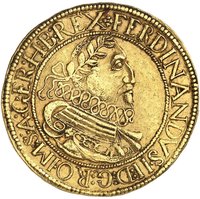
Obverse
Description:
Laureate bust right with curls, necklace, and Golden Fleece collar.
Inscription:
FERDINANDVS · II · D · G · RO · IM · S · AV · GER · H · BO · REX *
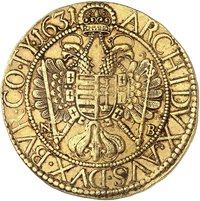
Reverse
Description:
Imperial crown above a double-headed eagle holding sword and scepter, bearing the full Hungarian coat of arms (Árpád stripes and double cross on triple hill) without a central shield. No mintmark.
Inscription:
ARCHI · DVX · AVS · DVX · BVR · CO · TYROLIS · 1634 ·
Edge
Plain
Mints
| Name | Mark |
|---|---|
| Baia Mare | NB |
Mintings
| Year | Mint Mark | Mintage | Quality | Collection |
|---|---|---|---|---|
| 1631 | N-B | — | ||
| 1634 | — | — |
Historical background
In 1631, Hungary existed as a fractured kingdom divided into three parts: Royal Hungary under Habsburg rule in the north and west, Ottoman-occupied central Hungary, and the semi-independent Principality of Transylvania in the east. This political fragmentation directly caused a chaotic and multi-layered currency situation. The Habsburgs, ruling from Vienna, introduced standardized silver thalers and kreutzers from their mints, which were intended to be the official coins of Royal Hungary. However, the ongoing Long War (1593-1606) and subsequent conflicts had drained silver reserves, leading to repeated debasements—reducing the precious metal content—which eroded public trust in these official issues.
Alongside the debased imperial coinage, a flood of underweight and inferior foreign coins, particularly Turkish akçe from the occupied territories and Polish and Dutch coins from trade, circulated widely. This created a complex and unstable exchange environment where merchants and moneychangers had to constantly assess the actual metal value of each coin. Most critically for the local economy, the Hungarian estates and even individual cities, like Kassa (Košice), often exercised their historic rights to mint their own lower-denomination coins (denars and polturas) to facilitate everyday small trade, adding another layer of variety and inconsistency.
The result was a monetary system in a state of persistent disorder and inflation, where the nominal value of a coin rarely matched its intrinsic metal worth. This currency confusion hampered commerce, complicated tax collection for the Habsburg treasury, and placed a heavy burden on the peasantry, who paid taxes in sound coin but often received wages in debased currency. Thus, the monetary landscape of 1631 Hungary was not one of unified policy but a contested and unreliable marketplace of metal, reflecting the kingdom's deep political divisions and the economic strain of its frontier position between two great empires.
Alongside the debased imperial coinage, a flood of underweight and inferior foreign coins, particularly Turkish akçe from the occupied territories and Polish and Dutch coins from trade, circulated widely. This created a complex and unstable exchange environment where merchants and moneychangers had to constantly assess the actual metal value of each coin. Most critically for the local economy, the Hungarian estates and even individual cities, like Kassa (Košice), often exercised their historic rights to mint their own lower-denomination coins (denars and polturas) to facilitate everyday small trade, adding another layer of variety and inconsistency.
The result was a monetary system in a state of persistent disorder and inflation, where the nominal value of a coin rarely matched its intrinsic metal worth. This currency confusion hampered commerce, complicated tax collection for the Habsburg treasury, and placed a heavy burden on the peasantry, who paid taxes in sound coin but often received wages in debased currency. Thus, the monetary landscape of 1631 Hungary was not one of unified policy but a contested and unreliable marketplace of metal, reflecting the kingdom's deep political divisions and the economic strain of its frontier position between two great empires.
✨ Legendary