

1 mark – Sweden
Add to wishlist
Sweden
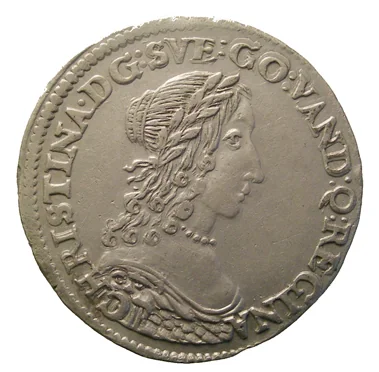
Obverse
Description:
Queen Christina's laureate bust right in circle, legend outside. (Type VII)
Inscription:
CHRISTINA·D G:SVE:GO:VAND:Q:REGINA·
Script: Latin
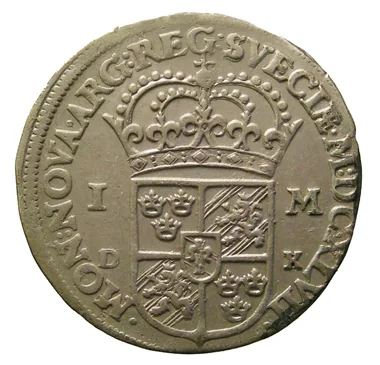
Reverse
Description:
Shield divides value and mintmark within circular legend. (Type VII)
Inscription:
·MON·NOVA·ARG:REG:SVECIÆ·M:DCXLVII·
1 M
D K
1 M
D K
Script: Latin
Edge
Mintings
| Year | Mint Mark | Mintage | Quality | Collection |
|---|---|---|---|---|
| 1646 | — | — | ||
| 1647 | — | — | ||
| 1648 | — | — |
Historical background
In 1646, Sweden was in the midst of the "Stormaktstiden" (the Era of Great Power), a period of immense military and political expansion. This ambition was funded by a complex and strained monetary system. The kingdom operated on a bimetallic standard of silver and copper, but the demands of the Thirty Years' War, in which Sweden was a dominant Protestant force, placed enormous fiscal pressure on the state. To finance its vast armies, the government, under the guardianship of Queen Christina and Chancellor Axel Oxenstierna, increasingly resorted to debasement—reducing the silver content in coins while maintaining their face value—and the exploitation of its rich copper resources at the Falun mine.
The result was a chaotic and inflationary currency environment. Alongside the official riksdaler, a wide variety of domestic and foreign coins circulated, including lightweight Swedish örtug and öre, German thalers, and Polish coins, all with fluctuating values. Most significantly, Sweden had pioneered the world's first successful copper plate money (plåtmynt) in 1644. These were large, cumbersome sheets of pure copper, stamped with a denomination, intended to back the currency with the nation's tangible wealth. A single ten-daler plate could weigh over 20 kilograms, making everyday transactions impractical and symbolizing a system where the intrinsic commodity value overshadowed its function as a convenient medium of exchange.
Consequently, the currency situation in 1646 was defined by tension between imperial ambition and economic reality. The state's need for war financing led to monetary experiments and debasement, undermining confidence and creating a cumbersome multi-metal system. While the copper plates showcased Sweden's natural resources, they also highlighted the strain of its great power status, setting the stage for future reforms, including the eventual establishment of Europe's first central bank, the Riksbank, in 1668, to bring order to the monetary chaos.
The result was a chaotic and inflationary currency environment. Alongside the official riksdaler, a wide variety of domestic and foreign coins circulated, including lightweight Swedish örtug and öre, German thalers, and Polish coins, all with fluctuating values. Most significantly, Sweden had pioneered the world's first successful copper plate money (plåtmynt) in 1644. These were large, cumbersome sheets of pure copper, stamped with a denomination, intended to back the currency with the nation's tangible wealth. A single ten-daler plate could weigh over 20 kilograms, making everyday transactions impractical and symbolizing a system where the intrinsic commodity value overshadowed its function as a convenient medium of exchange.
Consequently, the currency situation in 1646 was defined by tension between imperial ambition and economic reality. The state's need for war financing led to monetary experiments and debasement, undermining confidence and creating a cumbersome multi-metal system. While the copper plates showcased Sweden's natural resources, they also highlighted the strain of its great power status, setting the stage for future reforms, including the eventual establishment of Europe's first central bank, the Riksbank, in 1668, to bring order to the monetary chaos.

✨ Legendary