

10 Bahts (Office of the Comptroller General) – Thailand
Circulating commemorative coins
Commemoration: 100th Anniversary of the Office of the Comptroller General
Thailand
Context
Year: 1990
Thai Year: 2533
Issuer: Thailand 
Ruler: Bhumibol Adulyadej
Currency:
(since 1897)
Demonetized: Yes
Total mintage: 300,000
Material
References
Y: #Click to copy to clipboard236
Numista: #12240
Value
Exchange value: 10 THB = $0.32
Obverse
Description:
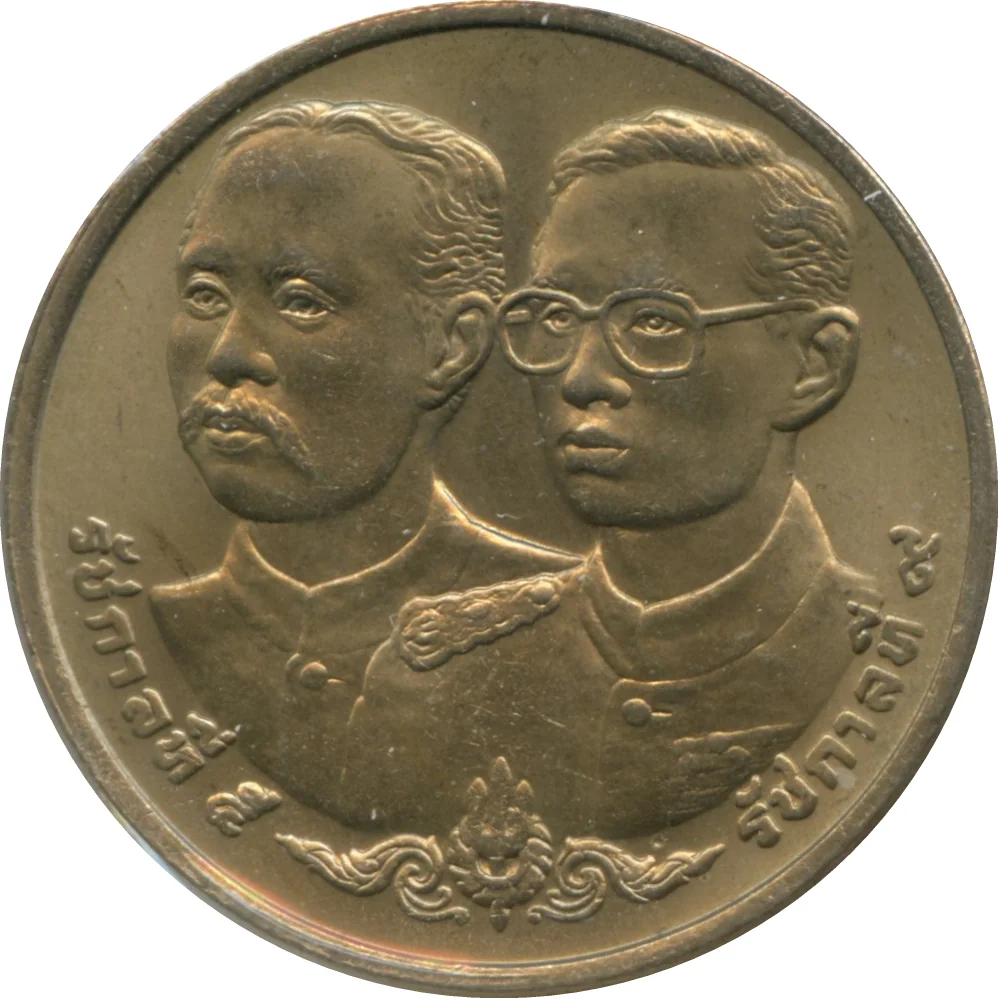
Busts of Kings Chulalongkorn and Bhumibol Adulyadej, with the Chakri dynasty emblem below.
Inscription:
รัชกาลที่ ๕ รัชกาลที่ ๙
Translation:
The Fifth Reign The Ninth Reign
Language: Thai
Reverse
Description:
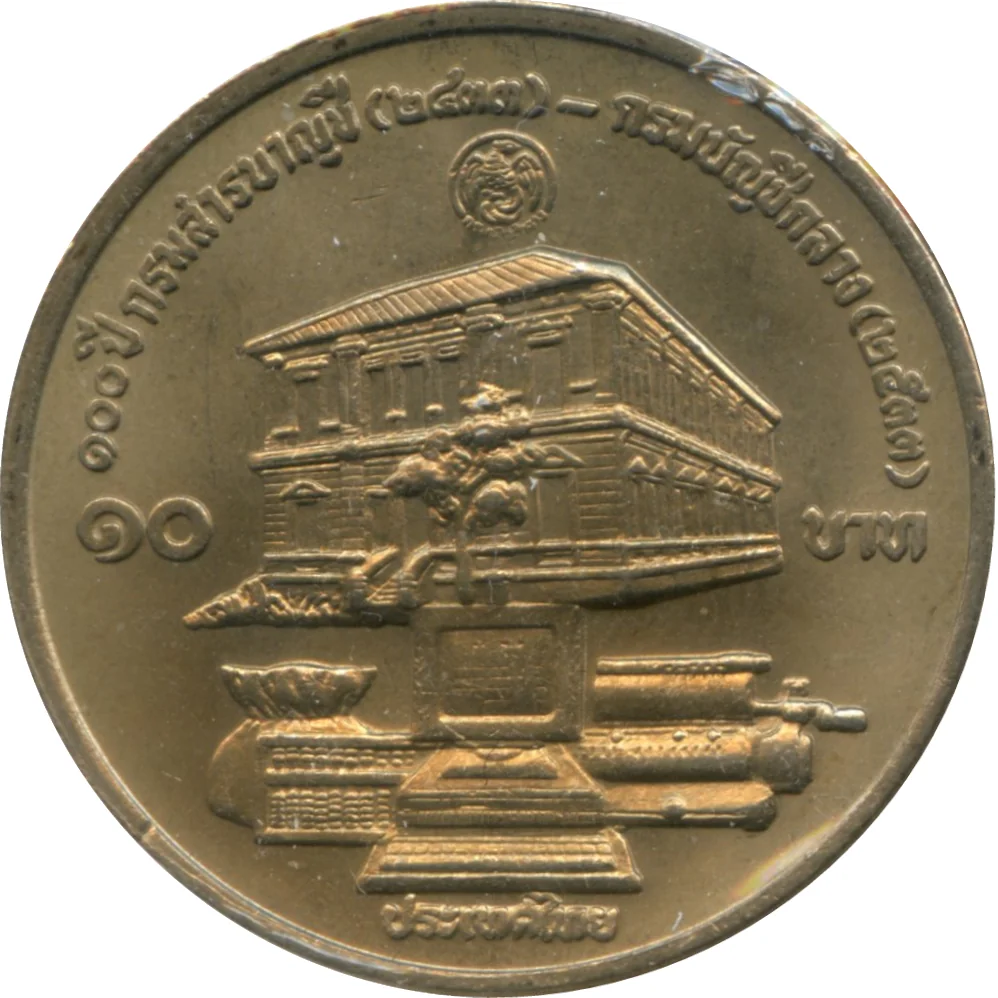
Seal above the Department of Account building, with a money bag, abacus, calculator, and computer below.
Inscription:
๑๐๐ ปี กรมสารบาญชี(๒๔๓๓)-กรมบัญชีกลาง(๒๕๓๓)
๑๐ บาท
ประเทศไทย
๑๐ บาท
ประเทศไทย
Translation:
One Hundred Years Department of the Comptroller-General's (2433)-Comptroller General's Department (2533)
Ten Baht
Thailand
Ten Baht
Thailand
Language: Thai
Edge
Reeded
Mintings
| Year | Mint Mark | Mintage | Quality | Collection |
|---|---|---|---|---|
| 1990 | — | 300,000 |
Historical background
In 1990, Thailand's currency, the baht, operated under a de facto fixed exchange rate regime, pegged to a basket of currencies dominated by the US dollar. This system, managed by the Bank of Thailand (BOT), provided a crucial anchor for stability during a period of remarkable economic transformation. The country was in the midst of an export-led boom, with GDP growth exceeding 10% that year, fueled by foreign direct investment and a rapidly expanding manufacturing sector. The stable baht was instrumental in this growth, providing predictability for international trade and investment, and helping to control inflation.
However, this stability came with significant policy constraints. To maintain the peg, the BOT had to align its interest rates with those of the United States and actively intervene in foreign exchange markets, buying or selling dollars to manage the baht's value. This limited the central bank's ability to use monetary policy independently to address domestic economic conditions. Furthermore, the peg, combined with Thailand's high interest rates, attracted substantial short-term capital inflows ("hot money"), which began to inflate asset bubbles, particularly in real estate and the stock market.
Beneath the surface of strong macroeconomic indicators, vulnerabilities were accumulating. The large-scale capital inflows led to a rapid expansion of private debt, much of it denominated in US dollars due to lower offshore interest rates, creating a dangerous currency mismatch on private sector balance sheets. While the crisis famously erupted in 1997, the seeds of the subsequent collapse—including an overvalued fixed exchange rate, a fragile financial sector, and excessive external borrowing—were being sown during the boom years of the early 1990s, with the rigid currency regime at the very center of these mounting risks.
However, this stability came with significant policy constraints. To maintain the peg, the BOT had to align its interest rates with those of the United States and actively intervene in foreign exchange markets, buying or selling dollars to manage the baht's value. This limited the central bank's ability to use monetary policy independently to address domestic economic conditions. Furthermore, the peg, combined with Thailand's high interest rates, attracted substantial short-term capital inflows ("hot money"), which began to inflate asset bubbles, particularly in real estate and the stock market.
Beneath the surface of strong macroeconomic indicators, vulnerabilities were accumulating. The large-scale capital inflows led to a rapid expansion of private debt, much of it denominated in US dollars due to lower offshore interest rates, creating a dangerous currency mismatch on private sector balance sheets. While the crisis famously erupted in 1997, the seeds of the subsequent collapse—including an overvalued fixed exchange rate, a fragile financial sector, and excessive external borrowing—were being sown during the boom years of the early 1990s, with the rigid currency regime at the very center of these mounting risks.

🌟 Limited