

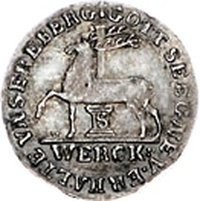
Obverse
Description:
Deer ahead.
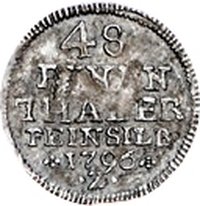
Reverse
Description:
Helmeted arms flanking a date, with EHAZ beneath.
Inscription:
E.H.A.Z.
Edge
Mints
| Name | Mark |
|---|---|
| Stolberg, Harz | — |
Mintings
| Year | Mint Mark | Mintage | Quality | Collection |
|---|---|---|---|---|
| 1793 | — | — |
Historical background
In 1793, the currency situation in the County of Stolberg-Stolberg and the County of Stolberg-Rossla was complex, reflecting the fragmented political landscape of the Holy Roman Empire. Both counties, though ruled by different branches of the same family, operated within overlapping monetary spheres. Officially, they fell under the monetary authority of the Kreis (Imperial Circle) of Upper Saxony, which promoted the use of the Reichsthaler as a standard accounting unit. However, the practical circulation of coinage was dominated by the larger and more economically influential neighboring states, particularly the Electorate of Saxony, whose abundant Saxon Thaler and Groschen coins were the de facto medium of daily trade.
This reliance on external coinage created inherent instability and inconvenience. The counts of Stolberg had limited minting rights, producing small-change pfennigs and occasional commemorative issues, but these were insufficient for larger transactions. Consequently, a multitude of foreign coins circulated, including Prussian, Brunswick, and even Austrian currency, each with fluctuating values. This necessitated constant use of money changers and published exchange tables (Kurszettel), as prices and debts often had to be calculated in the abstract Reichsthaler while payment was made in a mix of physical coins with varying silver content and legitimacy.
The year 1793 placed this fragile system under growing strain. The inflationary pressures of the ongoing French Revolutionary Wars were beginning to affect Central Europe, disrupting trade and the flow of silver. While not yet in a state of crisis, the monetary environment in the two Stolberg counties was characterized by dependency and complexity. It was a system ill-equipped for the coming economic upheavals of the Napoleonic era, which would soon dissolve the Holy Roman Empire itself and force a fundamental reorganization of German currency.
This reliance on external coinage created inherent instability and inconvenience. The counts of Stolberg had limited minting rights, producing small-change pfennigs and occasional commemorative issues, but these were insufficient for larger transactions. Consequently, a multitude of foreign coins circulated, including Prussian, Brunswick, and even Austrian currency, each with fluctuating values. This necessitated constant use of money changers and published exchange tables (Kurszettel), as prices and debts often had to be calculated in the abstract Reichsthaler while payment was made in a mix of physical coins with varying silver content and legitimacy.
The year 1793 placed this fragile system under growing strain. The inflationary pressures of the ongoing French Revolutionary Wars were beginning to affect Central Europe, disrupting trade and the flow of silver. While not yet in a state of crisis, the monetary environment in the two Stolberg counties was characterized by dependency and complexity. It was a system ill-equipped for the coming economic upheavals of the Napoleonic era, which would soon dissolve the Holy Roman Empire itself and force a fundamental reorganization of German currency.

✨ Legendary