

500 lire – Vatican City
Add to wishlist
Non-circulating coins
Commemoration: Sede Vacante
Vatican City
Context
Year: 1963
Issuer: Vatican City
Period:
Currency:
(1929—2001)
Demonetized: Yes
Total mintage: 200,000
Material
References
KM: #
Numista: #12217
Value
Exchange value: 500 VAL
Bullion value: $23.02
Obverse
Description:
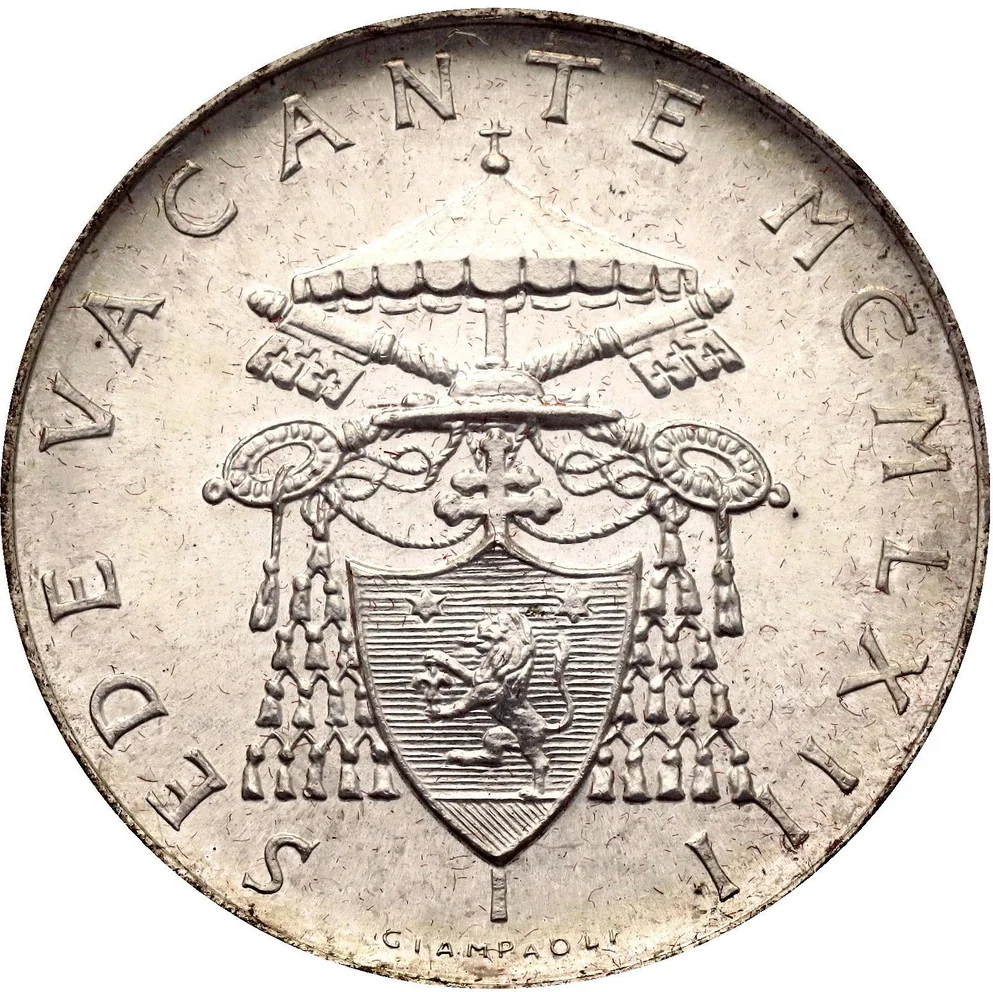
Arms of Cardinal Aloisi-Masella during the Sede Vacante.
Inscription:
SEDE VACANTE MCMLXIII
GIAMPAOLI
GIAMPAOLI
Script: Latin
Engraver: Pietro Giampaoli
Reverse
Description:
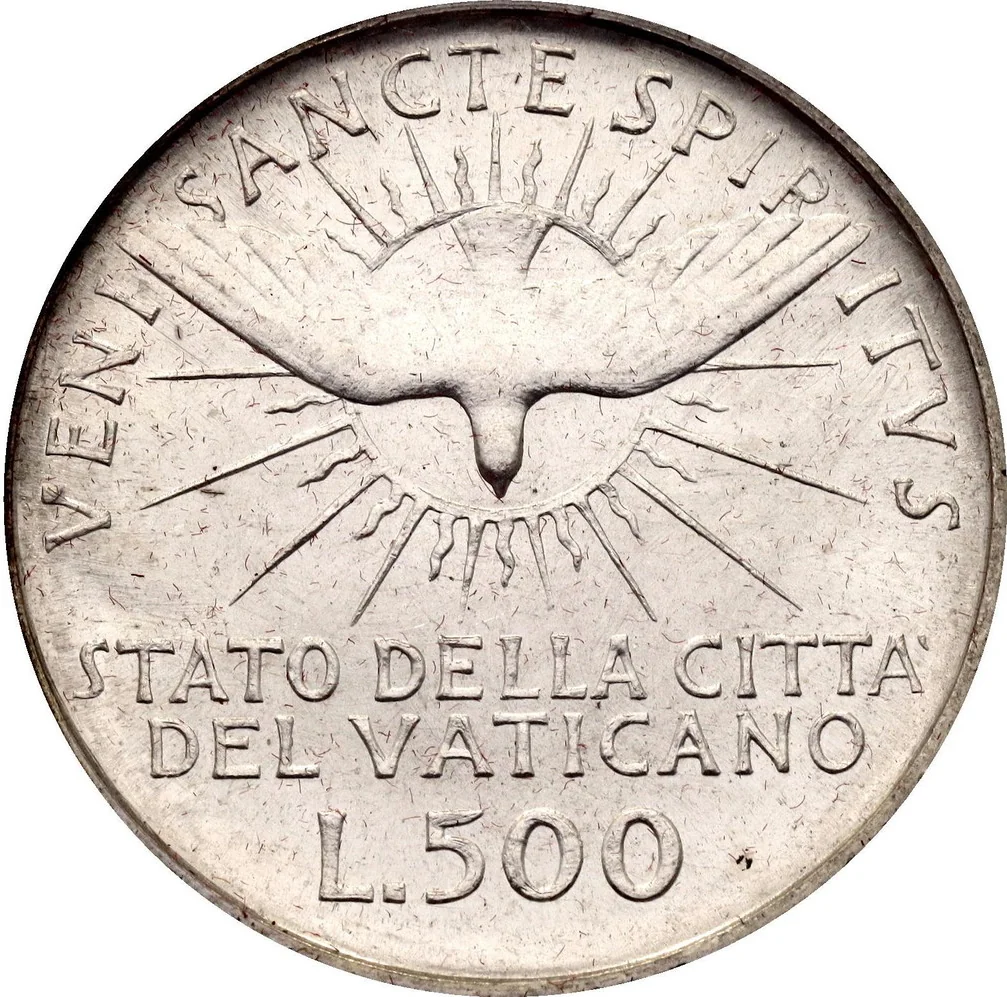
Dove splits sun over worth.
Inscription:
VENI SANCTE SPIR ITVS
STATO DELLA CITTA'
DEL VATICANO
L. 500
STATO DELLA CITTA'
DEL VATICANO
L. 500
Script: Latin
Engraver: Pietro Giampaoli
Edge
Lettered
Legend:
STATO DELLA CITTA DEL VATICANO
Mintings
| Year | Mint Mark | Mintage | Quality | Collection |
|---|---|---|---|---|
| 1963 | — | 200,000 |
Historical background
In 1963, Vatican City's currency situation was intrinsically linked to its unique status as an independent city-state surrounded by Italy. Following the 1929 Lateran Treaty, which established its sovereignty, the Vatican was granted the right to issue its own currency. However, in practice, it operated within the Italian monetary sphere. The Vatican lira was at parity with the Italian lira and was legal tender only within its tiny borders, creating a de facto monetary union where the two currencies circulated interchangeably. The Holy See's coinage, featuring the image of Pope John XXIII until his death in June 1963, was minted primarily for commemorative and symbolic purposes for collectors, rather than for daily economic transactions.
The year 1963 was one of transition, both pontifically and financially. Following the death of Pope John XXIII and the election of Pope Paul VI in June, new coinage bearing the new pontiff's effigy began preparation. Economically, the Vatican's currency was entirely backed by and dependent on the Italian lira, and its ability to issue coins was governed by a convention with the Italian government, limiting the quantity. The state's revenue streams—from museum admissions, postage stamps, and publications—were largely collected in Italian lire, further cementing this dependency.
This arrangement, while stable, highlighted the Vatican's practical economic integration with Italy despite its political independence. The currency system of 1963 was not one of autonomous monetary policy but of symbolic sovereignty, with the issuance of distinct coins serving as an assertion of statehood. This framework would remain largely unchanged until the introduction of the Euro in 2002, when Vatican City, through a special agreement with the European Union and Italy, gained the right to issue its own limited series of euro coins.
The year 1963 was one of transition, both pontifically and financially. Following the death of Pope John XXIII and the election of Pope Paul VI in June, new coinage bearing the new pontiff's effigy began preparation. Economically, the Vatican's currency was entirely backed by and dependent on the Italian lira, and its ability to issue coins was governed by a convention with the Italian government, limiting the quantity. The state's revenue streams—from museum admissions, postage stamps, and publications—were largely collected in Italian lire, further cementing this dependency.
This arrangement, while stable, highlighted the Vatican's practical economic integration with Italy despite its political independence. The currency system of 1963 was not one of autonomous monetary policy but of symbolic sovereignty, with the issuance of distinct coins serving as an assertion of statehood. This framework would remain largely unchanged until the introduction of the Euro in 2002, when Vatican City, through a special agreement with the European Union and Italy, gained the right to issue its own limited series of euro coins.
🌱 Fairly Common