

500 gourdes (Duvalier's Presidency - Full Employment) – Haiti
Add to wishlist
Non-circulating coins
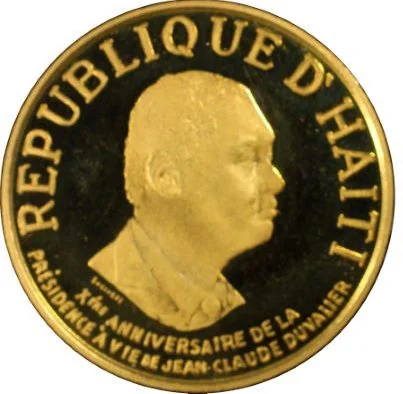
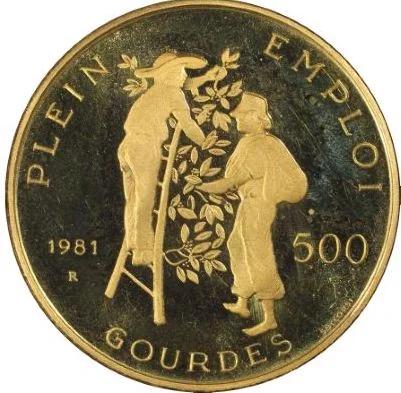
Commemoration: 10th Anniversary of Duvalier's Presidency - Full Employment
Haiti
Obverse
Description:
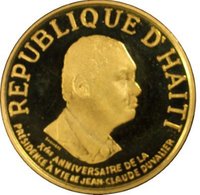
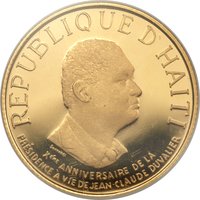
Jean Claude bust facing right, country name above.
Inscription:
REPUBLIQUE D'HAITI
SOCCORSI
XÉME ANNIVERSAIRE DE LA
PRÉSIDENCE À VIE DE JEAN-CLAUDE DUVALLER
SOCCORSI
XÉME ANNIVERSAIRE DE LA
PRÉSIDENCE À VIE DE JEAN-CLAUDE DUVALLER
Translation:
REPUBLIC OF HAITI
AID
TENTH ANNIVERSARY OF THE
LIFE PRESIDENCY OF JEAN-CLAUDE DUVALIER
AID
TENTH ANNIVERSARY OF THE
LIFE PRESIDENCY OF JEAN-CLAUDE DUVALIER
Script: Latin
Engraver: Maurizio Soccorsi
Reverse
Description:
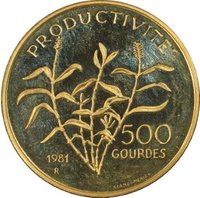
Harvesters: date left, denomination right.
Inscription:
PLEIN EMPLOI
1981
R
500
GOURDES
SOCCORSI
1981
R
500
GOURDES
SOCCORSI
Translation:
FULL EMPLOYMENT
1981
R
500
GOURDES
AID
1981
R
500
GOURDES
AID
Script: Latin
Language: French
Engraver: Maurizio Soccorsi
Edge
Reeded
Mints
| Name | Mark |
|---|---|
| Rome | R |
Mintings
| Year | Mint Mark | Mintage | Quality | Collection |
|---|---|---|---|---|
| 1981 | R | — | Proof |
Historical background
In 1981, Haiti’s currency situation was characterized by a rigid and unsustainable dual-exchange rate system, a legacy of the Duvalier regime's economic management. Officially, the Haitian gourde was pegged to the U.S. dollar at a fixed rate of 5 gourdes to $1. This "official rate" was reserved for government transactions, essential imports like oil, and the operations of a small elite with political connections. Alongside this, a vastly different "parallel" or black-market rate flourished, which by 1981 had depreciated to approximately 7 gourdes to $1, reflecting the severe overvaluation of the official currency.
This system created profound economic distortions. The overvalued official rate acted as a heavy subsidy for the privileged few who could access it, while it drained central bank reserves to maintain the unsustainable peg. For the vast majority of Haitians and regular businesses, the costly parallel market was the reality, making imported goods and necessities prohibitively expensive. The disparity between the two rates also encouraged corruption and rent-seeking, as lucrative profits could be made by obtaining dollars at the official rate and selling them on the black market.
The underlying pressures were immense. Haiti's economy was struggling with declining agricultural exports, rising trade deficits, and minimal foreign investment outside of assembly manufacturing in Port-au-Prince. The structural imbalances, coupled with the drain on reserves from defending the gourde, made the dual-rate system untenable. By the end of 1981, Haiti was under growing pressure from international financial institutions, particularly the International Monetary Fund (IMF), to unify its exchange rates and devalue the gourde as a condition for further assistance—a painful adjustment that would eventually occur in the following years.
This system created profound economic distortions. The overvalued official rate acted as a heavy subsidy for the privileged few who could access it, while it drained central bank reserves to maintain the unsustainable peg. For the vast majority of Haitians and regular businesses, the costly parallel market was the reality, making imported goods and necessities prohibitively expensive. The disparity between the two rates also encouraged corruption and rent-seeking, as lucrative profits could be made by obtaining dollars at the official rate and selling them on the black market.
The underlying pressures were immense. Haiti's economy was struggling with declining agricultural exports, rising trade deficits, and minimal foreign investment outside of assembly manufacturing in Port-au-Prince. The structural imbalances, coupled with the drain on reserves from defending the gourde, made the dual-rate system untenable. By the end of 1981, Haiti was under growing pressure from international financial institutions, particularly the International Monetary Fund (IMF), to unify its exchange rates and devalue the gourde as a condition for further assistance—a painful adjustment that would eventually occur in the following years.
✨ Legendary