

2 Fen – People's Republic of China
China
Context
Years: 1956–2000
Country: China 
Issuer: People's Republic of China
Period:
(since 1949)
Currency:
(since 1955)
Total mintage: 4,368,485
Material
References
KM: #Click to copy to clipboard2
Numista: #1221
Value
Exchange value: 0.02 CNY = $0.00
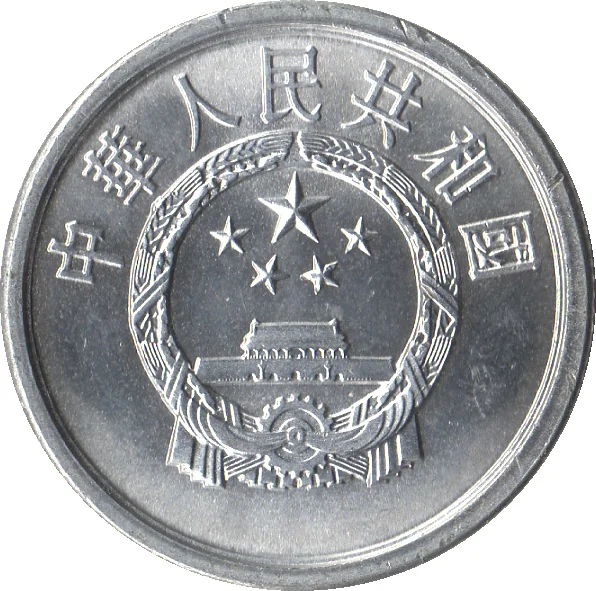
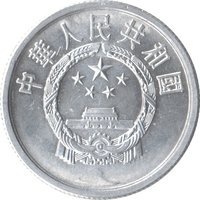
Obverse
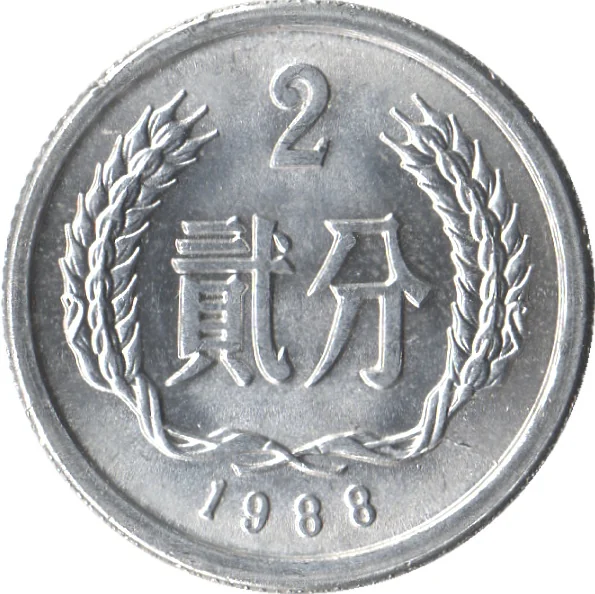
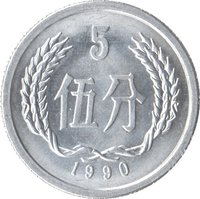
Reverse
Edge
Milled
Categories
| Symbols> Coat of Arms |
| Symbol> Wreath |
Mintings
| Year | Mint Mark | Mintage | Quality | Collection |
|---|---|---|---|---|
| 1956 | — | — | ||
| 1959 | — | — | ||
| 1960 | — | — | ||
| 1961 | — | — | ||
| 1962 | — | — | ||
| 1963 | — | — | ||
| 1964 | — | — | ||
| 1971 | — | — | ||
| 1974 | — | — | ||
| 1975 | — | — | ||
| 1976 | — | — | ||
| 1977 | — | 360,000 | ||
| 1978 | — | — | ||
| 1979 | — | — | ||
| 1980 | — | 10,000 | Proof | |
| 1980 | — | — | ||
| 1981 | — | — | ||
| 1981 | — | 10,000 | Proof | |
| 1982 | — | — | ||
| 1982 | — | 10,000 | Proof | |
| 1983 | — | 1,790,000 | ||
| 1983 | — | 10,000 | Proof | |
| 1984 | — | 10,000 | Proof | |
| 1984 | — | 1,963,000 | ||
| 1985 | — | — | ||
| 1985 | — | 4,825 | Proof | |
| 1986 | — | — | ||
| 1986 | — | 660 | Proof | |
| 1987 | — | — | ||
| 1988 | — | — | ||
| 1989 | — | — | ||
| 1990 | — | — | ||
| 1991 | — | — | ||
| 1991 | — | 20,000 | Proof | |
| 1992 | — | — | ||
| 1992 | — | 20,000 | Proof | |
| 1993 | — | — | In sets | |
| 1993 | — | 20,000 | Proof | |
| 1994 | — | — | In sets | |
| 1994 | — | 20,000 | Proof | |
| 1995 | — | 20,000 | Proof | |
| 1995 | — | — | In sets | |
| 1996 | — | — | In sets | |
| 1996 | — | 20,000 | Proof | |
| 1997 | — | — | In sets | |
| 1997 | — | 20,000 | Proof | |
| 1998 | — | — | In sets | |
| 1998 | — | 20,000 | Proof | |
| 1999 | — | — | In sets | |
| 1999 | — | 20,000 | Proof | |
| 2000 | — | — | In sets | |
| 2000 | — | 20,000 | Proof |
Historical background
In 1956, the currency situation in the People's Republic of China was one of consolidated stability under a fully centralized command economy. The key reform had already occurred in 1955 with the introduction of the Second Series of the Renminbi (RMB), which replaced the first, highly inflationary version at a rate of 10,000:1. This revaluation was a decisive and successful measure to restore public confidence in the currency after the hyperinflation of the civil war and early reconstruction period. By 1956, the new RMB, with its stable value, was firmly established as the sole legal tender, facilitating state planning and control.
This monetary stability was a direct function of the state's complete control over the financial system. The year 1956 fell within the First Five-Year Plan (1953-1957), a period of intensive Soviet-style industrialization and the collectivization of agriculture. All banking was nationalized under the People's Bank of China, which acted as both a central bank and a commercial monopoly. The currency's value and supply were administratively set to serve the physical output targets of the state plan, not market forces. Money primarily functioned as an accounting unit for state enterprises and a medium for distributing wages to the urban workforce, while rural economies remained largely non-monetized.
However, 1956 also marked a moment of subtle tension within this controlled system. It was the year of the "Hundred Flowers Campaign," a brief period where Mao Zedong encouraged intellectual criticism. Some economists, influenced by the discussions, cautiously questioned the rigidities of the Soviet model, including aspects of financial policy. While no immediate currency reforms followed, the debates of 1956 hinted at underlying inefficiencies. The stability was thus somewhat artificial, maintained by strict price controls, rationing for key goods, and the isolation of China from the international financial system—a fortress of stability built for, and dependent upon, the overarching planned economy.
This monetary stability was a direct function of the state's complete control over the financial system. The year 1956 fell within the First Five-Year Plan (1953-1957), a period of intensive Soviet-style industrialization and the collectivization of agriculture. All banking was nationalized under the People's Bank of China, which acted as both a central bank and a commercial monopoly. The currency's value and supply were administratively set to serve the physical output targets of the state plan, not market forces. Money primarily functioned as an accounting unit for state enterprises and a medium for distributing wages to the urban workforce, while rural economies remained largely non-monetized.
However, 1956 also marked a moment of subtle tension within this controlled system. It was the year of the "Hundred Flowers Campaign," a brief period where Mao Zedong encouraged intellectual criticism. Some economists, influenced by the discussions, cautiously questioned the rigidities of the Soviet model, including aspects of financial policy. While no immediate currency reforms followed, the debates of 1956 hinted at underlying inefficiencies. The stability was thus somewhat artificial, maintained by strict price controls, rationing for key goods, and the isolation of China from the international financial system—a fortress of stability built for, and dependent upon, the overarching planned economy.
🌱 Very Common