

1 florin – Hungary
Add to wishlist
Hungary
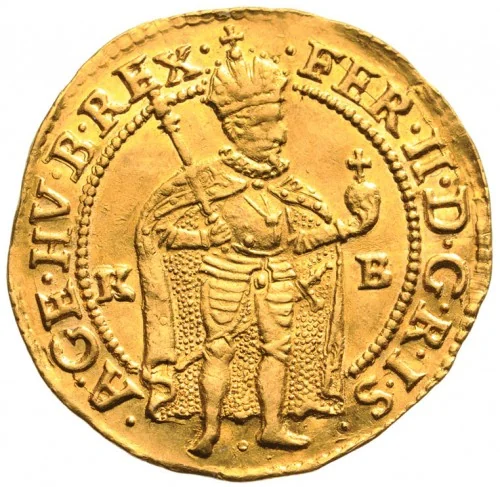
Obverse
Description:
King stands right, robed, holding orb and scepter; mintmark within inner circle.
Inscription:
FERD · D · G · R · I · S · · A · GE · HV B · REX
K B
K B
Script: Latin
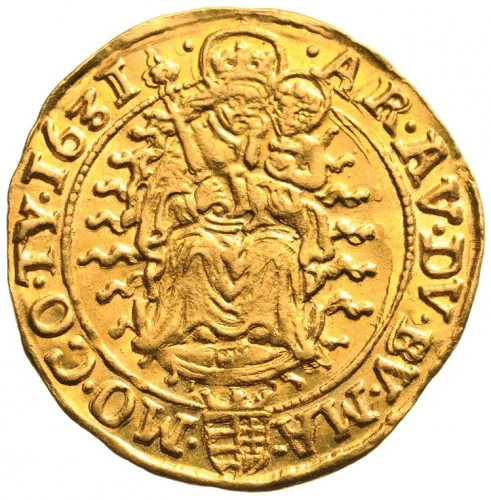
Reverse
Description:
Madonna and child on a crescent, holding a scepter, above the crowned Hungarian coat of arms.
Inscription:
AR · AV · DV · BV · MA · MO · CO · TY · 1631 ·
Script: Latin
Edge
Plain
Mints
| Name | Mark |
|---|---|
| Kremnica | KB |
Mintings
| Year | Mint Mark | Mintage | Quality | Collection |
|---|---|---|---|---|
| 1621 | K-B | — | ||
| 1622 | K-B | — | ||
| 1623 | K-B | — | ||
| 1624 | K-B | — | ||
| 1625 | K-B | — | ||
| 1626 | K-B | — | ||
| 1627 | K-B | — | ||
| 1628 | K-B | — | ||
| 1629 | K-B | — | ||
| 1630 | K-B | — | ||
| 1631 | K-B | — | ||
| 1632 | K-B | — | ||
| 1633 | K-B | — | ||
| 1634 | K-B | — | ||
| 1635 | K-B | — | ||
| 1636 | K-B | — | ||
| 1637 | K-B | — |
Historical background
In 1621, Hungary found itself in a complex and deteriorating currency situation, deeply entangled with the political and military strife of the early Thirty Years' War. The kingdom was divided into three parts: Royal Hungary under Habsburg rule, the Ottoman-occupied central territories, and the semi-independent Principality of Transylvania. This fragmentation led to a chaotic monetary landscape where various mints, under different authorities, produced coins of wildly varying quality and value. The Habsburgs, perpetually short of funds for their war efforts, engaged in severe currency debasement, drastically reducing the silver content of the coins minted in Royal Hungary, such as the denarius.
The primary consequence was a devastating inflation, as the public quickly lost trust in the official currency. This period saw the widespread circulation of underweight and clipped coins, alongside older, full-value coins that were hoarded, in a classic example of Gresham's Law ("bad money drives out good"). The situation was exacerbated by the influx of even more debased copper kreuzers from Austria, which flooded the market and further distorted prices. For the peasantry and soldiers paid in this worthless money, the result was impoverishment and social unrest, as the nominal face value of coins became detached from their actual metal worth.
Furthermore, the Ottoman-occupied regions and Transylvania operated with their own monetary systems, adding to the confusion for trade across the fragmented kingdom. Transylvania, under the ambitious Prince Gábor Bethlen (who was campaigning in Royal Hungary that very year), minted its own coins, while Turkish akçe and thalers from German states also circulated. This multi-currency environment, dominated by debased coinage, crippled local economies, undermined long-distance commerce, and placed a severe burden on the population, making the monetary chaos of 1621 a critical facet of the broader crisis facing Hungary in the early 17th century.
The primary consequence was a devastating inflation, as the public quickly lost trust in the official currency. This period saw the widespread circulation of underweight and clipped coins, alongside older, full-value coins that were hoarded, in a classic example of Gresham's Law ("bad money drives out good"). The situation was exacerbated by the influx of even more debased copper kreuzers from Austria, which flooded the market and further distorted prices. For the peasantry and soldiers paid in this worthless money, the result was impoverishment and social unrest, as the nominal face value of coins became detached from their actual metal worth.
Furthermore, the Ottoman-occupied regions and Transylvania operated with their own monetary systems, adding to the confusion for trade across the fragmented kingdom. Transylvania, under the ambitious Prince Gábor Bethlen (who was campaigning in Royal Hungary that very year), minted its own coins, while Turkish akçe and thalers from German states also circulated. This multi-currency environment, dominated by debased coinage, crippled local economies, undermined long-distance commerce, and placed a severe burden on the population, making the monetary chaos of 1621 a critical facet of the broader crisis facing Hungary in the early 17th century.

✨ Legendary