

5 Thalers – Hungary
Hungary

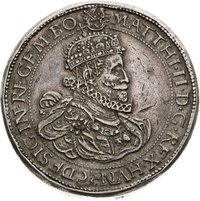
Obverse
Description:
Armored bust of Matthias facing right, wearing the Hungarian crown and Golden Fleece necklace. Madonna and Child above crown in background.
Inscription:
MATTHI·II·D·G·REX·HVN·ZC· DESIG·IN·REGEM·BO·
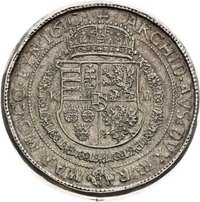
Reverse
Description:
Fourfold coat of arms with a central Austrian-Burgundian shield, KB mintmark, surrounded by the Order of the Golden Fleece necklace. Date in legend.
Inscription:
ARCHID·AVS·DVX·BVR·MAR·MO·CO·TYR·1610·
K B
K B
Edge
Plain
Mints
| Name | Mark |
|---|---|
| Kremnica | KB |
Mintings
| Year | Mint Mark | Mintage | Quality | Collection |
|---|---|---|---|---|
| 1610 | K-B | — |
Historical background
In 1610, the Kingdom of Hungary was in a state of severe monetary crisis, a direct consequence of the ongoing Long Turkish War (1593-1606) and the internal strife of the Habsburg-ruled region. The immense cost of the conflict had drained the royal treasury, leading the Habsburg court in Vienna to repeatedly debase the silver coinage, primarily the thaler and its fractional coins like the krajcár. By lowering the silver content while maintaining the same face value, the authorities created short-term revenue but triggered rampant inflation and a collapse in public trust in the currency.
This debasement created a chaotic multi-currency environment. High-quality older coins, foreign thalers (like the Reichsthaler), and the new, inferior domestic issues circulated simultaneously. Following Gresham's Law, "bad money drove out good," as people hoarded the older, purer coins and used the debased ones for payments. This was exacerbated by widespread counterfeiting and the circulation of clipped coins. The resulting price instability severely burdened the population, particularly soldiers paid in weak currency and peasants paying feudal dues, fueling social discontent.
The situation was further complicated by Hungary's tripartite division. The Ottoman-occupied central territories, the Habsburg-controlled Royal Hungary in the north and west, and the semi-independent Principality of Transylvania in the east each had differing degrees of monetary policy. While Royal Hungary suffered under Vienna's debasement, Transylvania, under Prince Gabriel Bethlen, maintained a more stable currency, creating distinct monetary zones. Thus, in 1610, Hungary's currency was not a unified system but a destabilized and fragmented one, representing the broader economic and political fragility of the realm in the early 17th century.
This debasement created a chaotic multi-currency environment. High-quality older coins, foreign thalers (like the Reichsthaler), and the new, inferior domestic issues circulated simultaneously. Following Gresham's Law, "bad money drove out good," as people hoarded the older, purer coins and used the debased ones for payments. This was exacerbated by widespread counterfeiting and the circulation of clipped coins. The resulting price instability severely burdened the population, particularly soldiers paid in weak currency and peasants paying feudal dues, fueling social discontent.
The situation was further complicated by Hungary's tripartite division. The Ottoman-occupied central territories, the Habsburg-controlled Royal Hungary in the north and west, and the semi-independent Principality of Transylvania in the east each had differing degrees of monetary policy. While Royal Hungary suffered under Vienna's debasement, Transylvania, under Prince Gabriel Bethlen, maintained a more stable currency, creating distinct monetary zones. Thus, in 1610, Hungary's currency was not a unified system but a destabilized and fragmented one, representing the broader economic and political fragility of the realm in the early 17th century.
✨ Legendary