

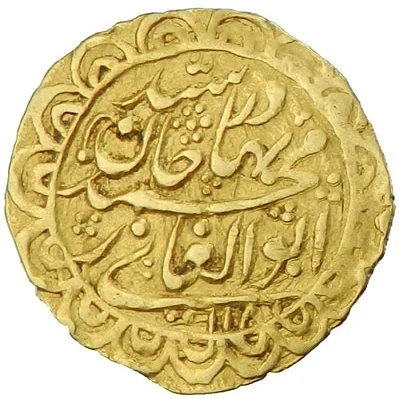
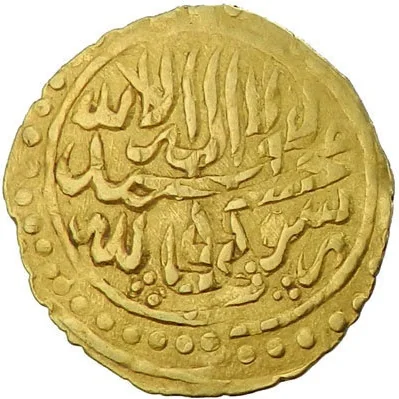
Tilla – Janid dynasty
Context
Year: 1768
Islamic (Hijri) Year: 1181
Country: Central Asia
Issuer: Janid dynasty
Currency:
Demonetized: Yes
Material
References
KM: #Click to copy to clipboard42.2
Numista: #166598
Value
Bullion value: $767.15
Mintings
| Year | Mint Mark | Mintage | Quality | Collection |
|---|---|---|---|---|
| 1768 | — | — |
Historical background
The Janid dynasty, also known as the Ashtarkhanids, ruled the Khanate of Bukhara in 1768 during a period of severe political and economic decline. The currency system, inherited from earlier Timurid and Shaybanid rulers, was in a state of profound crisis. The primary silver coin, the tanga, had been drastically debased over decades, with its silver content often reduced by more than half through the addition of copper. This was a direct result of the dynasty's weakening central authority, which led to provincial governors and powerful amirs striking their own inferior coins to fund local armies and projects, creating a chaotic monetary landscape with multiple, unreliable issues in circulation.
This rampant debasement triggered classic symptoms of monetary instability: price inflation, a loss of public trust in coinage, and a retreat to barter for local trade. Long-distance commerce, the lifeblood of the Silk Road region, was severely hampered as merchants struggled to assess the value of disparate coinages. Furthermore, the scarcity of high-quality silver dirhams or tangas disrupted the state's own revenue collection, as tax farmers paid the treasury in debased coin, creating a vicious cycle that further drained the khanate's wealth and undermined its ability to maintain infrastructure or a professional army.
The currency chaos of 1768 was both a cause and a symptom of the Janid dynasty's impending collapse. It reflected the loss of sovereign control over the economy and the fracturing of political power. Within a few years, this instability would culminate in the rise of the Manghit chiefs, who would soon overthrow the last Janid khan and establish a new dynasty. The monetary disarray, therefore, stands as a key indicator of the terminal weakness of Janid rule, demonstrating how the integrity of a realm's coinage is inextricably linked to the strength and legitimacy of its government.
This rampant debasement triggered classic symptoms of monetary instability: price inflation, a loss of public trust in coinage, and a retreat to barter for local trade. Long-distance commerce, the lifeblood of the Silk Road region, was severely hampered as merchants struggled to assess the value of disparate coinages. Furthermore, the scarcity of high-quality silver dirhams or tangas disrupted the state's own revenue collection, as tax farmers paid the treasury in debased coin, creating a vicious cycle that further drained the khanate's wealth and undermined its ability to maintain infrastructure or a professional army.
The currency chaos of 1768 was both a cause and a symptom of the Janid dynasty's impending collapse. It reflected the loss of sovereign control over the economy and the fracturing of political power. Within a few years, this instability would culminate in the rise of the Manghit chiefs, who would soon overthrow the last Janid khan and establish a new dynasty. The monetary disarray, therefore, stands as a key indicator of the terminal weakness of Janid rule, demonstrating how the integrity of a realm's coinage is inextricably linked to the strength and legitimacy of its government.
✨ Legendary