

⅛ Ducat – Austrian Empire
Austria
Context
Year: 1729
Country: Austria 
Issuer: Austrian Empire
Ruler: Charles VI
Currency:
(1520—1754)
Demonetized: Yes
References
KM: #Click to copy to clipboard1631
Numista: #166472
Value
Bullion value: $70.69
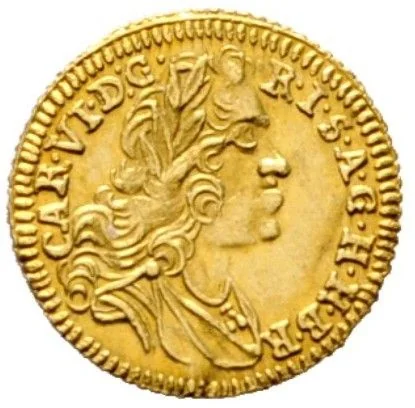
Obverse
Description:
Portrait right. Legend at 8h.
Inscription:
CAR VI D G // R I S A G HI H B R
Script: Latin
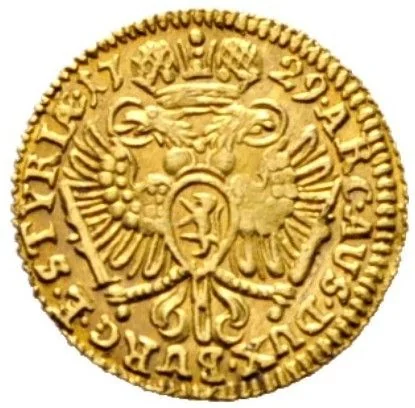
Reverse
Description:
Imperial eagle with central Styrian shield, date divided above.
Inscription:
ARC AUS DUX BURG Et STYRIÆ date
Script: Latin
Edge
Mints
| Name | Mark |
|---|---|
| Graz | — |
Mintings
| Year | Mint Mark | Mintage | Quality | Collection |
|---|---|---|---|---|
| 1729 | — | — |
Historical background
In 1729, the currency situation within the Habsburg-ruled Austrian Empire was complex and fragmented, reflecting the empire's diverse and decentralized political structure. There was no single, unified imperial currency. Instead, the monetary landscape was a patchwork of various silver Taler and gold Gulden coins, whose values and silver content could differ significantly between the Empire's core Austrian, Bohemian, and Hungarian lands. This system created persistent challenges for trade and state finance, as exchange rates between these regional currencies were fluid and often disputed.
The period was one of relative stability under Emperor Charles VI, who was focused on securing the Pragmatic Sanction to ensure his daughter Maria Theresa's succession. However, the monetary system still bore the scars of the earlier Wiener Stadtbanco (Vienna City Bank) crisis of 1702, which had exposed the dangers of paper money and credit without sufficient bullion backing. While the state bank was being cautiously restored, primary transactions relied on specie. A key unit of account was the Conventionsgulden, established by the 1753 convention but foreshadowed in earlier attempts at standardization, which aimed to create a common standard for the silver gulden across several German states, including parts of the Habsburg realm.
Ultimately, the currency situation of 1729 was characterized by a tense balance. The state's need for revenue to fund its military and court, particularly amid ongoing tensions with the Ottoman Empire, pressured the monetary system. Yet, major reforms were stalled by the estates and the complexities of the Habsburg composite monarchy. The system functioned, but its inefficiencies and vulnerabilities were clear, setting the stage for the more pressing fiscal and monetary crises that would confront Maria Theresa in the decades to follow, ultimately necessitating sweeping reforms.
The period was one of relative stability under Emperor Charles VI, who was focused on securing the Pragmatic Sanction to ensure his daughter Maria Theresa's succession. However, the monetary system still bore the scars of the earlier Wiener Stadtbanco (Vienna City Bank) crisis of 1702, which had exposed the dangers of paper money and credit without sufficient bullion backing. While the state bank was being cautiously restored, primary transactions relied on specie. A key unit of account was the Conventionsgulden, established by the 1753 convention but foreshadowed in earlier attempts at standardization, which aimed to create a common standard for the silver gulden across several German states, including parts of the Habsburg realm.
Ultimately, the currency situation of 1729 was characterized by a tense balance. The state's need for revenue to fund its military and court, particularly amid ongoing tensions with the Ottoman Empire, pressured the monetary system. Yet, major reforms were stalled by the estates and the complexities of the Habsburg composite monarchy. The system functioned, but its inefficiencies and vulnerabilities were clear, setting the stage for the more pressing fiscal and monetary crises that would confront Maria Theresa in the decades to follow, ultimately necessitating sweeping reforms.

✨ Legendary