

2 Thalers – Austrian Empire
Austria
Context
Year: 1607
Country: Austria 
Issuer: Austrian Empire
Ruler: Rudolph II
Currency:
(1520—1754)
Demonetized: Yes
References
KM: #Click to copy to clipboard83
Numista: #161469
Value
Bullion value: $172.72
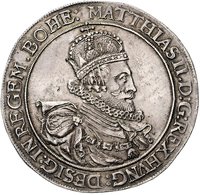
Obverse
Description:
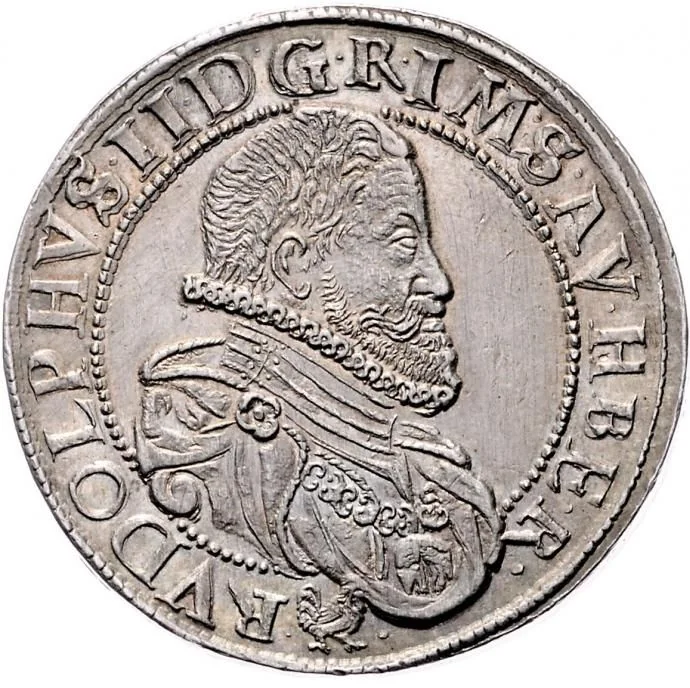
Right-facing portrait in beaded circle; rooster mint mark below bust.
Inscription:
RVDOLPHVS II D G R IM S AV H B E R
Script: Latin
Engraver: Andreas Handl
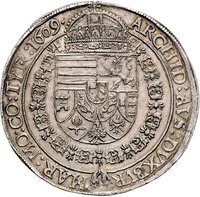
Reverse
Description:
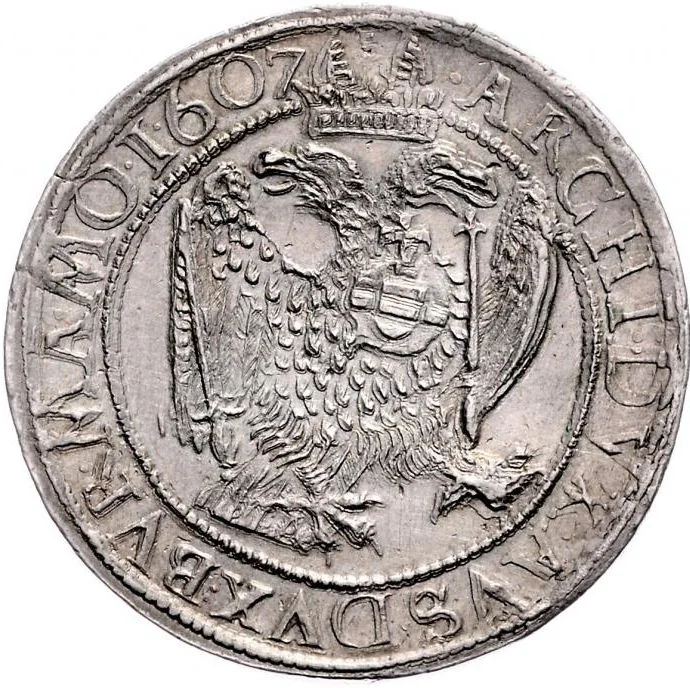
Eagle stepping right, bearing a small Austrian shield.
Inscription:
ARCHIDVX AVS DVX BUR MA MO
Script: Latin
Edge
Plain
Mints
| Name | Mark |
|---|---|
| Münze Österreich | — |
Mintings
| Year | Mint Mark | Mintage | Quality | Collection |
|---|---|---|---|---|
| 1607 | — | — |
Historical background
In 1607, the Habsburg-ruled Austrian Empire was grappling with a severe and chronic monetary crisis rooted in the previous century. The primary issue was the relentless debasement of the coinage, particularly the small-denomination kreuzer used in everyday transactions. The Habsburgs, perennially short of funds due to massive military expenditures against the Ottoman Empire and internal conflicts, repeatedly reduced the silver content of their coins to mint more money from the same silver reserves. This created a classic "bad money drives out good" scenario (Gresham's Law), where older, higher-silver coins were hoarded or exported, leaving the economy flooded with unstable, poor-quality currency.
The situation was exacerbated by the empire's fragmented economic structure. While the Habsburg court in Vienna set official minting policies, numerous local mints operated by individual estates and territories often engaged in competitive debasement to raise their own revenues. This led to a bewildering variety of coins of differing values circulating simultaneously, crippling trade and creating widespread distrust. Prices, especially for basic goods, became highly volatile as merchants adjusted for the declining purchasing power of the coinage, causing significant hardship for the common population and soldiers paid in devalued currency.
Emperor Rudolf II, whose reign was marked by financial neglect and political instability, made attempts at reform. In 1607, his authorities were likely enforcing or contemplating new currency regulations, such as the Münzordnung (coinage ordinances), which aimed to standardize minting and recall the most debased coins. However, these measures were typically temporary and ineffective against the structural pressures of Habsburg finance. The fundamental problem—financing imperial ambitions without a coherent fiscal state—remained unsolved, ensuring that the monetary instability of 1607 was not an isolated event but a persistent feature of the early modern Austrian economy.
The situation was exacerbated by the empire's fragmented economic structure. While the Habsburg court in Vienna set official minting policies, numerous local mints operated by individual estates and territories often engaged in competitive debasement to raise their own revenues. This led to a bewildering variety of coins of differing values circulating simultaneously, crippling trade and creating widespread distrust. Prices, especially for basic goods, became highly volatile as merchants adjusted for the declining purchasing power of the coinage, causing significant hardship for the common population and soldiers paid in devalued currency.
Emperor Rudolf II, whose reign was marked by financial neglect and political instability, made attempts at reform. In 1607, his authorities were likely enforcing or contemplating new currency regulations, such as the Münzordnung (coinage ordinances), which aimed to standardize minting and recall the most debased coins. However, these measures were typically temporary and ineffective against the structural pressures of Habsburg finance. The fundamental problem—financing imperial ambitions without a coherent fiscal state—remained unsolved, ensuring that the monetary instability of 1607 was not an isolated event but a persistent feature of the early modern Austrian economy.
✨ Legendary