Logo Title
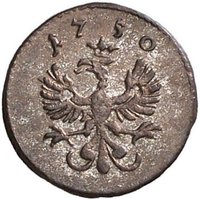
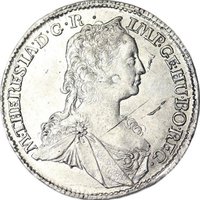
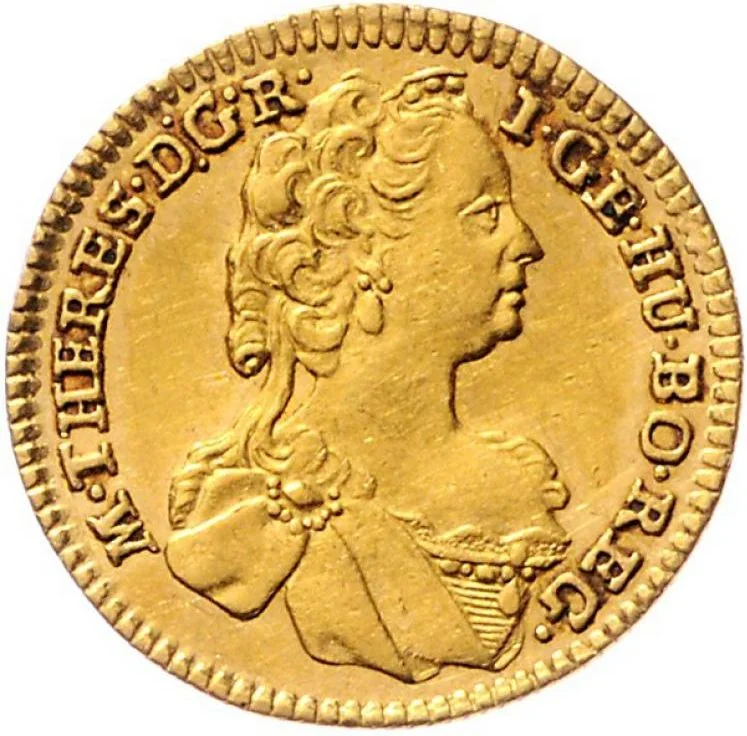
obverse
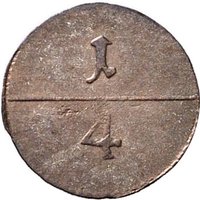
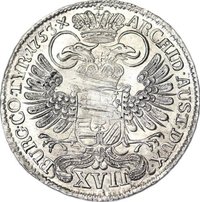
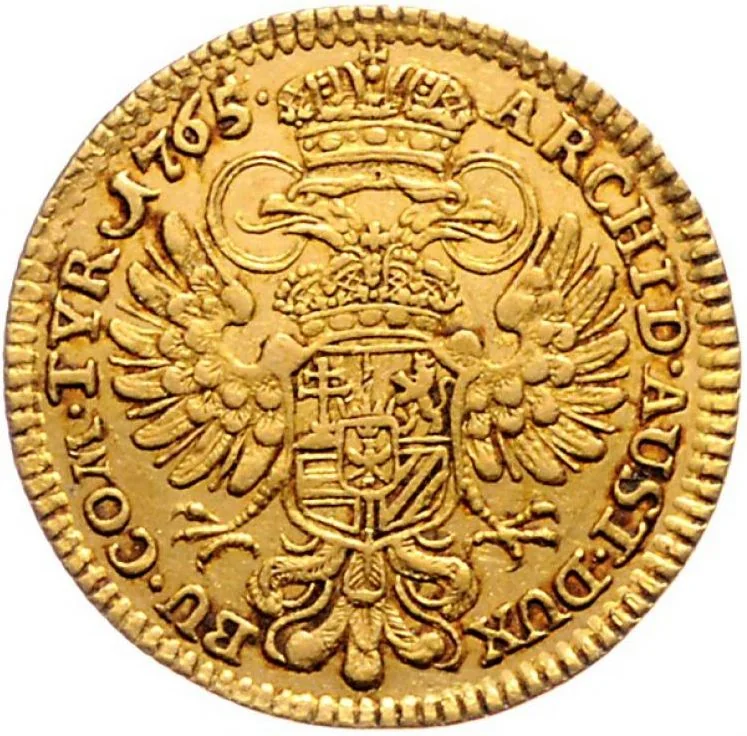
reverse
Auktionen Frühwald

1 Ducat – County of Tyrol

Austria
Context
Years: 1750–1765
Country: Austria Country flag
Currency:
Demonetized: Yes
Material
Weight: 3.47 g
Gold weight: 3.42 g
Shape: Round
Composition: 98.6% Gold
Magnetic: No
References
KM: #Click to copy to clipboard1783
Numista: #160879
Value
Bullion value: $568.22

Obverse

Description:
Portrait, unveiled, facing right.
Inscription:
M THERES D G R I GE HU BO REG
Script: Latin

Reverse

Description:
Double-headed imperial eagle bearing composite arms, with a central Tyrol shield.
Inscription:
ARCHID AUST DUX BU COM TYR 1765
Script: Latin

Edge

Plain

Mints

NameMark
Hall

Mintings

YearMint MarkMintageQualityCollection
1750
1752
1753
1754
1756
1760
1762
1764
1765

Historical background

In 1750, the County of Tyrol, a crown land of the Habsburg Monarchy, operated within a complex and often chaotic monetary landscape. The region did not have a single, unified currency but was a zone of circulation for multiple coinage systems. The official currency was based on the Convention standard, established across the Habsburg lands in 1753, which defined the value of the large silver Conventionsthaler. However, in daily practice, Tyrol's economy was dominated by the South German Kreutzer and Gulden system, due to the region's deep economic and cultural ties to the German states, particularly through the crucial trade routes over the Alpine passes.

This coexistence of systems led to persistent confusion and the problem of "bad money." Debased coins from neighboring states, especially small change like kreuzers, constantly flooded the market. Furthermore, Tyrol had a legacy of its own historic coinage, such as the Tyrolean Kreuzer and the gold Ducat, which remained in use but their values fluctuated against the newer Convention standards. The result was a marketplace where merchants and peasants alike had to be keenly aware of both the type and the physical condition of coins, with exchange rates between different forms of money being a daily negotiation and a source of potential loss.

The Habsburg state, under Empress Maria Theresa, was actively working to impose order. The great monetary reform of 1753, which created the unified Conventionsthaler, was a direct response to this chaos across all hereditary lands, including Tyrol. While the new standard provided a stable benchmark for large transactions and state finances, its full implementation at the local retail level was slow. Thus, in 1750, Tyrol was in a transitional period—caught between its fragmented, regional monetary past and the imposing, centralized system being enforced by Vienna, with the practical economy still relying on a cumbersome mix of old and new coins.
Legendary