

1⁄12 Riksdaler – Sweden
Sweden
Context
Year: 1811
Issuer: Sweden 
Ruler: Charles XIII
Currency:
(1798—1830)
Demonetized: Yes
Total mintage: 735,240
Material
References
KM: #Click to copy to clipboard583
Numista: #100281
Value
Bullion value: $6.11
Obverse
Reverse
Description:
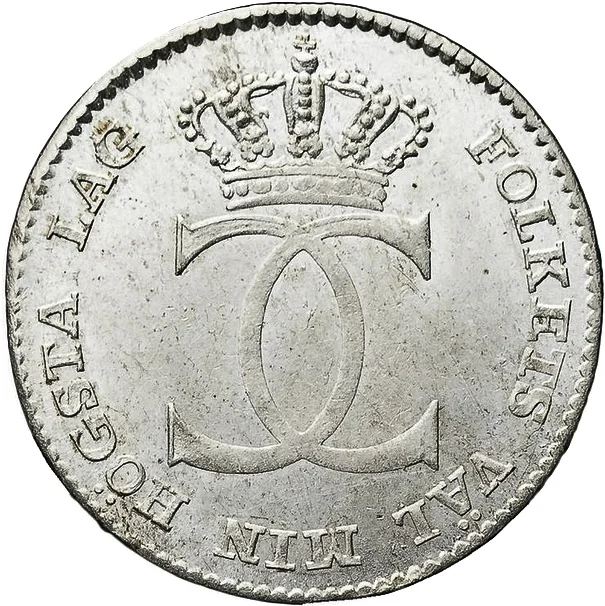
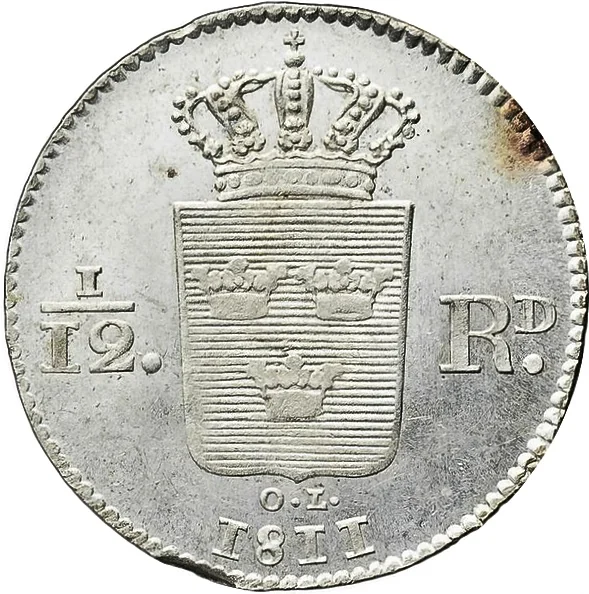
Shield with Sweden's three crowns divides value. Date and mintmark below.
Inscription:
1/12. RD.
O.L.
1811
O.L.
1811
Script: Latin
Edge
Mintings
| Year | Mint Mark | Mintage | Quality | Collection |
|---|---|---|---|---|
| 1811 | OL | 735,240 |
Historical background
In 1811, Sweden's currency situation was dire, a direct consequence of the nation's involvement in the Napoleonic Wars. To finance its military campaigns, including the costly loss of Finland to Russia in 1809, the state had resorted to the excessive printing of paper money known as riksdaler riksmynt. This led to severe inflation and a catastrophic loss of confidence in the currency, as its value in silver plummeted. The paper riksdaler traded at a deep discount against the silver riksdaler, creating a chaotic dual-system and effectively bankrupting the state.
In response to this crisis, the government, under the leadership of Chancellor Axel von Fersen, took radical action. In 1811, it established the Riksgäldskontoret (the National Debt Office) with a specific mandate to manage the debt and stabilize the currency. Its most significant and controversial measure was the realisationsplanen (the Realisation Plan), which aimed to recall and demonetize the devalued paper money. Holders of the old notes were forced to exchange them for new government bonds at only a fraction of their face value, a process that amounted to a state-enforced write-down of debt.
This policy, while fiscally necessary from the state's perspective, resulted in significant losses for many citizens, businesses, and institutions, causing widespread hardship and resentment. However, it laid the painful foundation for future stability. The 1811 reforms, though harsh, began the long process of restoring fiscal order, which would be solidified years later with the introduction of the stable riksdaler riksmynt based on a silver standard by the Riksbank in 1834.
In response to this crisis, the government, under the leadership of Chancellor Axel von Fersen, took radical action. In 1811, it established the Riksgäldskontoret (the National Debt Office) with a specific mandate to manage the debt and stabilize the currency. Its most significant and controversial measure was the realisationsplanen (the Realisation Plan), which aimed to recall and demonetize the devalued paper money. Holders of the old notes were forced to exchange them for new government bonds at only a fraction of their face value, a process that amounted to a state-enforced write-down of debt.
This policy, while fiscally necessary from the state's perspective, resulted in significant losses for many citizens, businesses, and institutions, causing widespread hardship and resentment. However, it laid the painful foundation for future stability. The 1811 reforms, though harsh, began the long process of restoring fiscal order, which would be solidified years later with the introduction of the stable riksdaler riksmynt based on a silver standard by the Riksbank in 1834.
✨ Legendary