

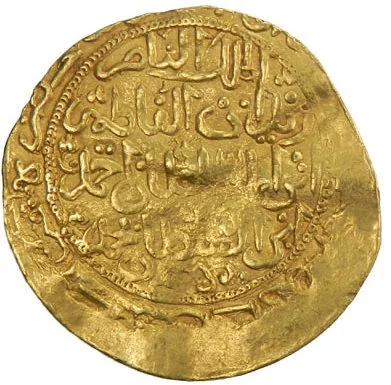
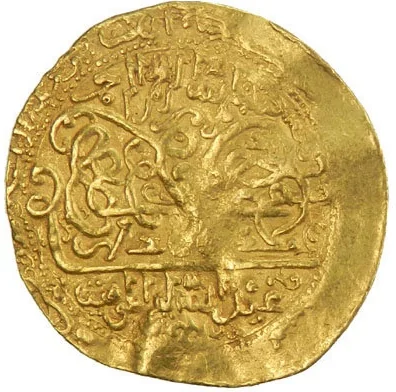
dinar – Morocco
Add to wishlist
Morocco
Context
Material
Weight: 4.5 g
Gold Weight:: 4.50 g
Shape: Irregular round
Composition: Gold
Magnetic: No
Technique: Hammered
References
KM: #
Numista: #157933
Value
Bullion value: $694.14
Mintings
| Year | Mint Mark | Mintage | Quality | Collection |
|---|---|---|---|---|
| 1605 | — | — | ||
| 1608 | — | — | ||
| 1609 | — | — | ||
| 1610 | — | — | ||
| 1611 | — | — |
Historical background
In 1605, the currency situation in the Saadian Sultanate of Morocco was complex and indicative of its position as a major crossroads of trade and empire. The state, under Sultan Zidan Abu Maali (r. 1603–1627), relied on a bimetallic system centered on the silver dirham and the gold dinar. However, the primary unit of account and most trusted coin for large-scale trade and state finance was the gold dinar, particularly the "benduqi" dinar, named after the Banu Duqali mint. Its stability was crucial, as Morocco sat at the nexus of trans-Saharan gold trade from West Africa and Mediterranean commerce with European powers.
This system faced significant external pressures. A flood of cheap Spanish-American silver into the global economy via Europe was devaluing silver coins, causing instability. More directly, the crown of Spain, following the 1604 peace treaty with England, redirected its military efforts and embarked on a campaign of economic warfare against Morocco. Spanish forces, occupying key coastal presidios like Larache and La Mamora, actively intercepted and embargoed Moroccan shipping. This stranglehold severely disrupted the Sultanate’s ability to mint coinage, as the import of precious metals—especially gold from the south and silver from European trade—was critically constrained.
Consequently, the period was marked by monetary scarcity and anxiety. The state's ability to pay its extensive military, particularly the elite ‘Abid al-Bukhari slave-soldiers and Berber contingents, was strained. This financial pressure contributed to internal unrest and challenged the Sultan's authority. In response, the Saadian administration would increasingly focus on controlling the vital sugar and saltpetre trade, while also turning to privateering from ports like Salé, to generate the bullion needed to stabilize the currency and fund the state’s ongoing struggles against both European incursions and internal rivals.
This system faced significant external pressures. A flood of cheap Spanish-American silver into the global economy via Europe was devaluing silver coins, causing instability. More directly, the crown of Spain, following the 1604 peace treaty with England, redirected its military efforts and embarked on a campaign of economic warfare against Morocco. Spanish forces, occupying key coastal presidios like Larache and La Mamora, actively intercepted and embargoed Moroccan shipping. This stranglehold severely disrupted the Sultanate’s ability to mint coinage, as the import of precious metals—especially gold from the south and silver from European trade—was critically constrained.
Consequently, the period was marked by monetary scarcity and anxiety. The state's ability to pay its extensive military, particularly the elite ‘Abid al-Bukhari slave-soldiers and Berber contingents, was strained. This financial pressure contributed to internal unrest and challenged the Sultan's authority. In response, the Saadian administration would increasingly focus on controlling the vital sugar and saltpetre trade, while also turning to privateering from ports like Salé, to generate the bullion needed to stabilize the currency and fund the state’s ongoing struggles against both European incursions and internal rivals.

✨ Legendary