

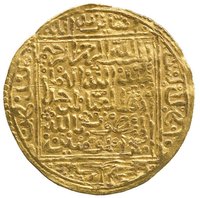
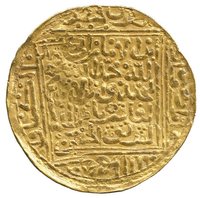
½ dinar – Morocco
Add to wishlist
Morocco
Obverse
Reverse
Edge
Mintings
| Year | Mint Mark | Mintage | Quality | Collection |
|---|---|---|---|---|
| — | — | — |
Historical background
In 1602, Morocco's currency system was deeply intertwined with its political instability and its pivotal role in global trade networks. The Saadi Sultanate, under Sultan Ahmad al-Mansur (r. 1578-1603), had recently concluded a golden age of prosperity funded by the lucrative trans-Saharan gold trade and ransoms from the Battle of the Three Kings. Al-Mansur’s treasury in Marrakesh was famously flush with gold, particularly from the Bambuk and Bure mines, which he used to mint high-quality gold dinars, known as benduqis. However, his death in 1603 plunged the realm into a protracted civil war between his sons, immediately threatening this monetary stability.
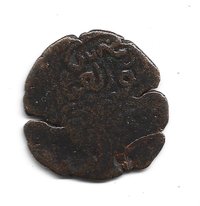
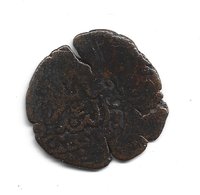
The primary circulating coins were the gold benduqi, the silver dirham, and the low-value copper falus. The system was bimetallic, but its integrity relied on the Sultan's control over the gold supply and the mint houses (dar al-sikka). The outbreak of war fragmented this control, as rival claimants seized regional mints in cities like Fez and Marrakesh to coin money for financing their armies. This led to a proliferation of coinages of varying weight and purity, causing confusion in markets and undermining trust in the currency. Furthermore, the immense wealth from the Songhai expedition (1591) had begun to dry up, straining the state's ability to maintain a consistent and ample coin supply.
Simultaneously, Morocco was a hub for foreign currencies. Spanish reales and Ottoman altuns circulated widely due to extensive trade with Europe and the Mediterranean, as well as the activities of Barbary Corsairs. The disruption in central authority meant these foreign coins, along with debased local issues, increasingly filled the vacuum, leading to a complex and unstable monetary environment. Thus, in 1602, Morocco stood at a precipice, transitioning from a period of strong, centralized currency under al-Mansur to an era of fragmentation where the state of the coinage directly reflected the fracturing political landscape.
The primary circulating coins were the gold benduqi, the silver dirham, and the low-value copper falus. The system was bimetallic, but its integrity relied on the Sultan's control over the gold supply and the mint houses (dar al-sikka). The outbreak of war fragmented this control, as rival claimants seized regional mints in cities like Fez and Marrakesh to coin money for financing their armies. This led to a proliferation of coinages of varying weight and purity, causing confusion in markets and undermining trust in the currency. Furthermore, the immense wealth from the Songhai expedition (1591) had begun to dry up, straining the state's ability to maintain a consistent and ample coin supply.
Simultaneously, Morocco was a hub for foreign currencies. Spanish reales and Ottoman altuns circulated widely due to extensive trade with Europe and the Mediterranean, as well as the activities of Barbary Corsairs. The disruption in central authority meant these foreign coins, along with debased local issues, increasingly filled the vacuum, leading to a complex and unstable monetary environment. Thus, in 1602, Morocco stood at a precipice, transitioning from a period of strong, centralized currency under al-Mansur to an era of fragmentation where the state of the coinage directly reflected the fracturing political landscape.
✨ Legendary