

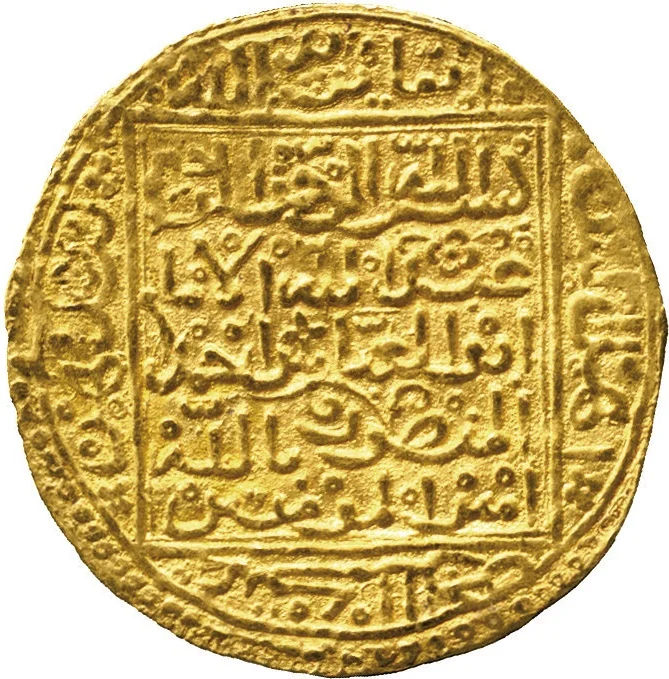
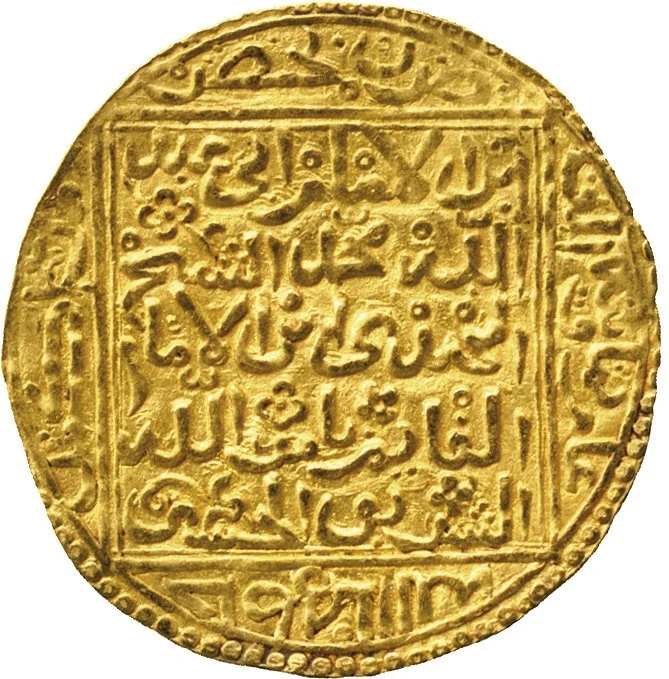
Dinar – Morocco
Morocco
Context
Years: 1596–1604
Issuer: Morocco 
Ruler: Abu’l-‘Abbas Ahmad al-Mansur
Currency:
(1549—1659)
Demonetized: Yes
Material
References
KM: #Click to copy to clipboard3
Numista: #157699
Value
Bullion value: $750.11
Obverse
Inscription:
Centre
بسم الله الرحمان الرحيم
عبد الله الامام
ابو العباس احمد
المنصور بالله
امير المؤمنين
Cercle
انما يريد الله
ليذهب
عنكم الرجس
اهل البيت
بسم الله الرحمان الرحيم
عبد الله الامام
ابو العباس احمد
المنصور بالله
امير المؤمنين
Cercle
انما يريد الله
ليذهب
عنكم الرجس
اهل البيت
Script: Arabic
Reverse
Inscription:
Centre
ابن الامام ابي عبد
الله محمد الشيخ
المهدي ابن الامام
القائم بامر الله
الشريف الحسني
Cercle
ضرب بحضرة
مراكش
حاطها الله
عام ثمانية و الف
ابن الامام ابي عبد
الله محمد الشيخ
المهدي ابن الامام
القائم بامر الله
الشريف الحسني
Cercle
ضرب بحضرة
مراكش
حاطها الله
عام ثمانية و الف
Script: Arabic
Edge
Mintings
| Year | Mint Mark | Mintage | Quality | Collection |
|---|---|---|---|---|
| 1596 | — | — | ||
| 1600 | — | — | ||
| 1602 | — | — | ||
| 1603 | — | — | ||
| 1604 | — | — |
Historical background
In 1596, the currency situation in the Saadian Sultanate of Morocco was characterized by a complex and often unstable bimetallic system, heavily influenced by both internal pressures and international trade. The primary coins in circulation were the gold benduqi (based on the Ottoman sultani) and the silver dirham. Their values and availability were in constant flux due to the kingdom's deep integration into Mediterranean and trans-Saharan trade networks. The influx of American silver via European merchants, particularly the Spanish and Portuguese, caused significant inflation and drove the scarce gold coinage to a premium, disrupting local markets.
This monetary instability was exacerbated by the state's own fiscal practices. The Saadian sultan Ahmad al-Mansur (r. 1578–1603), while at the height of his power following the pivotal Battle of Wadi al-Makhazin in 1578, engaged in massive expenditures. These included funding a lavish court, maintaining a powerful military, and financing ambitious projects like the invasion of the Songhai Empire in 1591, which was motivated in part by the desire to control West African gold mines. To raise revenue, the mints (dar al-sikka) often debased the silver coinage, reducing its precious metal content and further eroding public trust in the currency.
Consequently, the monetary landscape was one of regional fragmentation and daily hardship. In major port cities like Salé and Safi, European silver coins such as Spanish reales circulated freely alongside local issues, while in the interior and southern trade routes, older silver coins and even minted gold dust remained essential. For the common population, this meant fluctuating prices, uncertainty in basic transactions, and a heavy reliance on smaller fractional copper coins (fulus) for daily market life, all under the shadow of a state treasury straining to finance its imperial ambitions.
This monetary instability was exacerbated by the state's own fiscal practices. The Saadian sultan Ahmad al-Mansur (r. 1578–1603), while at the height of his power following the pivotal Battle of Wadi al-Makhazin in 1578, engaged in massive expenditures. These included funding a lavish court, maintaining a powerful military, and financing ambitious projects like the invasion of the Songhai Empire in 1591, which was motivated in part by the desire to control West African gold mines. To raise revenue, the mints (dar al-sikka) often debased the silver coinage, reducing its precious metal content and further eroding public trust in the currency.
Consequently, the monetary landscape was one of regional fragmentation and daily hardship. In major port cities like Salé and Safi, European silver coins such as Spanish reales circulated freely alongside local issues, while in the interior and southern trade routes, older silver coins and even minted gold dust remained essential. For the common population, this meant fluctuating prices, uncertainty in basic transactions, and a heavy reliance on smaller fractional copper coins (fulus) for daily market life, all under the shadow of a state treasury straining to finance its imperial ambitions.
✨ Legendary