

12 Kreuzers – County of Lippe-Detmold
Context
Year: 1619
Issuer: County of Lippe-Detmold
Ruler: Matthias
Currency:
(1413—1788)
Demonetized: Yes
Total mintage: 8,012
Material
References
KM: #Click to copy to clipboard16
Numista: #156461
Value
Bullion value: $8.49
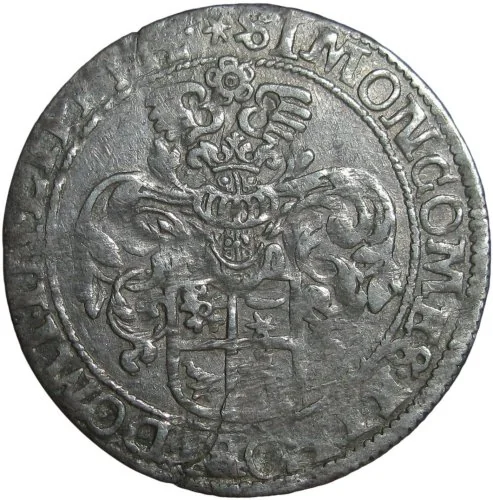
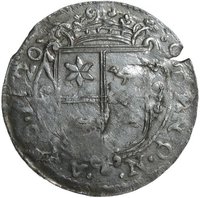
Obverse
Description:
Ornate helmet above a quartered coat of arms.
Inscription:
*SIMON.COMES.ET.NOBI/DOMI IN.LIPPIA
Script: Latin
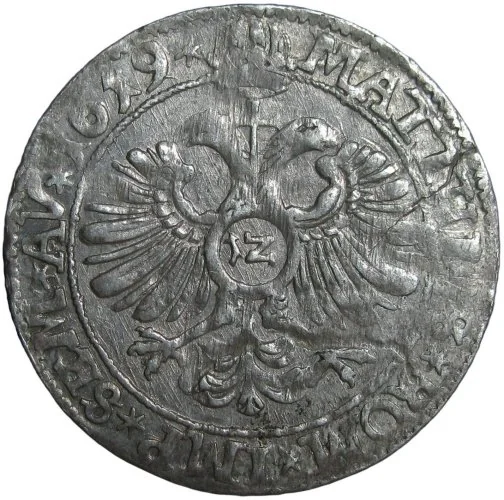
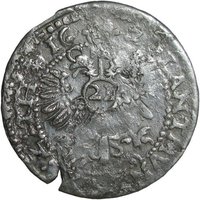
Reverse
Description:
Imperial Eagle with orb, Matthias inscription, and date.
Inscription:
MATTHIAS*ROM*IMP*SEM*AV*I6I9*
Script: Latin
Edge
Mints
| Name | Mark |
|---|---|
| Detmold | — |
Mintings
| Year | Mint Mark | Mintage | Quality | Collection |
|---|---|---|---|---|
| 1619 | — | 8,012 |
Historical background
In 1619, the County of Lippe-Detmold, a small German territory within the Holy Roman Empire, operated within a complex and fragmented monetary system. Like most principalities, it did not possess the sovereign right to mint its own high-value coins (like thalers or gold gulden); that privilege was reserved for the Emperor and larger electoral states. Instead, Lippe's currency landscape was dominated by a flood of circulating foreign coins from neighboring minting authorities, such as the nearby Bishopric of Paderborn and the Duchy of Brunswick-Lüneburg, alongside imperial issues. This created a chaotic environment where the value and silver content of coins in daily use varied greatly.
The county's own minting activity was largely restricted to lower-denomination Scheidemünzen (small change), such as Pfennige and Dreier, intended for local trade. These coins often had a fiduciary value, meaning their metal content was worth less than their face value, and their acceptance was legally limited to the territory itself. This practice was economically precarious, as overproduction or a loss of public trust could lead to rapid devaluation. Furthermore, the year 1619 marked the very beginning of the Thirty Years' War, a conflict that would soon trigger widespread monetary crisis across Germany, though its full devastating impact on currency debasement and inflation was still on the horizon.
Therefore, the monetary situation in Lippe-Detmold in 1619 was one of fragile dependency and impending instability. The county lacked control over the primary coinage in its economy, relied on a patchwork of external currencies, and supplemented this with vulnerable local small change. While not yet in a state of severe crisis, its position within the Empire's decentralized monetary framework left it acutely exposed to the coming waves of war-driven debasement and economic turmoil that would characterize the following decades.
The county's own minting activity was largely restricted to lower-denomination Scheidemünzen (small change), such as Pfennige and Dreier, intended for local trade. These coins often had a fiduciary value, meaning their metal content was worth less than their face value, and their acceptance was legally limited to the territory itself. This practice was economically precarious, as overproduction or a loss of public trust could lead to rapid devaluation. Furthermore, the year 1619 marked the very beginning of the Thirty Years' War, a conflict that would soon trigger widespread monetary crisis across Germany, though its full devastating impact on currency debasement and inflation was still on the horizon.
Therefore, the monetary situation in Lippe-Detmold in 1619 was one of fragile dependency and impending instability. The county lacked control over the primary coinage in its economy, relied on a patchwork of external currencies, and supplemented this with vulnerable local small change. While not yet in a state of severe crisis, its position within the Empire's decentralized monetary framework left it acutely exposed to the coming waves of war-driven debasement and economic turmoil that would characterize the following decades.
✨ Legendary