

500 Lire – Vatican City
Vatican City
Context
Year: 1967
Issuer: Vatican City 
Ruler: Paul VI
Currency:
(1929—2001)
Demonetization: 1 March 2002
Total mintage: 110,000
Material
References
KM: #Click to copy to clipboard99
Numista: #12157
Value
Exchange value: 500 VAL
Bullion value: $25.98
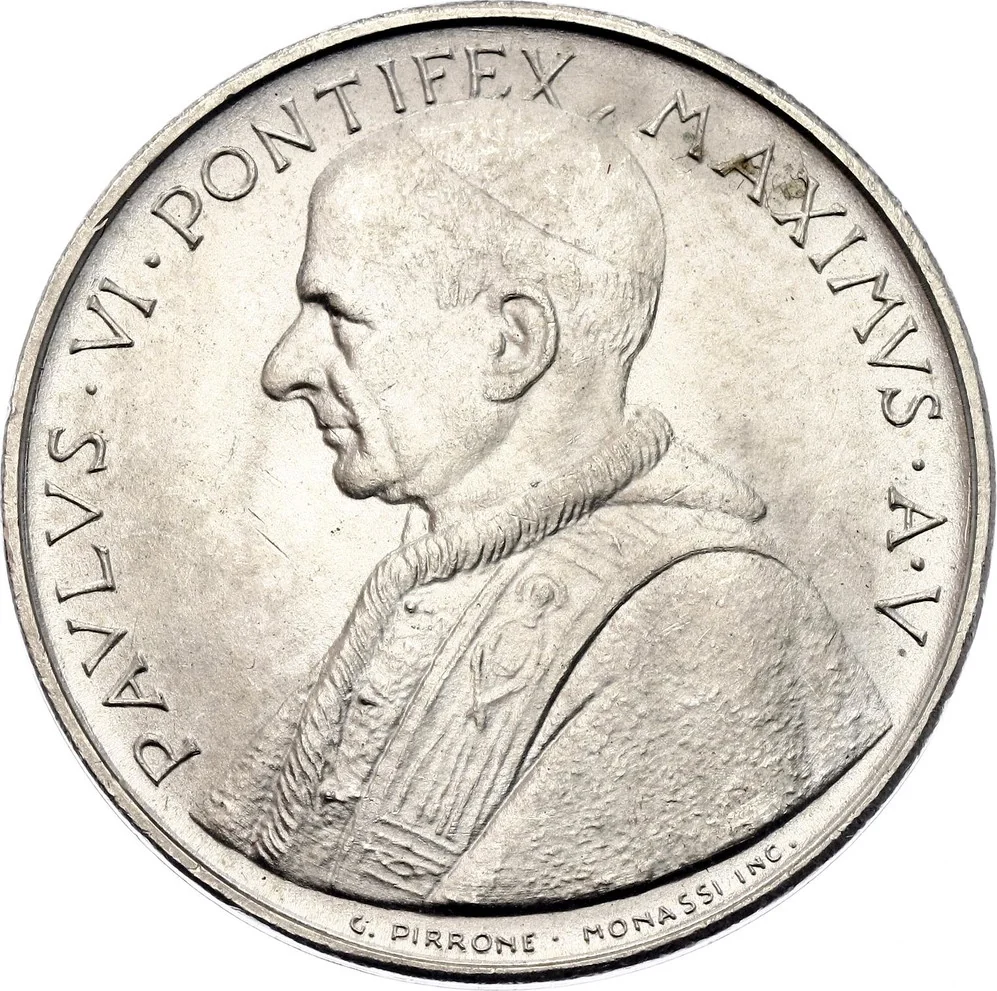
Obverse
Description:
Left turn
Inscription:
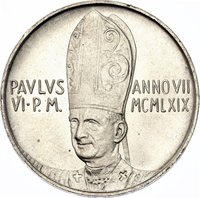
PAVLVS·VI·PONTIFEX MAXIMVS·A·V
G. PIRRONE · MONASSI INC.
G. PIRRONE · MONASSI INC.
Script: Latin
Engraver: Giuseppe Pirrone
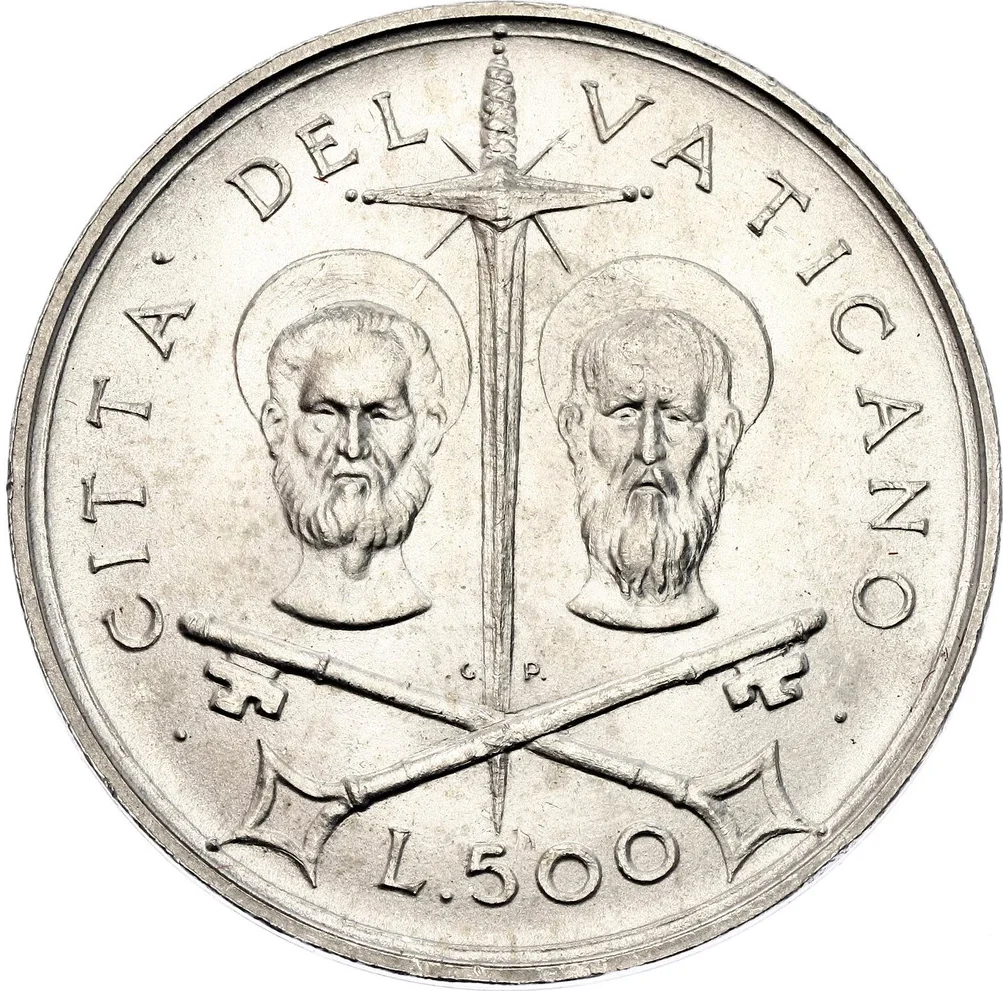
Reverse
Description:
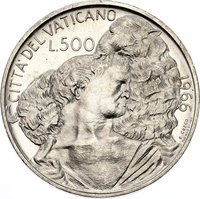
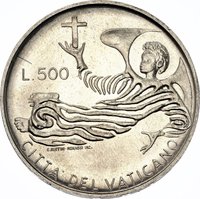
Saints Peter and Paul flank a sword with crossed keys beneath.
Inscription:
CITTA' DEL VATICANO
G. P.
L.500
G. P.
L.500
Script: Latin
Engraver: Giuseppe Pirrone
Edge
Plain with excuse lettering inside a groove
Legend:
+++IN•NOMINE•DOMINI
Categories
| Person> Religious figure |
| Mustache/Beard |
| Religion> Religious objects |
| Object> Cold weapons |
Mintings
| Year | Mint Mark | Mintage | Quality | Collection |
|---|---|---|---|---|
| 1967 | — | 110,000 |
Historical background
In 1967, Vatican City's currency situation was uniquely defined by its status as a sovereign city-state without a traditional, independent monetary system. While it possessed the right to mint its own coinage under the terms of the 1929 Lateran Treaty, it did not issue paper banknotes and relied entirely on the Italian lira as its de facto circulating currency. The Vatican's minted coins—featuring the image of the reigning Pope Paul VI—were legal tender within its borders and, by special concordat, throughout Italy and San Marino. However, their primary purpose was commemorative and numismatic, serving pilgrims and collectors rather than facilitating everyday commerce, which was conducted in Italian lire.
This arrangement was underpinned by a complex financial agreement with Italy. The Italian government supplied the Vatican with the necessary base metal planchets for coin production, and the volumes were strictly limited by treaty to amounts deemed commensurate with the city-state's small size and needs. Furthermore, the Vatican benefited financially from this system through the seigniorage profit—the difference between the face value of the coins and their metal and production costs—which provided a modest but meaningful source of independent revenue. Crucially, the value of Vatican coinage was pegged 1:1 to the Italian lira, making it a fully integrated subsidiary component of the Italian monetary zone.
The year 1967 fell within a period of relative stability for this system, but it existed on the cusp of significant change. The global move away from the Bretton Woods system and the eventual period of high inflation in Italy (the "Years of Lead") during the 1970s would later strain the fixed relationship. Ultimately, this dependency meant that Vatican City's monetary policy was entirely passive, mirroring the decisions of the Banca d'Italia. Thus, in 1967, the currency situation reflected the Vatican's pragmatic blend of symbolic sovereignty and practical economic integration with its Italian host.
This arrangement was underpinned by a complex financial agreement with Italy. The Italian government supplied the Vatican with the necessary base metal planchets for coin production, and the volumes were strictly limited by treaty to amounts deemed commensurate with the city-state's small size and needs. Furthermore, the Vatican benefited financially from this system through the seigniorage profit—the difference between the face value of the coins and their metal and production costs—which provided a modest but meaningful source of independent revenue. Crucially, the value of Vatican coinage was pegged 1:1 to the Italian lira, making it a fully integrated subsidiary component of the Italian monetary zone.
The year 1967 fell within a period of relative stability for this system, but it existed on the cusp of significant change. The global move away from the Bretton Woods system and the eventual period of high inflation in Italy (the "Years of Lead") during the 1970s would later strain the fixed relationship. Ultimately, this dependency meant that Vatican City's monetary policy was entirely passive, mirroring the decisions of the Banca d'Italia. Thus, in 1967, the currency situation reflected the Vatican's pragmatic blend of symbolic sovereignty and practical economic integration with its Italian host.
🌱 Fairly Common