

1 Thaler – Kingdom of Bohemia
Context
Year: 1780
Country: Bohemia
Issuer: Kingdom of Bohemia
Ruler: Maria Theresa
Currency:
(1754—1857)
Demonetized: Yes
References
KM: #Click to copy to clipboard816
Numista: #105992
Obverse
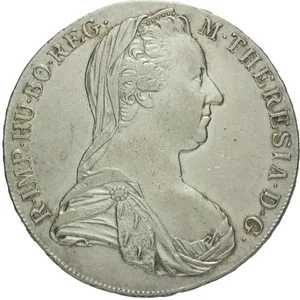
Description:
Veiled head right. Legend begins at 1 o'clock.
Inscription:
M·THERESIA·D·G· R·IMP·HU·BO·REG
Script: Latin
Reverse
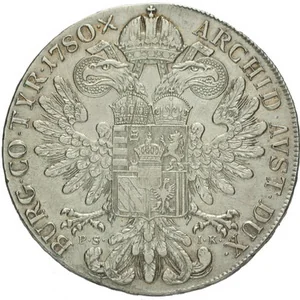
Description:
Imperial double eagle, crowned, with double-crowned breast shield. Legend begins at 1 o'clock.
Inscription:
ARCHID·AVST·DUX· BURG·CO·TYR·1780
Script: Latin
Edge
IUSTITIA ET CLEMENTIA surrounded by leaves
Legend:
IUSTITIA ET CLEMENTIA
Mints
| Name | Mark |
|---|---|
| Prague | — |
Mintings
| Year | Mint Mark | Mintage | Quality | Collection |
|---|---|---|---|---|
| 1780 | EvS-IK | — | ||
| 1780 | PS-IK | — |
Historical background
In 1780, the Kingdom of Bohemia, a core crown land of the Habsburg Monarchy, operated within a complex and somewhat antiquated monetary system. The official currency was the Conventionsthaler (also known as the Konventionsthaler), a large silver coin established by a monetary convention across the Habsburg territories in 1753. It was divided into 120 Kreuzer, with the Kreuzer itself subdivided into 4 Pfennigs. This system, however, coexisted with a legacy of older, debased coinage still in circulation, creating practical challenges for daily commerce and accounting.
The monetary situation was directly managed from Vienna, reflecting Bohemia's integrated yet subordinate economic position within the wider monarchy. Empress Maria Theresa, whose portrait adorned the widely trusted "Maria Theresa Thaler," had provided a degree of stability. However, the strains of the recent Seven Years' War (1756-1763) had pressured state finances, a burden inherited by her son and co-ruler, Joseph II, who assumed sole reign upon her death in 1780. While not yet in a state of crisis, the system was ripe for the rationalizing reforms characteristic of Joseph's enlightened absolutism.
Consequently, the currency situation in 1780 was one of transition. The existing Conventionsthaler standard was stable but cumbersome. Joseph II would soon embark on significant centralizing reforms, which included monetary policy. Within a few years, this would lead to the introduction of a new, decimal-based system with the Gulden (florin) as the chief unit, divided into 100 Kreuzer, a change formally decreed in 1786. Therefore, the monetary landscape in Bohemia in 1780 stood on the brink of modernization, still defined by the mid-18th-century conventions but under the rule of a monarch eager to impose greater uniformity and efficiency on his realms.
The monetary situation was directly managed from Vienna, reflecting Bohemia's integrated yet subordinate economic position within the wider monarchy. Empress Maria Theresa, whose portrait adorned the widely trusted "Maria Theresa Thaler," had provided a degree of stability. However, the strains of the recent Seven Years' War (1756-1763) had pressured state finances, a burden inherited by her son and co-ruler, Joseph II, who assumed sole reign upon her death in 1780. While not yet in a state of crisis, the system was ripe for the rationalizing reforms characteristic of Joseph's enlightened absolutism.
Consequently, the currency situation in 1780 was one of transition. The existing Conventionsthaler standard was stable but cumbersome. Joseph II would soon embark on significant centralizing reforms, which included monetary policy. Within a few years, this would lead to the introduction of a new, decimal-based system with the Gulden (florin) as the chief unit, divided into 100 Kreuzer, a change formally decreed in 1786. Therefore, the monetary landscape in Bohemia in 1780 stood on the brink of modernization, still defined by the mid-18th-century conventions but under the rule of a monarch eager to impose greater uniformity and efficiency on his realms.
💎 Very Rare