

1 Ducat – Landgraviate of Hesse-Darmstadt
Context
Years: 1746–1755
Issuer: Landgraviate of Hesse-Darmstadt
Ruler: Louis VIII
Currency:
(1568—1805)
Demonetized: Yes
Material
References
KM: #Click to copy to clipboard180
Numista: #154604
Value
Bullion value: $567.18
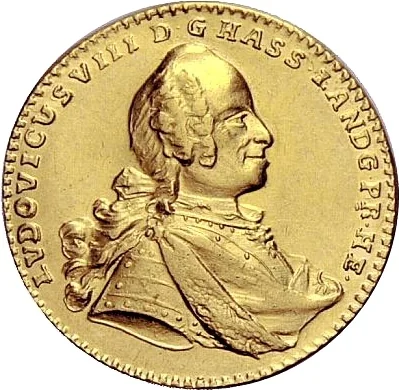
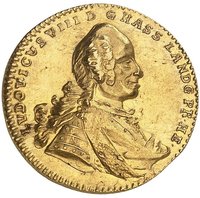
Obverse
Description:
Armored bust facing right.
Script: Latin
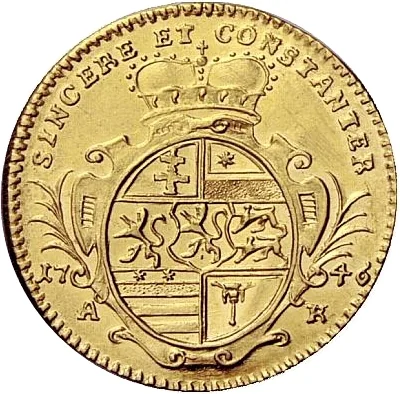
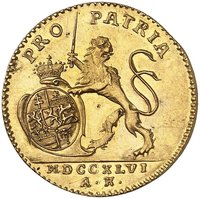
Reverse
Description:
Crowned arms in ornate oval.
Script: Latin
Edge
Mints
| Name | Mark |
|---|---|
| Darmstadt | — |
Mintings
| Year | Mint Mark | Mintage | Quality | Collection |
|---|---|---|---|---|
| 1746 | — | — | ||
| — | — | — | ||
| 1748 | S | — | ||
| 1749 | S | — | ||
| 1751 | — | — | ||
| 1753 | — | — | ||
| 1755 | — | — |
Historical background
In 1746, the currency situation in the Landgraviate of Hesse-Darmstadt was characterized by significant complexity and instability, a common challenge across the fragmented German states of the Holy Roman Empire. The landgraviate did not have a monopoly on coinage; its monetary system was a confusing mosaic of various circulating currencies. These included not only coins minted by the Darmstadt rulers themselves but also those from neighboring Hessian states (like Hesse-Kassel), the larger regional powers (such as the Reichsthaler from the Austrian Empire), and even older, debased coins from previous centuries. This proliferation created a chronic problem of uncertain exchange rates and fluctuating values that hampered trade and state finance.
The root of this disorder lay in the prerogative of coinage (Münzregal), a right held by many imperial princes. Successive rulers were often tempted to engage in monetary manipulation, such as issuing debased coinage with lower precious metal content to generate short-term profit for the treasury, a practice known as Kipper- und Wipperzeit that had caused widespread crisis a century earlier. While not in such an acute phase in 1746, the legacy of debasement and the constant influx of foreign coins of varying quality meant that merchants and officials had to be expert money-changers. The effective value of a coin depended heavily on its metal content, age, and origin, rather than its face value.
For Landgrave Ludwig VIII, who reigned from 1739 to 1768, managing this chaotic system was a key administrative and economic concern. The year 1746 fell within the War of the Austrian Succession (1740-1748), which placed additional fiscal strain on the territory. The need to finance military obligations likely exacerbated the temptation to exploit seigniorage (the profit from minting coins), while simultaneously making a stable and reliable currency for paying troops and suppliers more urgent. Thus, the currency situation of 1746 was one of entrenched complexity, further strained by the geopolitical pressures of war, setting the stage for future, though often incremental, attempts at monetary regulation and standardization.
The root of this disorder lay in the prerogative of coinage (Münzregal), a right held by many imperial princes. Successive rulers were often tempted to engage in monetary manipulation, such as issuing debased coinage with lower precious metal content to generate short-term profit for the treasury, a practice known as Kipper- und Wipperzeit that had caused widespread crisis a century earlier. While not in such an acute phase in 1746, the legacy of debasement and the constant influx of foreign coins of varying quality meant that merchants and officials had to be expert money-changers. The effective value of a coin depended heavily on its metal content, age, and origin, rather than its face value.
For Landgrave Ludwig VIII, who reigned from 1739 to 1768, managing this chaotic system was a key administrative and economic concern. The year 1746 fell within the War of the Austrian Succession (1740-1748), which placed additional fiscal strain on the territory. The need to finance military obligations likely exacerbated the temptation to exploit seigniorage (the profit from minting coins), while simultaneously making a stable and reliable currency for paying troops and suppliers more urgent. Thus, the currency situation of 1746 was one of entrenched complexity, further strained by the geopolitical pressures of war, setting the stage for future, though often incremental, attempts at monetary regulation and standardization.
✨ Legendary