

1 Falus – City of Qandahar
Afghanistan
Context
Year: 1796
Islamic (Hijri) Year: 1211
Country: Afghanistan 
Issuer: City of Qandahar
Currency:
(1747—1891)
Demonetized: Yes
Material
References
KM: #Click to copy to clipboard10
Numista: #154151
Obverse
Description:
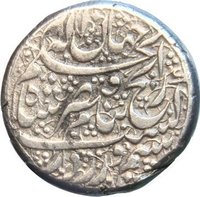
Sword surrounded by dots.
Reverse
Description:
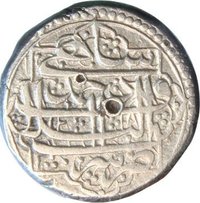
Arabic inscription.
Edge
Mintings
| Year | Mint Mark | Mintage | Quality | Collection |
|---|---|---|---|---|
| 1796 | — | — |
Historical background
In 1796, the city of Qandahar existed in a state of monetary complexity and transition, caught between decaying imperial systems and emerging regional powers. As a historic trade hub on the crossroads of Central and South Asia, the city’s bazaars saw a jumble of currencies in circulation. The most prominent were the silver rupees of the moribund Mughal Empire and the even more debased coins of the fading Afsharid and Durrani dynasties, often clipped or worn thin from decades of use. These coins competed with a steady influx of European silver, particularly Spanish dollars and Dutch rijksdaalders, brought by trade networks stretching to the Indian Ocean, which were valued for their reliable bullion content.
This monetary fragmentation was a direct reflection of the political instability following the death of Ahmad Shah Durrani in 1772. By 1796, the Durrani Empire was fractured, and Qandahar was effectively under the contested control of local Barakzai and Sadozai chieftains, with the Shah in Kabul, Zaman Shah, struggling to assert authority. Without a strong central minting authority, the city lacked a uniform, trusted currency. Transactions relied heavily on the weight and purity of metal rather than the stamp of a sovereign, and money-changers (sarraf) were essential figures in the marketplace, assessing and exchanging this heterogeneous mix.
The currency situation thus imposed a significant burden on commerce and daily life, creating an environment of uncertainty and transactional friction. The lack of reliable small denomination coinage also hampered minor trade. This economic disarray mirrored the broader geopolitical uncertainty, as the city awaited the rise of a new power that could impose monetary order—a stability that would only begin to materialize with the consolidation of the Barakzai dynasty under Dost Mohammad Khan in the decades to follow.
This monetary fragmentation was a direct reflection of the political instability following the death of Ahmad Shah Durrani in 1772. By 1796, the Durrani Empire was fractured, and Qandahar was effectively under the contested control of local Barakzai and Sadozai chieftains, with the Shah in Kabul, Zaman Shah, struggling to assert authority. Without a strong central minting authority, the city lacked a uniform, trusted currency. Transactions relied heavily on the weight and purity of metal rather than the stamp of a sovereign, and money-changers (sarraf) were essential figures in the marketplace, assessing and exchanging this heterogeneous mix.
The currency situation thus imposed a significant burden on commerce and daily life, creating an environment of uncertainty and transactional friction. The lack of reliable small denomination coinage also hampered minor trade. This economic disarray mirrored the broader geopolitical uncertainty, as the city awaited the rise of a new power that could impose monetary order—a stability that would only begin to materialize with the consolidation of the Barakzai dynasty under Dost Mohammad Khan in the decades to follow.

💎 Extremely Rare