

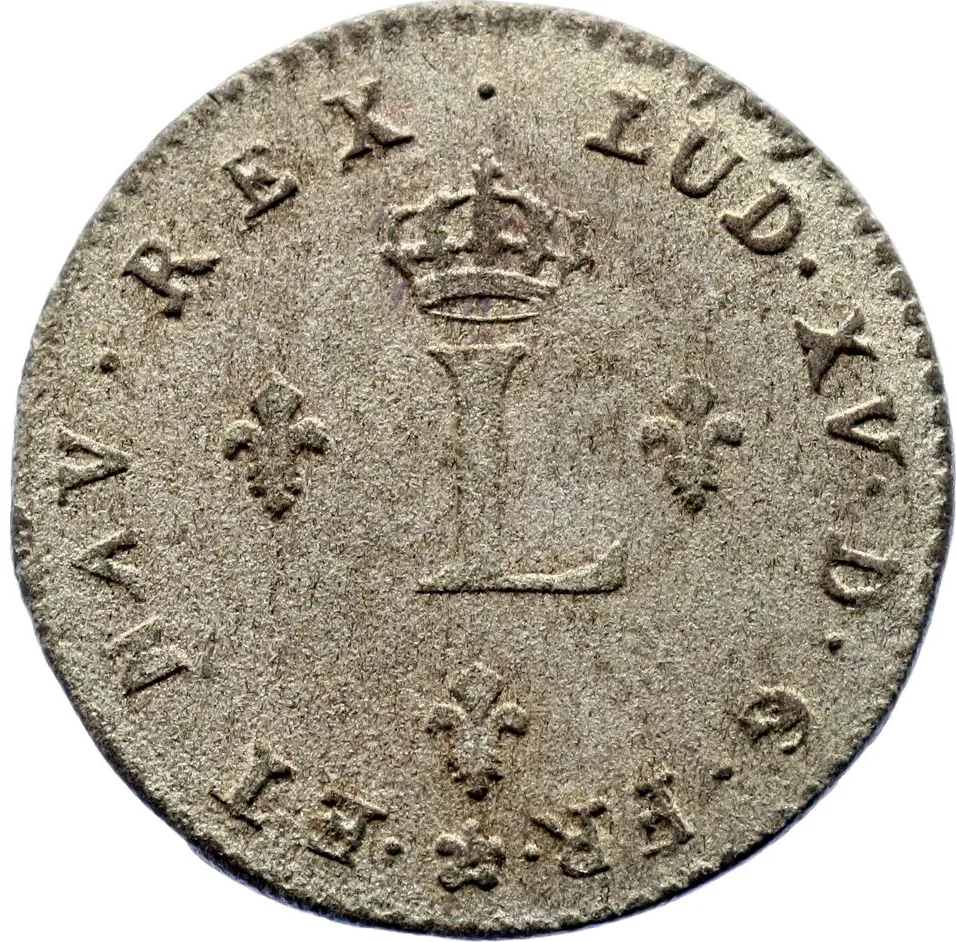
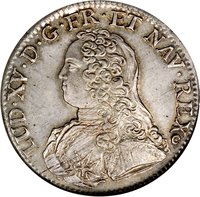
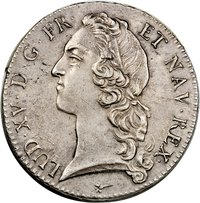
Obverse
Description:
Crowned L with three fleur-de-lis.
Inscription:
•LUD• XV• D• G• FR•ET• NAV• REX
Script: Latin
Engraver: Joseph-Charles Röettiers
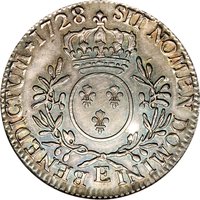
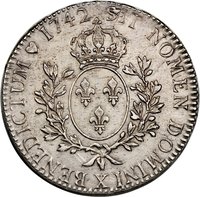
Reverse
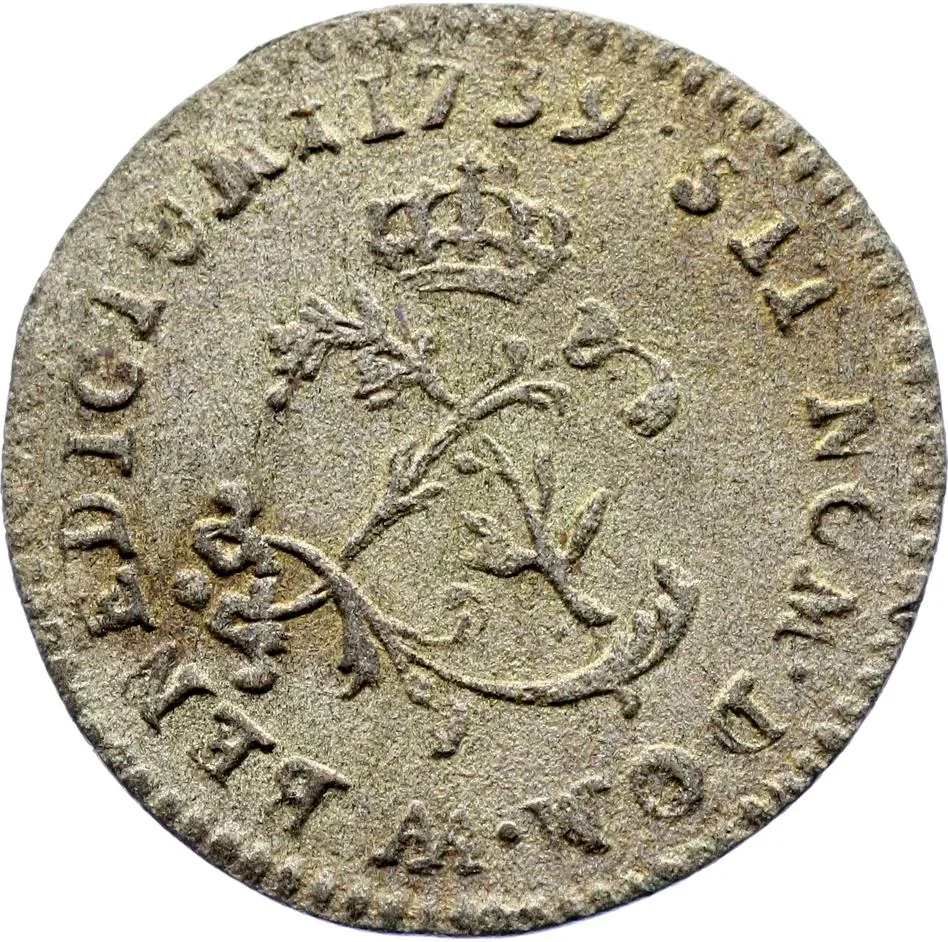
Description:
Crowned double L monogram with floral accents, dated above.
Inscription:
•SIT• NOM• DOM• H• BENEDICTUM 1742
Script: Latin
Engraver: Joseph-Charles Röettiers
Edge
Plain
Categories
| Symbol> Fleur-de-lis |
Mints
Mintings
| Year | Mint Mark | Mintage | Quality | Collection |
|---|---|---|---|---|
| 1738 | & | 57,000 | ||
| 1738 | 9 | 2,536 | ||
| 1738 | A | 2,770,886 | ||
| 1738 | C | 30,851 | ||
| 1738 | D | 322,600 | ||
| 1738 | E | 20,788 | ||
| 1738 | H | 28,302 | ||
| 1738 | K | 14,384 | ||
| 1738 | M | 185,285 | ||
| 1738 | O | 122,610 | ||
| 1738 | P | 211,879 | ||
| 1738 | Q | 25,300 | ||
| 1738 | S | 285,156 | ||
| 1738 | T | 47,344 | ||
| 1738 | V | 121,525 | ||
| 1738 | AA | 487,350 | ||
| 1738 | B | 366,777 | ||
| 1738 | BB | 441,882 | ||
| 1738 | I | 10,732 | ||
| 1738 | N | 309,521 | ||
| 1738 | G | 115,084 | ||
| 1738 | R | 22,438 | ||
| 1738 | W | 339,610 | ||
| 1738 | X | 172,241 | ||
| 1738 | Y | 100,443 | ||
| 1738 | ϽϹ | 89,973 | ||
| 1739 | 9 | 606,993 | ||
| 1739 | A | 8,068,970 | ||
| 1739 | AA | 1,786,950 | ||
| 1739 | B | 2,462,459 | ||
| 1739 | BB | 911,038 | ||
| 1739 | C | 1,580,526 | ||
| 1739 | D | 2,770,852 | ||
| 1739 | E | 1,029,417 | ||
| 1739 | L | 136,038 | ||
| 1739 | M | 2,004,900 | ||
| 1739 | N | 1,091,425 | ||
| 1739 | T | 442,282 | ||
| 1739 | V | 986,587 | ||
| 1739 | W | 6,475,088 | ||
| 1739 | X | 1,741,599 | ||
| 1739 | Y | 684,618 | ||
| 1739 | Z | 269,299 | ||
| 1739 | ϽϹ | 1,760,962 | ||
| 1739 | & | 269,299 | ||
| 1739 | G | 581,336 | ||
| 1739 | H | 667,891 | ||
| 1739 | I | 630,618 | ||
| 1739 | K | 1,282,512 | ||
| 1739 | O | 1,755,561 | ||
| 1739 | P | 1,382,522 | ||
| 1739 | Q | 371,839 | ||
| 1739 | R | 875,296 | ||
| 1739 | S | 1,681,076 | ||
| 1740 | & | 166,141 | ||
| 1740 | 9 | 801,090 | ||
| 1740 | AA | 487,350 | ||
| 1740 | B | 1,491,204 | ||
| 1740 | BB | 198,213 | ||
| 1740 | C | 597,695 | ||
| 1740 | E | 510,619 | ||
| 1740 | G | 169,864 | ||
| 1740 | H | 217,927 | ||
| 1740 | I | 601,653 | ||
| 1740 | K | 521,696 | ||
| 1740 | L | 129,311 | ||
| 1740 | M | 665,408 | ||
| 1740 | R | — | ||
| 1740 | S | 408,422 | ||
| 1740 | T | 300,484 | ||
| 1740 | V | 240,306 | ||
| 1740 | W | 404,693 | ||
| 1740 | X | 378,378 | ||
| 1740 | Y | 230,908 | ||
| 1740 | Z | 149,328 | ||
| 1740 | D | 678,136 | ||
| 1740 | N | 400,898 | ||
| 1740 | O | 419,182 | ||
| 1740 | P | 326,035 | ||
| 1740 | A | 1,089,942 | ||
| 1740 | Q | 328,897 | ||
| 1740 | ϽϹ | 212,918 | ||
| 1741 | C | 310,034 | ||
| 1741 | D | 393,994 | ||
| 1741 | H | — | ||
| 1741 | I | 150,800 | ||
| 1741 | K | 522,000 | ||
| 1741 | L | 75,066 | ||
| 1741 | M | 291,570 | ||
| 1741 | N | 98,803 | ||
| 1741 | O | 220,197 | ||
| 1741 | P | — | ||
| 1741 | Q | 113,527 | ||
| 1741 | R | — | ||
| 1741 | S | 63,200 | ||
| 1741 | T | 44,500 | ||
| 1741 | — | — | ||
| 1741 | & | 45,600 | ||
| 1741 | 9 | — | ||
| 1741 | A | — | ||
| 1741 | AA | 781,000 | ||
| 1741 | B | — | ||
| 1741 | BB | 1,134,936 | ||
| 1741 | E | 210,192 | ||
| 1741 | G | — | ||
| 1741 | V | 92,010 | ||
| 1741 | W | — | ||
| 1741 | Z | 96,271 | ||
| 1741 | ϽϹ | 124,200 | ||
| 1742 | 9 | 109,325 | ||
| 1742 | A | 984,500 | ||
| 1742 | AA | 784,000 | ||
| 1742 | B | 80,034 | ||
| 1742 | BB | 234,720 | ||
| 1742 | G | 76,187 | ||
| 1742 | H | 26,000 | ||
| 1742 | I | 103,550 | ||
| 1742 | K | 176,478 | ||
| 1742 | L | 17,250 | ||
| 1742 | W | 332,520 | ||
| 1742 | Y | 40,004 | ||
| 1742 | C | 194,793 | ||
| 1742 | D | 49,070 | ||
| 1742 | E | 87,782 | ||
| 1742 | M | 246,202 | ||
| 1742 | N | 79,912 | ||
| 1742 | O | 135,533 | ||
| 1742 | P | 129,666 | ||
| 1742 | Q | 91,522 | ||
| 1742 | V | 32,446 | ||
| 1743 | & | 32,160 | ||
| 1743 | 9 | 61,392 | ||
| 1743 | A | 435,860 | ||
| 1743 | AA | 627,200 | ||
| 1743 | BB | 126,250 | ||
| 1743 | C | 167,554 | ||
| 1743 | D | — | ||
| 1743 | E | 68,217 | ||
| 1743 | H | 25,932 | ||
| 1743 | I | 52,400 | ||
| 1743 | K | 87,024 | ||
| 1743 | L | — | ||
| 1743 | M | 131,224 | ||
| 1743 | O | 136,322 | ||
| 1743 | P | 136,045 | ||
| 1743 | T | — | ||
| 1743 | W | 174,944 | ||
| 1744 | K | 143,472 | ||
| 1744 | L | — | ||
| 1744 | 9 | 18,900 | ||
| 1744 | A | 414,310 | ||
| 1744 | AA | 313,600 | ||
| 1744 | BB | 327,046 | ||
| 1744 | C | 115,958 | ||
| 1744 | E | 63,451 | ||
| 1744 | H | 23,057 | ||
| 1744 | I | 143,472 | ||
| 1744 | M | 105,750 | ||
| 1744 | O | 35,738 | ||
| 1744 | P | 167,898 | ||
| 1744 | W | 354,428 | ||
| 1745 | L | — | ||
| 1745 | W | 152,171 | ||
| 1745 | A | 293,130 | ||
| 1745 | AA | 947,800 | ||
| 1745 | BB | — | ||
| 1745 | C | 99,950 | ||
| 1745 | E | 26,311 | ||
| 1745 | H | 23,010 | ||
| 1746 | A | 467,486 | ||
| 1746 | AA | 1,097,600 | ||
| 1746 | BB | — | ||
| 1746 | C | 98,430 | ||
| 1746 | E | 53,465 | ||
| 1746 | H | 27,546 | ||
| 1746 | L | — | ||
| 1746 | W | 119,472 | ||
| 1747 | A | 327,160 | ||
| 1747 | AA | 315,000 | ||
| 1747 | BB | — | ||
| 1747 | C | 71,277 | ||
| 1747 | E | 31,386 | ||
| 1747 | H | 66,744 | ||
| 1747 | L | — | ||
| 1747 | W | 168,960 | ||
| 1748 | W | — | ||
| 1748 | A | 218,000 | ||
| 1748 | AA | 156,800 | ||
| 1748 | BB | — | ||
| 1748 | C | 79,385 | ||
| 1748 | E | 31,483 | ||
| 1748 | H | 28,600 | ||
| 1748 | L | 84,450 | ||
| 1749 | E | 28,240 | ||
| 1749 | H | 105,000 | ||
| 1749 | L | 199,000 | ||
| 1749 | A | 78,400 | ||
| 1749 | AA | 120,125 | ||
| 1749 | BB | — | ||
| 1749 | C | 68,147 | ||
| 1749 | W | — | ||
| 1750 | A | 266,370 | ||
| 1750 | AA | 156,800 | ||
| 1750 | BB | — | ||
| 1750 | C | 82,467 | ||
| 1750 | E | 32,680 | ||
| 1750 | H | 600,800 | ||
| 1750 | L | 59,700 | ||
| 1751 | C | 59,294 | ||
| 1751 | H | 62,986 | ||
| 1751 | L | 99,300 | ||
| 1751 | A | 234,070 | ||
| 1751 | BB | — | ||
| 1752 | A | 91,800 | ||
| 1752 | BB | — | ||
| 1752 | C | 5,439 | ||
| 1752 | H | 27,070 | ||
| 1752 | L | 86,000 | ||
| 1753 | A | 114,620 | ||
| 1753 | BB | — | ||
| 1754 | A | 672,600 | ||
| 1754 | BB | — | ||
| 1755 | BB | — | ||
| 1755 | A | 688,800 | ||
| 1756 | A | 128,600 | ||
| 1756 | BB | 46,713 | ||
| 1757 | A | 91,900 | ||
| 1757 | BB | — | ||
| 1758 | BB | — | ||
| 1758 | A | — | ||
| 1759 | A | 91,300 | ||
| 1759 | BB | — | ||
| 1760 | A | 73,440 | ||
| 1760 | BB | — | ||
| 1761 | A | 154,200 | ||
| 1761 | BB | — | ||
| 1762 | A | 205,600 | ||
| 1762 | AA | — | ||
| 1762 | BB | 309,065 | ||
| 1763 | A | 163,400 | ||
| 1764 | A | 96,468 | ||
| 1764 | BB | 30,208 |
Historical background
In 1738, France operated under a complex and often precarious monetary system, a legacy of the financial experiments and crises of the previous decades. The nation was on a bimetallic standard, where both gold and silver coins were legal tender, with their values set by royal decree. However, the official ratio between gold and silver frequently failed to match the market ratio, leading to Gresham's Law in practice: "bad money drives out good." Under-valued coins would be hoarded or melted down for bullion, causing shortages and disrupting commerce. The most infamous recent shock was the System of John Law (1716-1720), a failed scheme involving paper money and a national bank that culminated in a devastating crash, leaving a deep public distrust of financial innovation and paper notes.
The currency in circulation was a bewildering array of coins, not only from the current king, Louis XV, but also older issues from Louis XIV, each with varying metallic content and wear. Furthermore, the livre tournois (the accounting unit) was not a physical coin but a money of account, with actual transactions conducted in écus (silver), louis d'or (gold), and a host of smaller denominations like sols and deniers. The Controller General of Finances, Philibert Orry, who served from 1730 to 1745, pursued a policy of monetary stability and deflation in this period, aiming to increase the value of the livre by recalling and re-minting coins. While intended to restore confidence, these manipulations often caused short-term hardship and market confusion.
Overall, the currency situation in 1738 was one of fragile stability following the trauma of Law's System. The state's finances were strained by the recent War of the Polish Succession (1733-1738), and the monarchy relied heavily on intricate, often predatory, fiscal mechanisms rather than a stable, uniform currency. The system was administratively cumbersome, vulnerable to speculation, and a constant concern for both the government seeking revenue and the populace engaged in daily trade, setting the stage for the persistent financial weaknesses that would plague the French monarchy later in the century.
The currency in circulation was a bewildering array of coins, not only from the current king, Louis XV, but also older issues from Louis XIV, each with varying metallic content and wear. Furthermore, the livre tournois (the accounting unit) was not a physical coin but a money of account, with actual transactions conducted in écus (silver), louis d'or (gold), and a host of smaller denominations like sols and deniers. The Controller General of Finances, Philibert Orry, who served from 1730 to 1745, pursued a policy of monetary stability and deflation in this period, aiming to increase the value of the livre by recalling and re-minting coins. While intended to restore confidence, these manipulations often caused short-term hardship and market confusion.
Overall, the currency situation in 1738 was one of fragile stability following the trauma of Law's System. The state's finances were strained by the recent War of the Polish Succession (1733-1738), and the monarchy relied heavily on intricate, often predatory, fiscal mechanisms rather than a stable, uniform currency. The system was administratively cumbersome, vulnerable to speculation, and a constant concern for both the government seeking revenue and the populace engaged in daily trade, setting the stage for the persistent financial weaknesses that would plague the French monarchy later in the century.
🌱 Fairly Common