

¼ thaler – Sayn-Wittgenstein-Sayn
Add to wishlist
Circulating commemorative coins
Commemoration: Death of Luise Juliane von Erbach
Germany
Context
Year: 1670
Country: Germany
Issuer: Sayn-Wittgenstein-Sayn
Ruler: Louise Juliane of Erbach
Currency:
Demonetized: Yes
Total mintage: 200
References
KM: #
Numista: #150513
Value
Bullion value: $17.97
Obverse
Description:
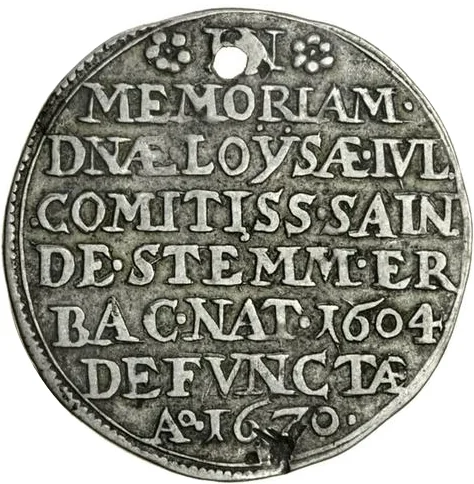
Inscription: 8 lines, includes dates.
Inscription:
IN / MEMORIAM / DNÆ. LOŸSÆ. IVL. / COMITISS. SAIN. / DE. STEMM. ER / BAC. NAT. 1604 / DEFVNCTÆ. / Ao. 1670.
Script: Latin
Reverse
Description:
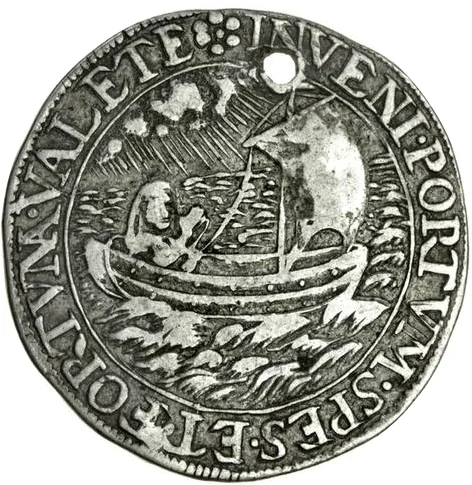
Countess sailing, sun breaking through clouds, all within a circle.
Inscription:
INVENI. PORTVM. SPES. ET. FORTVNA. VALETE.
Script: Latin
Edge
Mintings
| Year | Mint Mark | Mintage | Quality | Collection |
|---|---|---|---|---|
| 1670 | — | 200 |
Historical background
In 1670, the County of Sayn-Wittgenstein-Sayn, a small, forested territory within the Holy Roman Empire, faced a complex and challenging currency situation typical of the German Kleinstaaterei (small-state system). The county did not possess the right of Münzregal (the sovereign privilege to mint coins), which was held by its overlord, the Count of Sayn-Wittgenstein-Berleburg. Consequently, the county's economy operated with a mixture of external currencies. The most important of these was the Reichsthaler, the theoretical standard silver coin of the Empire, alongside various circulating Guldengroschen and regional thalers from neighboring minting authorities.
The practical monetary circulation was a chaotic jumble. Alongside imperial coins, a plethora of lower-quality regional coins, such as Albuses and Kreuzers, circulated from nearby ecclesiastical and temporal states. Furthermore, the heavy use of physically worn and clipped coins, as well as counterfeits, exacerbated the problem. This created significant difficulties in trade and taxation, as the intrinsic silver content of a coin often mattered more than its face value, requiring constant evaluation and exchange rate calculations.
This monetary fragmentation directly impacted the county's administration and economy. Counts had to issue frequent Münzedikte (currency ordinances) to fix exchange rates between the myriad of coins in an attempt to stabilize local transactions. The lack of control over currency also limited the county's fiscal autonomy, making it vulnerable to inflationary waves caused by the debasement of coins elsewhere in the Empire. Ultimately, the currency situation in 1670 reflected Sayn-Wittgenstein-Sayn's political dependency and the broader, dysfunctional monetary system of the Holy Roman Empire, where economic unity was stifled by a patchwork of local sovereignties.
The practical monetary circulation was a chaotic jumble. Alongside imperial coins, a plethora of lower-quality regional coins, such as Albuses and Kreuzers, circulated from nearby ecclesiastical and temporal states. Furthermore, the heavy use of physically worn and clipped coins, as well as counterfeits, exacerbated the problem. This created significant difficulties in trade and taxation, as the intrinsic silver content of a coin often mattered more than its face value, requiring constant evaluation and exchange rate calculations.
This monetary fragmentation directly impacted the county's administration and economy. Counts had to issue frequent Münzedikte (currency ordinances) to fix exchange rates between the myriad of coins in an attempt to stabilize local transactions. The lack of control over currency also limited the county's fiscal autonomy, making it vulnerable to inflationary waves caused by the debasement of coins elsewhere in the Empire. Ultimately, the currency situation in 1670 reflected Sayn-Wittgenstein-Sayn's political dependency and the broader, dysfunctional monetary system of the Holy Roman Empire, where economic unity was stifled by a patchwork of local sovereignties.
✨ Legendary