

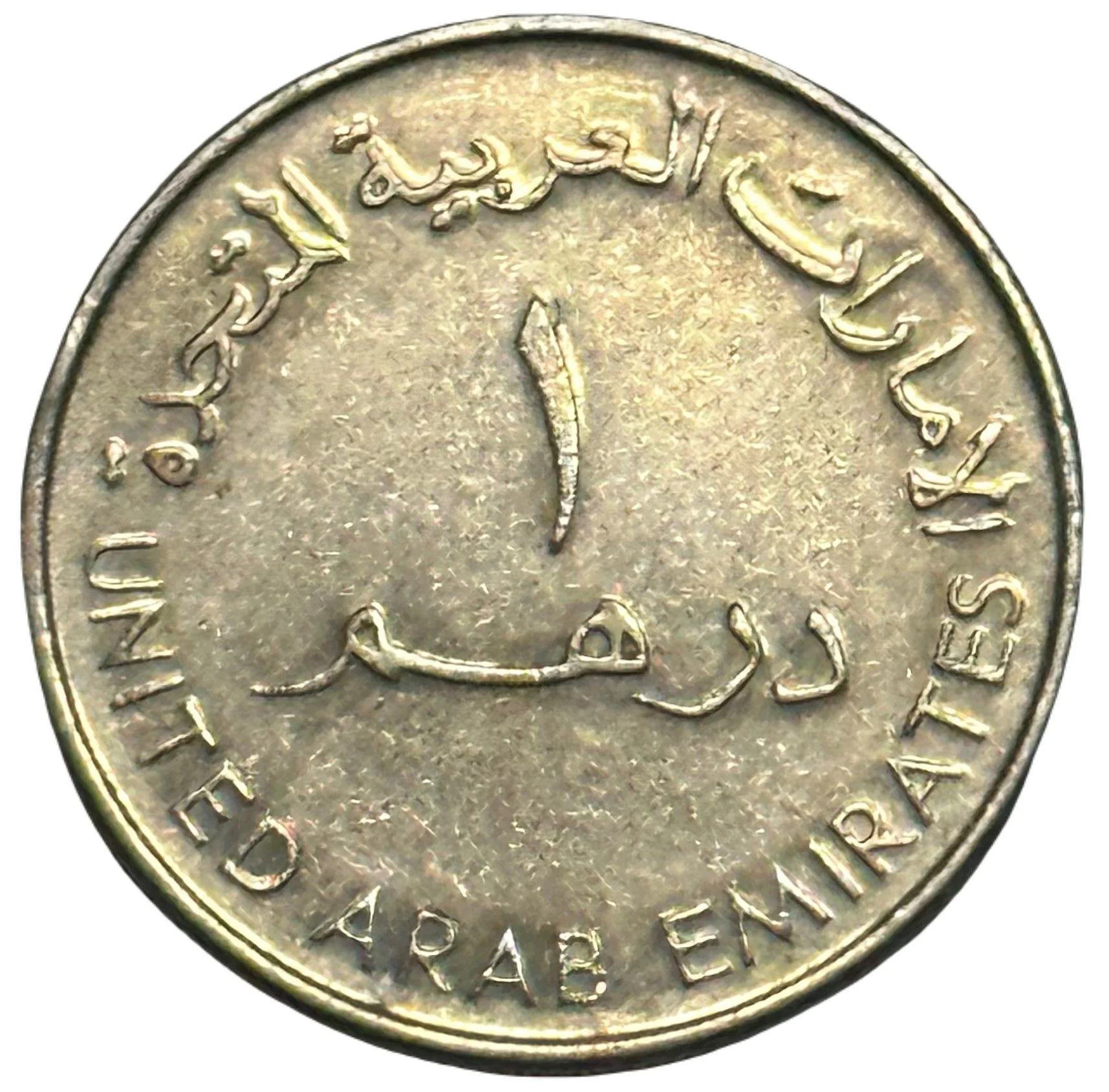
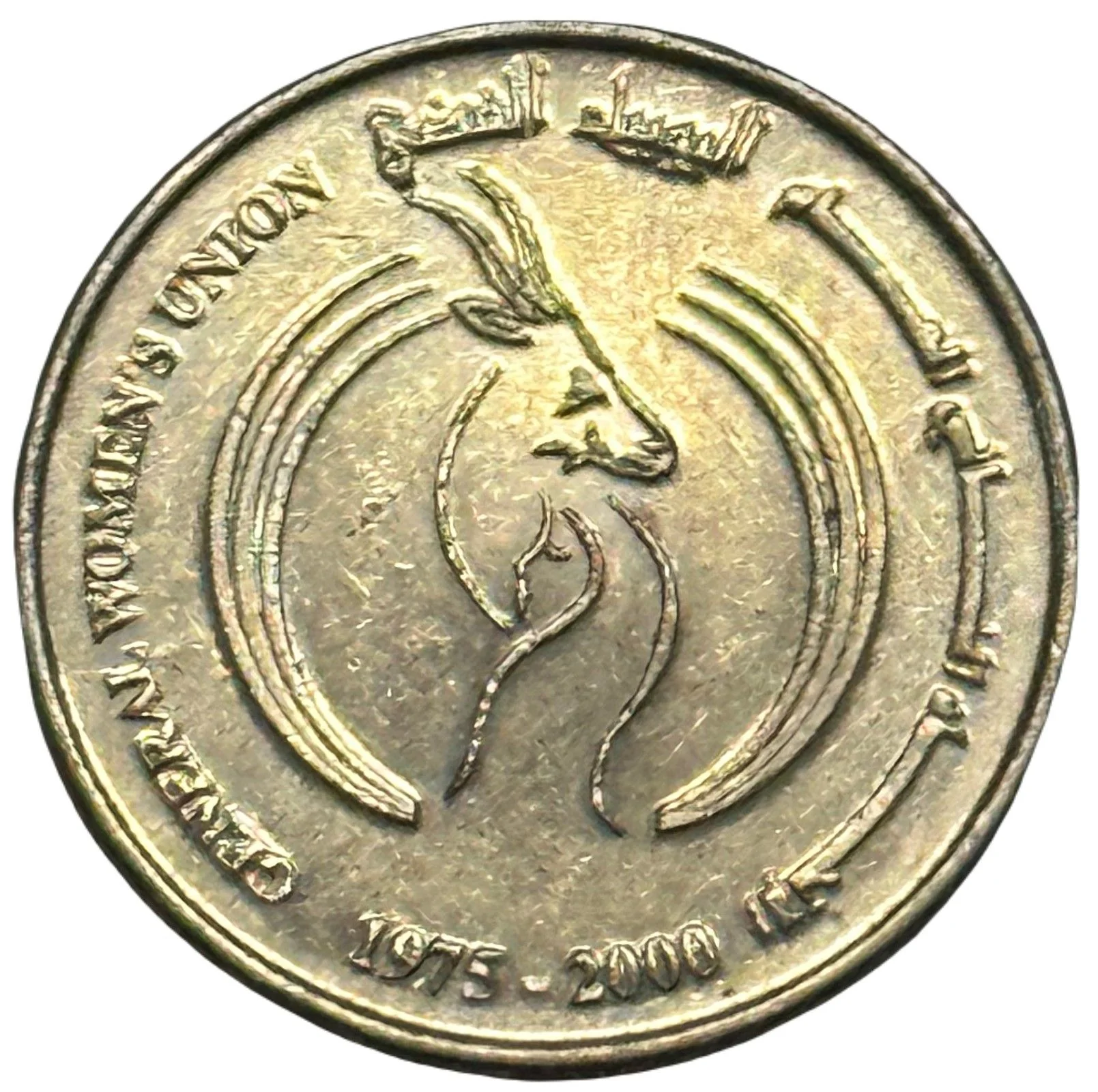
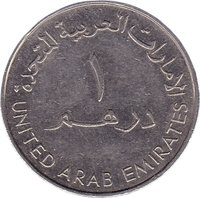
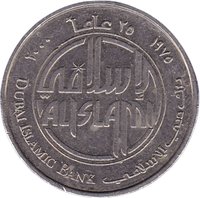
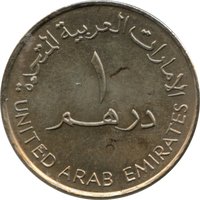
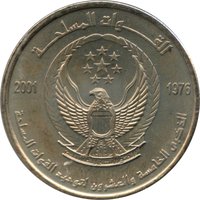
1 dirham – United Arab Emirates
Add to wishlist
Circulating commemorative coins
Commemoration: The Silver Jubilee of the General Women's Union
United Arab Emirates
Context
Year: 2000
Issuer: United Arab Emirates
Ruler: Zayed bin Sultan Al Nahyan
Currency:
(since 1973)
Total mintage: 500,000
Material
Diameter: 23.8 mm
Weight: 6.4 g
Thickness: 1.9 mm
Shape: Round
Composition: Copper-nickel
Technique: Milled
Alignment: Medal alignment
flip
References
KM: #
Numista: #12132
Value
Exchange value: 1 AED
Obverse
Reverse
Edge
Reeded
Mints
| Name | Mark |
|---|---|
| Münze Österreich | — |
Mintings
| Year | Mint Mark | Mintage | Quality | Collection |
|---|---|---|---|---|
| 2000 | — | 500,000 |
Historical background
In the year 2000, the United Arab Emirates' currency situation was defined by stability and a firm pegging arrangement. The UAE Dirham (AED) had been officially fixed to the International Monetary Fund's Special Drawing Rights (SDR) since 1978, but for practical purposes, it was pegged to the U.S. Dollar. This peg, established at a rate of AED 3.6725 to USD 1, provided a crucial anchor for the economy, which was heavily reliant on oil exports and international trade. The fixed exchange rate eliminated currency risk for foreign investors and businesses, fostered price stability by controlling imported inflation, and simplified financial transactions in a burgeoning economy that was becoming a major global hub.
This monetary policy was managed by the UAE Central Bank, which maintained substantial foreign exchange reserves, primarily in US dollars, to defend the peg. The arrangement was widely seen as successful, supporting the country's rapid economic development and diversification efforts beyond hydrocarbons. However, it also meant that the UAE surrendered control over its independent monetary policy; interest rates and money supply decisions were effectively aligned with those of the US Federal Reserve to maintain the currency's parity. This was generally acceptable given the dollar's role in global oil markets and the UAE's economic structure.
Looking ahead from 2000, the currency situation was not a subject of significant domestic debate, as the benefits of stability were prioritized. The fixed peg to the dollar remained a cornerstone of financial policy, providing a predictable environment as the UAE prepared for even greater integration into the global economy, notably with the impending launch of the Dubai International Financial Centre in 2004. The system established by 2000 would prove durable, remaining firmly in place for decades to come, even as discussions about potential Gulf currency union with other GCC states periodically arose.
This monetary policy was managed by the UAE Central Bank, which maintained substantial foreign exchange reserves, primarily in US dollars, to defend the peg. The arrangement was widely seen as successful, supporting the country's rapid economic development and diversification efforts beyond hydrocarbons. However, it also meant that the UAE surrendered control over its independent monetary policy; interest rates and money supply decisions were effectively aligned with those of the US Federal Reserve to maintain the currency's parity. This was generally acceptable given the dollar's role in global oil markets and the UAE's economic structure.
Looking ahead from 2000, the currency situation was not a subject of significant domestic debate, as the benefits of stability were prioritized. The fixed peg to the dollar remained a cornerstone of financial policy, providing a predictable environment as the UAE prepared for even greater integration into the global economy, notably with the impending launch of the Dubai International Financial Centre in 2004. The system established by 2000 would prove durable, remaining firmly in place for decades to come, even as discussions about potential Gulf currency union with other GCC states periodically arose.
🌱 Common