

¼ Ducat – Denmark
Denmark
Context

Material
References
KM: #Click to copy to clipboard235
Numista: #144492
Value
Bullion value: $138.96
Obverse
Description:
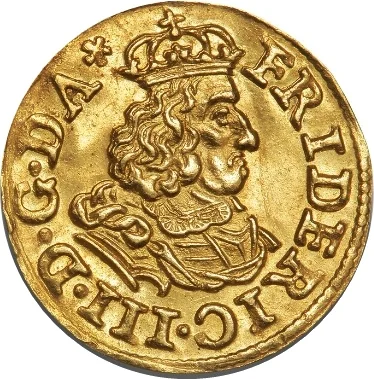
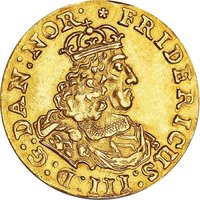
Right-facing bust of King Frederik III, crowned and draped. Legend around rim.
Inscription:
FRIDERIC · III · D:G · DA *
Script: Latin
Reverse
Description:
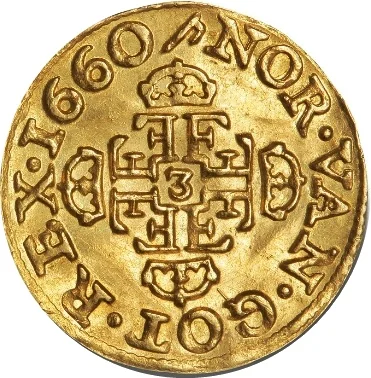
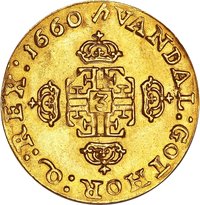
King’s “F3” monogram in a cross shape, each arm crowned. Encircled by legend, date, and mintmark.
Inscription:
NOR · VAN · GOT · REX · 1660
Script: Latin
Edge
Mints
| Name | Mark |
|---|---|
| Copenhagen | ☘ |
Mintings
| Year | Mint Mark | Mintage | Quality | Collection |
|---|---|---|---|---|
| 1660 | h | — | ||
| 1664 | ☘ | — |
Historical background
In 1660, Denmark stood at a pivotal moment, with its currency system deeply strained by the financial and territorial catastrophes of recent wars. The costly conflicts with Sweden, culminating in the devastating losses of the Scanian provinces in the 1658 Treaty of Roskilde, had emptied the royal treasury. To fund these wars, the state had resorted to heavy borrowing and, most damagingly, the repeated debasement of the coinage. By lowering the silver content in coins like the skilling and mark while maintaining their face value, the Crown created short-term revenue but triggered severe inflation, a loss of public trust in the currency, and economic instability for both trade and ordinary citizens.
The situation was characterized by a chaotic multiplicity of coins in circulation. Alongside the debased domestic currency, older, full-value coins were hoarded, and a plethora of foreign coins—especially German, Dutch, and Swedish—circulated at fluctuating values. This complex system, where the intrinsic metal value often differed wildly from the proclaimed nominal value, created a confusing and inefficient market. Merchants struggled with exchange rates, and the crown faced difficulty collecting taxes in a reliable standard of value, further crippling state finances.
This monetary crisis directly contributed to the political revolution of 1660. The bankrupt monarchy, unable to pay the nobility-led army, leveraged support from the burghers and clergy to push through the Kongeloven (King’s Law), establishing absolute and hereditary monarchy. For the new absolute monarch, Frederik III, currency reform became an immediate and pressing necessity to consolidate power, restore economic order, and fund the state. Thus, the chaotic currency situation of 1660 set the stage for the comprehensive monetary reforms that would follow in the coming decades under the absolute monarchy.
The situation was characterized by a chaotic multiplicity of coins in circulation. Alongside the debased domestic currency, older, full-value coins were hoarded, and a plethora of foreign coins—especially German, Dutch, and Swedish—circulated at fluctuating values. This complex system, where the intrinsic metal value often differed wildly from the proclaimed nominal value, created a confusing and inefficient market. Merchants struggled with exchange rates, and the crown faced difficulty collecting taxes in a reliable standard of value, further crippling state finances.
This monetary crisis directly contributed to the political revolution of 1660. The bankrupt monarchy, unable to pay the nobility-led army, leveraged support from the burghers and clergy to push through the Kongeloven (King’s Law), establishing absolute and hereditary monarchy. For the new absolute monarch, Frederik III, currency reform became an immediate and pressing necessity to consolidate power, restore economic order, and fund the state. Thus, the chaotic currency situation of 1660 set the stage for the comprehensive monetary reforms that would follow in the coming decades under the absolute monarchy.
✨ Legendary