

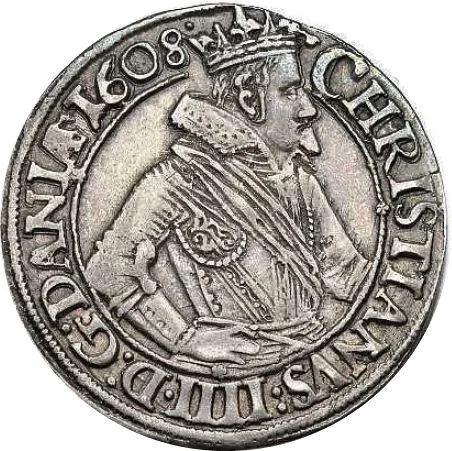
Obverse
Description:
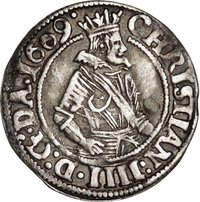
King Christian IV facing right within a circle. Date outside circle.
Inscription:
CHRISTIANVS·IIII·D:G·DANIÆ·1608
Script: Latin
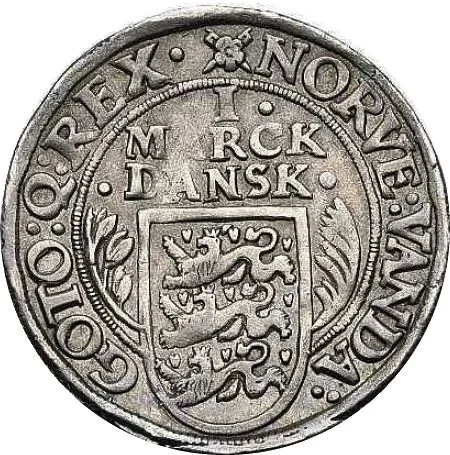
Reverse
Description:
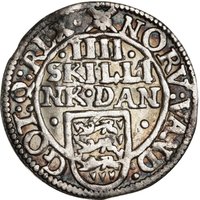
Three lines of lettering above Denmark’s flat-topped coat of arms, flanked by decorative branches. A thick circle encloses the value and shield’s upper half. The surrounding legend is divided by the shield, with the Helsingør mintmark (crossed halberds behind a flower) at its end.
Inscription:
.I:
MARCK
·DANSK·
NORVE:VANDA: | GOTO:Q:REX· (mm)
MARCK
·DANSK·
NORVE:VANDA: | GOTO:Q:REX· (mm)
Script: Latin
Edge
Mints
| Name | Mark |
|---|---|
| Helsingør | — |
Mintings
| Year | Mint Mark | Mintage | Quality | Collection |
|---|---|---|---|---|
| 1607 | — | — | ||
| 1608 | — | — | ||
| 1609 | — | — |
Historical background
In 1607, Denmark was operating under a complex and strained monetary system, a legacy of the Kalmar Union and subsequent regional conflicts. The official currency was the Danish rigsdaler, a large silver coin, but the reality was a chaotic mix of domestic and foreign coins circulating simultaneously. German, Dutch, and Baltic coins, especially the ubiquitous Lübeck marks and skillings, were widely used in trade, leading to constant difficulties with exchange rates and valuations. This proliferation undermined royal authority over the economy and facilitated clipping and counterfeiting, which further eroded public trust in the coinage.
The situation was exacerbated by the state's chronic financial difficulties, particularly the debts from the recently concluded Kalmar War with Sweden (1611-1613). King Christian IV, who ruled from 1588 to 1648, frequently resorted to debasement—reducing the silver content in coins while maintaining their face value—as a short-term method to finance his lavish court, ambitious building projects (like the nascent Rosenborg Castle), and military ventures. This practice, while filling the royal coffers temporarily, triggered inflation, harmed creditors and people on fixed incomes, and destabilized both domestic commerce and international trade, upon which Denmark's prosperity relied.
Consequently, 1607 fell within a period of significant monetary experimentation and recurring crisis. Efforts to reform and unify the currency were repeatedly attempted but often failed due to immediate fiscal pressures. The year itself was not one of major reform but rather a point within a prolonged struggle to assert central control over a fragmented system. The underlying tensions would continue, ultimately contributing to the economic challenges that plagued Christian IV's later reign, especially following Denmark's disastrous entry into the Thirty Years' War in 1625.
The situation was exacerbated by the state's chronic financial difficulties, particularly the debts from the recently concluded Kalmar War with Sweden (1611-1613). King Christian IV, who ruled from 1588 to 1648, frequently resorted to debasement—reducing the silver content in coins while maintaining their face value—as a short-term method to finance his lavish court, ambitious building projects (like the nascent Rosenborg Castle), and military ventures. This practice, while filling the royal coffers temporarily, triggered inflation, harmed creditors and people on fixed incomes, and destabilized both domestic commerce and international trade, upon which Denmark's prosperity relied.
Consequently, 1607 fell within a period of significant monetary experimentation and recurring crisis. Efforts to reform and unify the currency were repeatedly attempted but often failed due to immediate fiscal pressures. The year itself was not one of major reform but rather a point within a prolonged struggle to assert central control over a fragmented system. The underlying tensions would continue, ultimately contributing to the economic challenges that plagued Christian IV's later reign, especially following Denmark's disastrous entry into the Thirty Years' War in 1625.
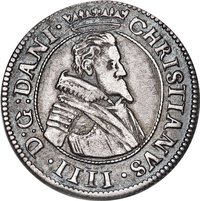
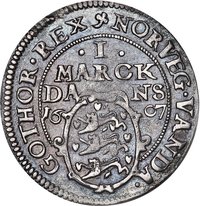
💎 Extremely Rare