

1 Schilling – Livonian Order
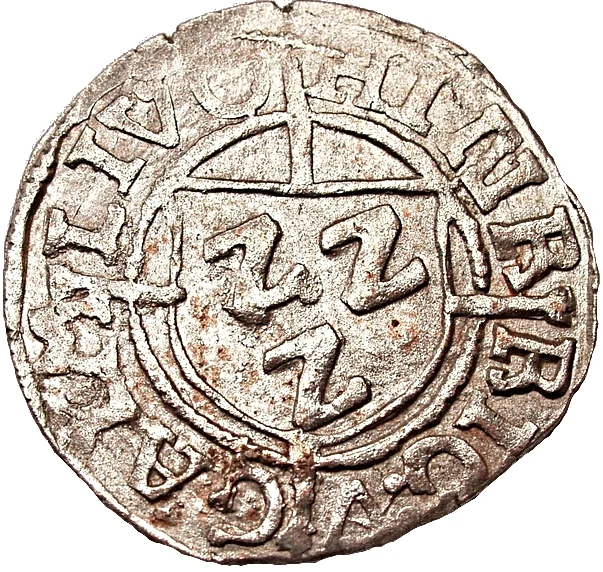
Obverse
Description:
Shield with a flat top over a cross, dividing the surrounding legend.
Inscription:
HINR - RIG · V - GAL · M - LIVO -
Script: Latin
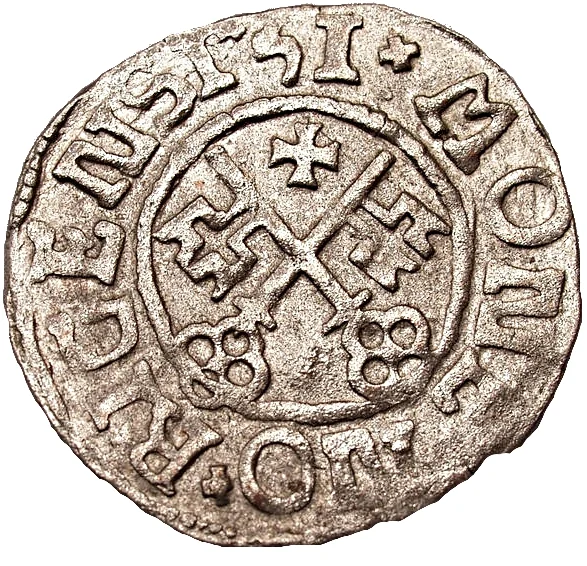
Reverse
Edge
Plain
Mints
| Name | Mark |
|---|---|
| Riga | — |
Mintings
| Year | Mint Mark | Mintage | Quality | Collection |
|---|---|---|---|---|
| 1551 | — | — |
Historical background
In 1551, the Livonian Order, a weakening theocratic state in what is now Estonia and Latvia, faced a profound monetary crisis rooted in its political and economic decline. The Order's currency system was fragmented and debased, lacking a strong, unified coinage. The primary circulating silver coin was the Livonian mark, but its value was unstable and its silver content often reduced to finance the Order's mounting debts and military expenditures. This debasement eroded public trust and complicated trade, as merchants and cities increasingly preferred reliable foreign coins.
The situation was exacerbated by the region's complex political landscape. The Order shared authority with the Archbishopric of Riga and the independent Hanseatic cities, like Reval (Tallinn) and Riga, which often issued their own coinage or favored foreign currency. Furthermore, the lucrative Baltic trade was dominated by the Joachimsthaler and other high-quality German and Dutch coins, which flowed into port cities, undermining the local monetary authority. This created a dual system where foreign "hard" currency was used for major commerce, while the Order's weaker coinage circulated locally, causing inflation and hardship for the common population.
Ultimately, the monetary instability of 1551 was a symptom of the Order's impending collapse. It could no longer control its economy or defend its territory. Within a few years, the Livonian War (1558–1583) would erupt, drawing in neighboring powers—Russia, Sweden, Poland-Lithuania, and Denmark. The war would shatter the Order entirely, leading to the partition of its lands and the complete dissolution of its monetary system, replaced by the currencies of the new sovereign powers that divided the Baltic region.
The situation was exacerbated by the region's complex political landscape. The Order shared authority with the Archbishopric of Riga and the independent Hanseatic cities, like Reval (Tallinn) and Riga, which often issued their own coinage or favored foreign currency. Furthermore, the lucrative Baltic trade was dominated by the Joachimsthaler and other high-quality German and Dutch coins, which flowed into port cities, undermining the local monetary authority. This created a dual system where foreign "hard" currency was used for major commerce, while the Order's weaker coinage circulated locally, causing inflation and hardship for the common population.
Ultimately, the monetary instability of 1551 was a symptom of the Order's impending collapse. It could no longer control its economy or defend its territory. Within a few years, the Livonian War (1558–1583) would erupt, drawing in neighboring powers—Russia, Sweden, Poland-Lithuania, and Denmark. The war would shatter the Order entirely, leading to the partition of its lands and the complete dissolution of its monetary system, replaced by the currencies of the new sovereign powers that divided the Baltic region.
✨ Legendary