

10 Kreuzers – Teutonic Order
Circulating commemorative coins
Commemoration: Death of Karl Alexander von Lothringen
Germany

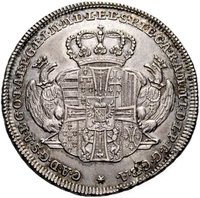
Obverse
Description:
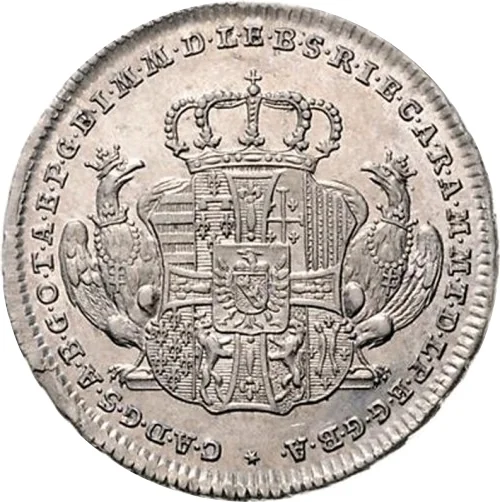
Crowned arms with eagle supporters.
Inscription:
C A D G S A B G O T A E P G E I M M D L E B S R I E C A R A M M T D L P E G G B A
Script: Latin
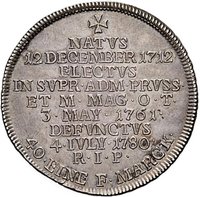
Reverse
Description:
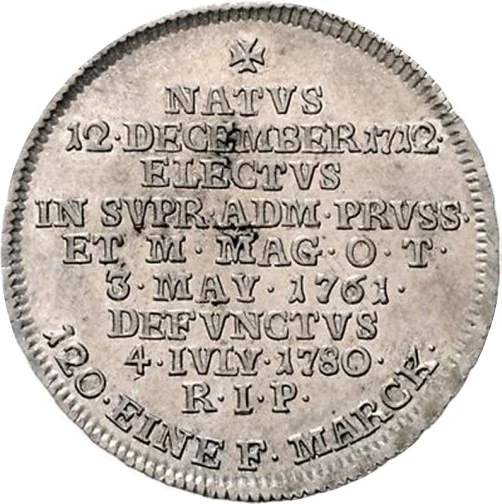
Cross patée above ten-line text.
Script: Latin
Edge
Mintings
| Year | Mint Mark | Mintage | Quality | Collection |
|---|---|---|---|---|
| 1780 | — | 800 |
Historical background
By 1780, the currency situation within the Teutonic Order State was a complex and deteriorating system, reflecting the Order's deep political and economic decline. The state, a relic of the medieval crusading era, was now a fragmented territory consisting largely of the Duchy of Courland and Semigallia (a fief) and scattered holdings in the Holy Roman Empire. It lacked a unified, modern monetary system. Circulation was dominated by a chaotic mix of foreign coins, particularly Polish złoty and grosz, Prussian thalers, and Russian rubles, alongside older Order coinage of varying and often dubious value. This monetary fragmentation severely hampered internal trade and state finance, as the Order’s government had little control over its own money supply.
The root cause of this monetary disorder was the Order's loss of sovereignty and economic purpose. Since its secularization in 1525, the remaining Teutonic Order existed as a minor ecclesiastical state within the Polish-Lithuanian Commonwealth and the Holy Roman Empire, its grand master effectively a prince-bishop of the Empire. Its income was largely derived from its agricultural estates, which were inefficiently managed under a feudal system, and it failed to develop significant commerce or industry. Consequently, the Order’s treasury was perennially weak, preventing any serious attempt to reform the currency or issue new, authoritative coinage that could displace foreign money. The monetary chaos was a symptom of a state that had become an economic backwater.
Ultimately, the currency situation mirrored the Order's impending dissolution. With no central monetary authority, frequent debasements of the little coinage it did produce, and reliance on the currencies of powerful neighbours like Prussia, Russia, and Poland, the Teutonic Order State demonstrated a complete lack of fiscal sovereignty. This financial impotence was a clear indicator that the state was no longer viable. Within a generation, the final partitions of Poland (1795) would sweep away the Order's remaining territorial holdings, rendering its internal currency problems moot as its lands were absorbed by the monetarily stronger partitioning powers.
The root cause of this monetary disorder was the Order's loss of sovereignty and economic purpose. Since its secularization in 1525, the remaining Teutonic Order existed as a minor ecclesiastical state within the Polish-Lithuanian Commonwealth and the Holy Roman Empire, its grand master effectively a prince-bishop of the Empire. Its income was largely derived from its agricultural estates, which were inefficiently managed under a feudal system, and it failed to develop significant commerce or industry. Consequently, the Order’s treasury was perennially weak, preventing any serious attempt to reform the currency or issue new, authoritative coinage that could displace foreign money. The monetary chaos was a symptom of a state that had become an economic backwater.
Ultimately, the currency situation mirrored the Order's impending dissolution. With no central monetary authority, frequent debasements of the little coinage it did produce, and reliance on the currencies of powerful neighbours like Prussia, Russia, and Poland, the Teutonic Order State demonstrated a complete lack of fiscal sovereignty. This financial impotence was a clear indicator that the state was no longer viable. Within a generation, the final partitions of Poland (1795) would sweep away the Order's remaining territorial holdings, rendering its internal currency problems moot as its lands were absorbed by the monetarily stronger partitioning powers.
✨ Legendary