

¼ Thaler – Teutonic Order
Circulating commemorative coins
Commemoration: Death of Ludwig Anton von Pfalz-Neuburg
Germany
Context

Material
References
KM: #Click to copy to clipboard126
Numista: #139156
Value
Bullion value: $20.10
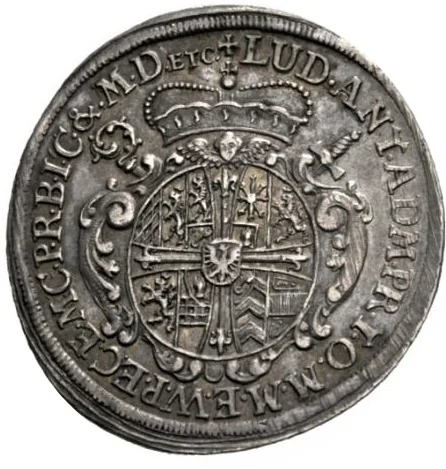
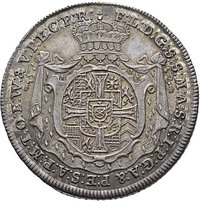
Obverse
Description:
Crowned arms divided by a cross.
Inscription:
LUD ANT ADM PR I O M M E W P ECEMC P R B I C & M D ETC
Script: Latin
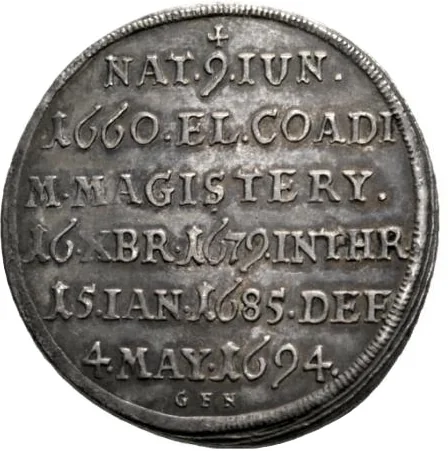
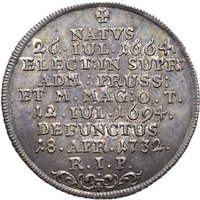
Reverse
Description:
Inscription: six lines with dates, mintmaster initials below.
Inscription:
NAT 9 IUN
1660 EL COADI
M MAGISTERY
16X BR 1679 INT HR
15 IAN 1685 DEF
4 MAY 1694
GFN
1660 EL COADI
M MAGISTERY
16X BR 1679 INT HR
15 IAN 1685 DEF
4 MAY 1694
GFN
Script: Latin
Edge
Mints
| Name | Mark |
|---|---|
| Nuremberg | — |
Mintings
| Year | Mint Mark | Mintage | Quality | Collection |
|---|---|---|---|---|
| 1694 | — | — |
Historical background
In 1694, the Teutonic Order’s currency system was a complex and strained relic of a bygone era, operating within the broader economic framework of the Polish-Lithuanian Commonwealth. The Order’s territory, the Duchy of Prussia, had been a fief of the Polish Crown since 1525, and its monetary policy was heavily influenced by, and often subordinate to, the Commonwealth’s chaotic financial system. The primary circulating coins were the Prussian groschen and schilling, but these existed alongside a flood of debased Polish coinage and foreign specie, leading to chronic instability and frequent revaluations.
The core of the crisis was severe monetary debasement. The Polish-Lithuanian Commonwealth, engaged in costly wars with the Ottoman Empire and later with Russia, had resorted to drastically reducing the silver content in its own coinage, particularly the tymf. This "bad money" flooded Prussia, driving out the older, full-value coins (Gresham’s Law in action) and causing rampant inflation. The Teutonic Order’s administration, led by the Elector of Brandenburg (who was also the Grand Master of the Order in a personal union), struggled to maintain the integrity of its own currency while its economy was inundated with depreciated neighboring coins.
Consequently, 1694 fell within a period of urgent monetary reform. The Order’s authorities, recognizing that the situation was crippling trade and state revenues, were actively working to stabilize and control the currency. This culminated in the major recoinage of 1695-96, initiated by Elector Frederick III, which aimed to replace the debased mixed currency with new, standardized Prussian coins of reliable silver content. Thus, the background for 1694 is one of acute financial disorder serving as the immediate catalyst for a decisive state-led intervention to assert monetary sovereignty and economic stability.
The core of the crisis was severe monetary debasement. The Polish-Lithuanian Commonwealth, engaged in costly wars with the Ottoman Empire and later with Russia, had resorted to drastically reducing the silver content in its own coinage, particularly the tymf. This "bad money" flooded Prussia, driving out the older, full-value coins (Gresham’s Law in action) and causing rampant inflation. The Teutonic Order’s administration, led by the Elector of Brandenburg (who was also the Grand Master of the Order in a personal union), struggled to maintain the integrity of its own currency while its economy was inundated with depreciated neighboring coins.
Consequently, 1694 fell within a period of urgent monetary reform. The Order’s authorities, recognizing that the situation was crippling trade and state revenues, were actively working to stabilize and control the currency. This culminated in the major recoinage of 1695-96, initiated by Elector Frederick III, which aimed to replace the debased mixed currency with new, standardized Prussian coins of reliable silver content. Thus, the background for 1694 is one of acute financial disorder serving as the immediate catalyst for a decisive state-led intervention to assert monetary sovereignty and economic stability.
✨ Legendary